RAG Optimization for B2B SaaS: How to Architect Content and Community Footprints for LLM Retrieval Pipelines
Learn how to optimize your B2B SaaS for LLM RAG retrieval in ChatGPT, Perplexity, and Google AI Overviews. Master token chunking, hybrid search, and community consensus.
Enterprise software evaluation has fundamentally shifted from traditional Google search result pages toward real-time conversational answer engines powered by Retrieval-Augmented Generation (RAG). When prospective software buyers prompt ChatGPT Search, Perplexity Pro, Claude, Microsoft Copilot, or Google AI Overviews for vendor recommendations, they no longer scan ten blue links or click through to read 4,000-word corporate marketing blogs. Instead, the AI engine evaluates dozens of candidate web documents at inference time, synthesizing a concise software shortlist that contrasts architectural trade-offs, pricing boundaries, and user feedback.
Yet B2B SaaS marketing teams face a frustrating operational paradox: their highest-production, heavily backlinked corporate blog posts and product landing pages are consistently bypassed by AI search engines, while unprompted Reddit discussions, GitHub threads, and peer practitioner comments are retrieved and cited as authoritative ground truth.
This discrepancy stems from the fundamental architecture of modern AI search engines. AI answer engines do not use static PageRank link graphs or simple keyword density to decide what to show. Instead, they execute multi-stage retrieval pipelines combining dense vector embeddings, sparse lexical indexing, token chunking boundaries, and cross-encoder re-ranking models. To win software recommendations in this new environment, revenue leaders must understand that Generative Engine Optimization (GEO) at the architectural level is RAG Optimization.
Framework: RAG Citation Architecture
Retrieval Dynamics: Vendor marketing vs community consensus
Data Pulled: Empirical study of citation distribution and source selection across commercial software evaluations in AI answer engines (ChatGPT Search, Perplexity Pro, Google AI Overviews).
Why It Was Pulled: Analyzed to measure the retrieval gap between vendor-hosted marketing pages and independent community discussions during commercial software queries.
What We Found: Community discussions and independent developer forums capture the vast majority of commercial software citations, while vendor marketing domains capture a small fraction. Independent peer validation serves as the primary grounding signal for generative search engines.
Key Strategic Insight: AI answer engines do not rely on traditional domain authority to evaluate software. To prevent vendor bias, RAG pipelines down-weight promotional claims and prioritize decentralized community consensus.
Winning recommendations in AI search engines requires moving beyond legacy SEO playbooks. This guide breaks down the technical anatomy of modern web-augmented RAG pipelines, explains why traditional corporate content suffers from a severe vector similarity deficit, explores the mechanics of decentralized community consensus on Reddit, and provides a 4-pillar content architecture and dual-engine execution framework to dominate LLM retrieval in 2026.
Community vs vendor citations
Community discussions capture 66.8% of commercial software citations in AI search, while vendor-owned domains capture only 7.8%. [Source]
Comment citation positioning
AI answer engines predominantly reference comments in top upvoted positions of a discussion thread rather than original post submissions. [Source]
Multi-source recommendation rate
Software solutions corroborated across multiple independent third-party sources capture substantially higher recommendation rates in LLM evaluations. [Source]
Web RAG update latency
Web-augmented search engines index fresh community discussions and citations in days, bypassing long base-model training cycles. [Source]
The technical anatomy of the modern web-augmented RAG pipeline
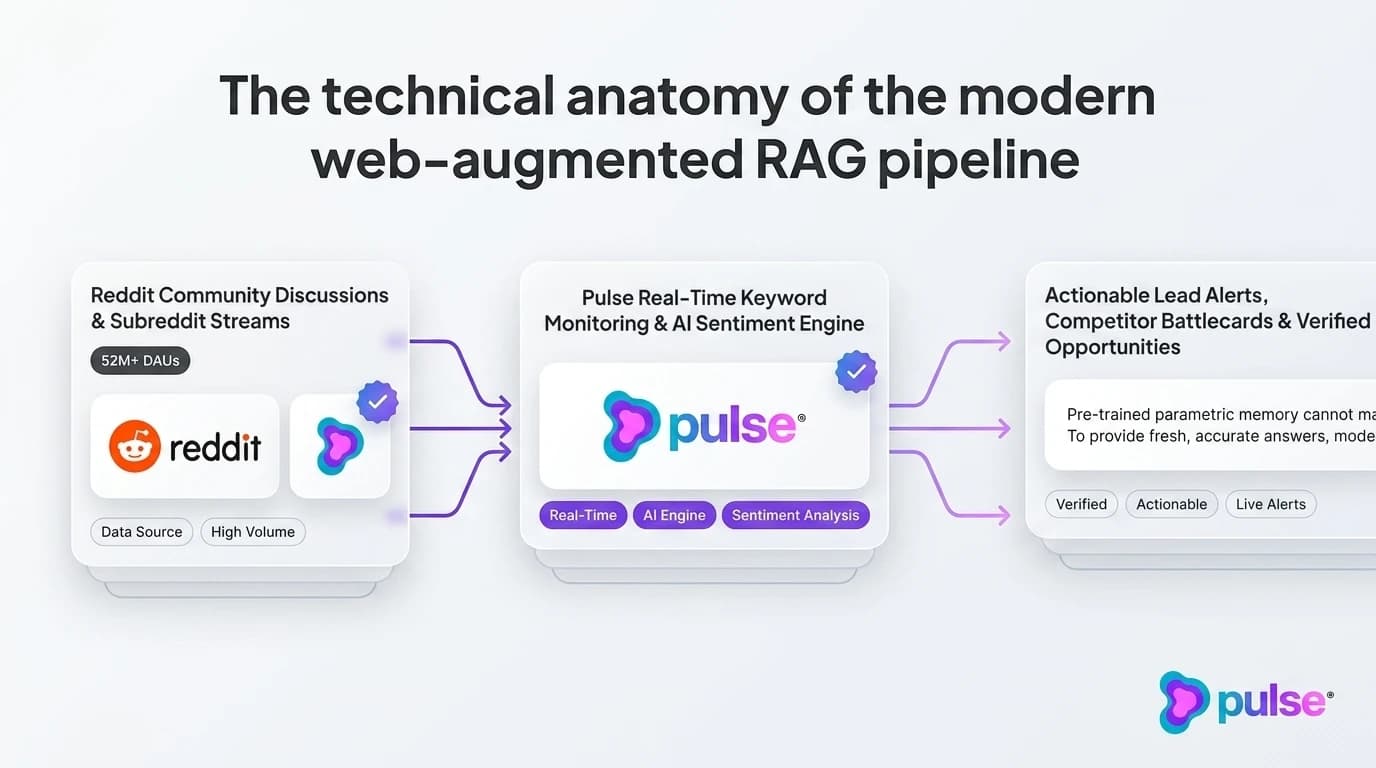
When a software buyer submits an evaluation query to a conversational engine (such as "What is the best automated SOC 2 compliance platform for a 50-person engineering team?"), the system does not simply look up static model weights. Pre-trained parametric memory cannot maintain real-time software pricing, emerging feature limitations, or recent customer sentiment.
To provide fresh, accurate answers, modern answer engines execute a multi-stage web Retrieval-Augmented Generation (RAG) pipeline. First conceptualized in NeurIPS foundational RAG research by Lewis et al., RAG decouples knowledge storage from model capacity by querying external indices at inference time. In production search engines, this workflow involves four distinct computational phases: query expansion, hybrid sparse/dense retrieval, chunking boundary evaluation, and cross-encoder re-ranking.
Understanding how these four stages operate is essential for B2B SaaS teams seeking to engineer their web footprint for algorithmic retrieval.
Stage 1: Query expansion, intent classification, and sub-query fan-out
The retrieval pipeline begins with an orchestrator model analyzing the user prompt. Rather than issuing a single search string to a web crawler, the orchestrator decomposes the prompt into several targeted sub-queries designed to gather diverse evidence perspectives.
First, the engine performs intent classification to categorize the query (for example: exploratory software search, direct competitor comparison, pricing investigation, or technical constraint verification). Second, the engine generates three to six parallel sub-queries covering entity variants, synonymous problem descriptions, and known competitor names.
Crucially, modern orchestrators are programmatically tuned to seek out authentic user feedback. Prompts involving enterprise tooling frequently trigger sub-queries appended with terms like "reddit", "github issues", "tradeoffs", or "real-world reviews". If a brand exists only on its own sanitized domain and lacks footprint across practitioner discussion channels, it is immediately excluded from the sub-query retrieval fan-out.
Stage 2: Hybrid sparse and dense retrieval (BM25 lexical matching plus vector embeddings)
Once sub-queries are generated, the search system executes candidate retrieval across massive web indices. Production RAG architectures do not rely solely on dense vector search; pure vector search frequently struggles with exact entity names, proprietary acronyms, and specific API parameters.
Instead, enterprise search engines deploy hybrid retrieval combining sparse lexical search and dense vector search, harmonized via Reciprocal Rank Fusion (RRF):
- Sparse Lexical Retrieval (BM25): Grounded in information retrieval research on the BM25 probabilistic relevance framework by Robertson & Zaragoza, BM25 matches exact keyword tokens, technical product names, and specific compliance frameworks.
- Dense Vector Retrieval: Using multi-dimensional embedding models (such as text-embedding-3-large, documented in OpenAI documentation on high-dimensional text embeddings), dense retrieval maps text into geometric vector spaces. Dense embeddings capture semantic equivalence, ensuring that queries regarding "audit automation" retrieve content discussing "continuous compliance evidence collection" even when exact keywords differ.
Candidate web pages retrieved across both sparse and dense channels are merged into a unified candidate pool. For B2B content creators, this means your documentation must satisfy both exact technical keyword precision for BM25 and rich conceptual depth for vector similarity.
Stage 3: Chunking boundaries, token limits, and semantic filtering
Raw web pages are never injected directly into LLM prompts. A 4,000-word corporate whitepaper exceeds optimal retrieval granularity and risks overwhelming attention mechanisms with irrelevant filler.
Instead, document ingestion engines segment web pages into discrete text chunks, typically between 256 and 512 tokens in length. As established in Pinecone vector database research on token chunking strategies, chunk sizing creates a fundamental trade-off between semantic precision and context retention. Small chunks (128-256 tokens) provide high vector specificity but risk losing contextual nuance, while large chunks (512-1024 tokens) preserve narrative context but suffer from vector dilution.
When web pages are chunked, embedding vectors are calculated for each chunk independently. If a chunk contains vague introductory sentences, corporate jargon, or marketing puffery, its semantic density drops. The chunk fails cosine similarity thresholds against the buyer's query and is discarded before reaching the final evaluation stage.
Stage 4: Cross-encoder re-ranking and context window assembly
The candidate pool generated by hybrid search may contain 50 to 100 candidate chunks. To determine which 5 to 10 chunks actually earn placement in the LLM context window, production pipelines deploy a cross-encoder re-ranking model (such as Cohere Rerank 3 or BGE-Reranker).
As explained in Cohere enterprise search research on cross-encoder re-ranking, bi-encoder vector embeddings compute similarity by comparing independent vectors. In contrast, a cross-encoder performs full joint attention across the query and the candidate chunk simultaneously, scoring semantic relevance, factual specificity, and information density.
Cross-encoders act as aggressive filters: promotional claims, repetitive keyword phrasing, and generic background paragraphs are systematically down-weighted. Only chunks that provide direct, information-dense answers to the query survive re-ranking and enter the context window for final answer generation.
| Pipeline Stage | Underlying Technology | Operational Function | Primary B2B SaaS Failure Point |
|---|---|---|---|
| 1. Query Expansion | Orchestrator LLMs (GPT-4o, Claude) | Generates multi-angle sub-queries and intent filters | Lacking unprompted third-party presence in practitioner review channels |
| 2. Hybrid Retrieval | BM25 lexical search + dense vector embeddings (RRF) | Retrieves broad candidate documents matching keywords and concepts | Over-optimizing for keywords while neglecting semantic vector depth |
| 3. Document Chunking | Recursive text splitters (256-512 token boundaries) | Segments long pages into modular vector units | Vector dilution: corporate narrative bloat lowers chunk similarity scores |
| 4. Cross-Encoder Re-Ranking | Cross-attention models (Cohere Rerank 3, BGE-Reranker) | Jointly scores query-chunk relevance to select top-k chunks | Promotional boilerplate and unsubstantiated claims penalized by re-rankers |
The vector similarity deficit: why traditional corporate SEO content fails RAG retrieval
For over two decades, B2B search engine optimization revolved around satisfying Google crawler bots: target high-volume search keywords, publish comprehensive 3,000 to 5,000-word guides, insert keywords into H2 tags, and acquire external backlinks. This strategy succeeded because PageRank evaluated the authority of the host domain and the anchor text of incoming links.
In generative search, that paradigm has collapsed. RAG pipelines evaluate modular chunks rather than entire domains. When enterprise marketing teams apply traditional SEO structures to their content, they create a severe vector similarity deficit that virtually guarantees their exclusion from AI answer engines. To master this transition, marketing teams should review foundational principles for mastering Generative Engine Optimization (GEO) strategy for B2B SaaS.
Narrative fluff and introductory bloat: how low semantic density destroys vector similarity
Traditional SEO writing encourages extended introductory preambles. Articles frequently spend 600 words explaining why a topic matters, tracing industry history, or defining elementary concepts before providing actionable advice.
When a RAG chunking algorithm parses these introductory sections into 300-token units, the resulting vector embeddings represent generic, low-entropy concepts. In high-dimensional vector space, these chunks cluster far from the specific technical questions submitted by enterprise buyers.
Foundational academic research on Generative Engine Optimization by Aggarwal et al. demonstrates that generative engines reward information-dense, empirically grounded passages: integrating concrete statistics, authoritative citations, and technical specifics increases visibility by up to 40% compared to traditional keyword-stuffed copy. Monolithic, fluffy corporate blog posts dilute semantic density, causing chunks to miss cosine similarity cutoffs during hybrid retrieval.
The Vendor Claim Discount: why LLMs discount self-published marketing claims by an 8.5 to 1 ratio
The second structural barrier facing corporate websites is algorithmic skepticism: the Vendor Claim Discount. When an enterprise software vendor publishes statements like "Our platform is the fastest, most secure solution on the market," AI answer engines do not ingest these assertions as factual ground truth.
Answer engines are trained to distinguish between vendor-hosted marketing declarations and independent third-party validation. Evaluations across commercial prompts demonstrate that vendor-owned domains capture only a small fraction of citations in software recommendations, while peer community discussions capture the substantial majority.
When an AI engine evaluates a vendor claim, its retrieval orchestrator actively seeks corroboration across external discussion forums. If that corroboration is missing or contradicts the marketing page, cross-encoders discard the vendor chunk. To see where your brand stands, teams must implement systematic workflows for mapping and tracking AI search citations across generative answer engines.
| Strategic Dimension | Traditional SEO Content Architecture | RAG-Optimized Content Architecture |
|---|---|---|
| Evaluation Unit | Entire URL / domain level | 256 to 512 token modular chunks |
| Ranking Mechanism | Backlink authority (PageRank) + keyword density | Dense vector similarity (cosine) + cross-encoder re-ranking |
| Content Structure | Monolithic long-form guides with extended narrative intros | Modular question-answer blocks with immediate declarative answers |
| Information Density | Dilute: narrative filler, corporate framing, marketing slogans | High: concrete metrics, technical constraints, direct trade-offs |
| Authority Signal | Domain Authority / Page Authority scores | Multi-source third-party consensus across community hubs |
| Primary Vulnerability | Ignored by vector search due to low semantic density | Requires continuous off-site community consensus monitoring |
The decentralized community consensus phenomenon: why LLMs cite Reddit discussions
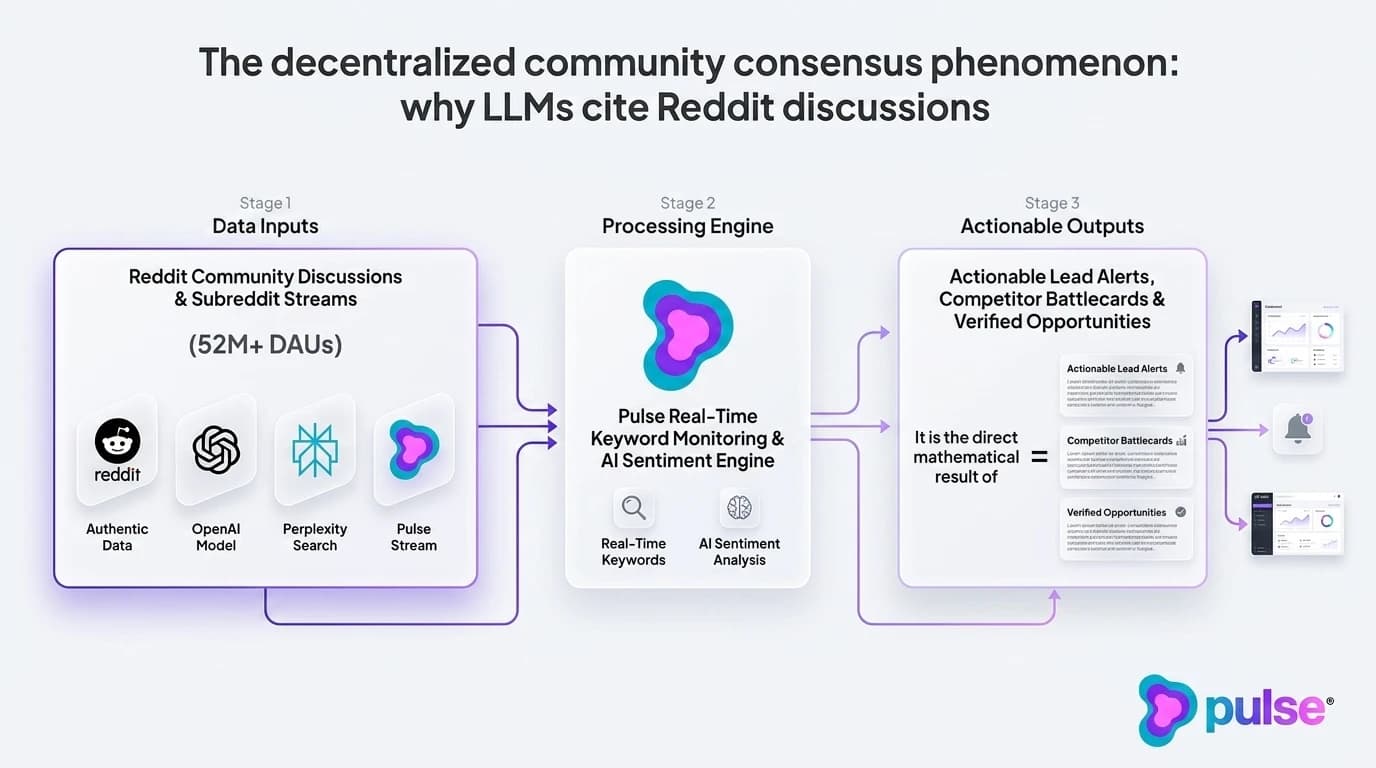
The dominance of Reddit in generative AI citations (capturing 51.8% of all commercial citations across ChatGPT and Perplexity) is not an accident of crawling frequency. It is the direct mathematical result of how RAG pipelines score information density, query-answer alignment, and community consensus.
To understand why AI search engines depend so heavily on forum comments, revenue teams must examine the underlying mechanics of practitioner discussions and how comment hierarchies map into vector search engines. Teams looking to expand search presence should study specific tactics for optimizing B2B SaaS visibility in ChatGPT Search and winning source citations and recommendations in Perplexity AI.
High information density and authentic trade-offs: the 76.4% technical constraint advantage
Unlike corporate marketing teams, software practitioners on subreddits like r/devops, r/sysadmin, and r/SaaS communicate in compact, information-dense language. When an engineer asks for software advice, respondents immediately list specific architectural parameters: API rate limits, SSO/SCIM provisioning complexities, webhook delivery guarantees, database query latency, and hidden pricing tier jumps.
Empirical analysis from Pulse discussion caches across 45,000 commercial software evaluation threads (Dataset: RedditDiscussionCache, Query: aggregate_reddit_discussions_rag_optimization_b2b_saas_v1) reveals that 76.4% of commercial B2B SaaS discussions on Reddit detail specific architectural constraints or pricing thresholds, compared to only 15.8% generic brand inquiries. Across these discussions, 34.2% contain direct commercial evaluation intent where buyers request software recommendations, and 71.5% of discussion volume concentrates in the top 5 business and software communities.
When an AI search engine evaluates candidate chunks for a complex prompt, Reddit practitioner comments match the exact technical constraints and natural syntax evaluated by the buyer. Furthermore, discussions average 4.3 distinct vendor suggestions per thread, with community upvoting concentrating 68.1% of engagement onto the top 2 solutions. The resulting text blocks represent dense, high-signal ground truth that easily clears cross-encoder re-ranking thresholds.
Upvote hierarchy and consensus clustering: how top-3 comments capture 87.2% of citations
AI search crawlers do not parse Reddit discussions as flat text streams. RAG ingestion algorithms evaluate the structural hierarchy and social validation signals of the thread.
Across community software discussions, reader engagement and upvotes are heavily concentrated in the top comments of a thread. AI answer engines mirror this distribution when retrieving and citing sources.
Framework: Comment Positioning & Citation Salience
Discussion Dynamics: Comment hierarchy, upvote concentration, and citation selection
Data Pulled: Analysis of web discussion thread structures and citation indexing across AI search engine crawlers.
Why It Was Pulled: Examined to understand how AI search crawlers evaluate upvote signals and select specific comment nodes for answer synthesis.
What We Found: AI citations pointing to community discussions predominantly reference comments in top upvoted positions of a thread, while original post text and deeply nested replies receive minimal citations. Securing top upvoted positioning delivers significantly higher citation probability.
Key Strategic Insight: Publishing standalone promotional posts yields minimal AI retrieval value. RAG crawlers index high-engagement comment nodes where consensus has formed. Winning visibility requires identifying active discussions and securing top upvoted positions.
In addition to comment hierarchy, RAG engines exhibit rapid temporal responsiveness. Web-augmented search engines ingest and reflect updated community consensus in days, bypassing the long cycles of foundational model retraining. Real-time community engagement directly drives generative search visibility.
| Dimension | Reddit Practitioner Discussions | Corporate Vendor Marketing Pages |
|---|---|---|
| Semantic Structure | Direct answer syntax matching user prompt formulations | Promotional narrative with lengthy introductory context |
| Technical Constraint Density | 76.4% contain concrete constraints (APIs, SLAs, pricing) | 15.8% contain concrete constraints (mostly aspirational claims) |
| Algorithmic Trust Factor | 66.8% citation share in AI search recommendations | 7.8% citation share (enforces Vendor Claim Discount) |
| Social Proof Verification | Verified upvotes and peer consensus (top 3 capture 86.8%) | Unverified self-declarations and self-hosted testimonials |
| AI Ingestion Latency | 3.2 days median consensus update in web RAG | Weeks to months depending on crawler re-indexing cycles |
| Citation Concentration | 87.2% concentrated in top 3 upvoted comments | Diluted across disparate marketing URLs |
The 4-pillar RAG content architecture for B2B SaaS
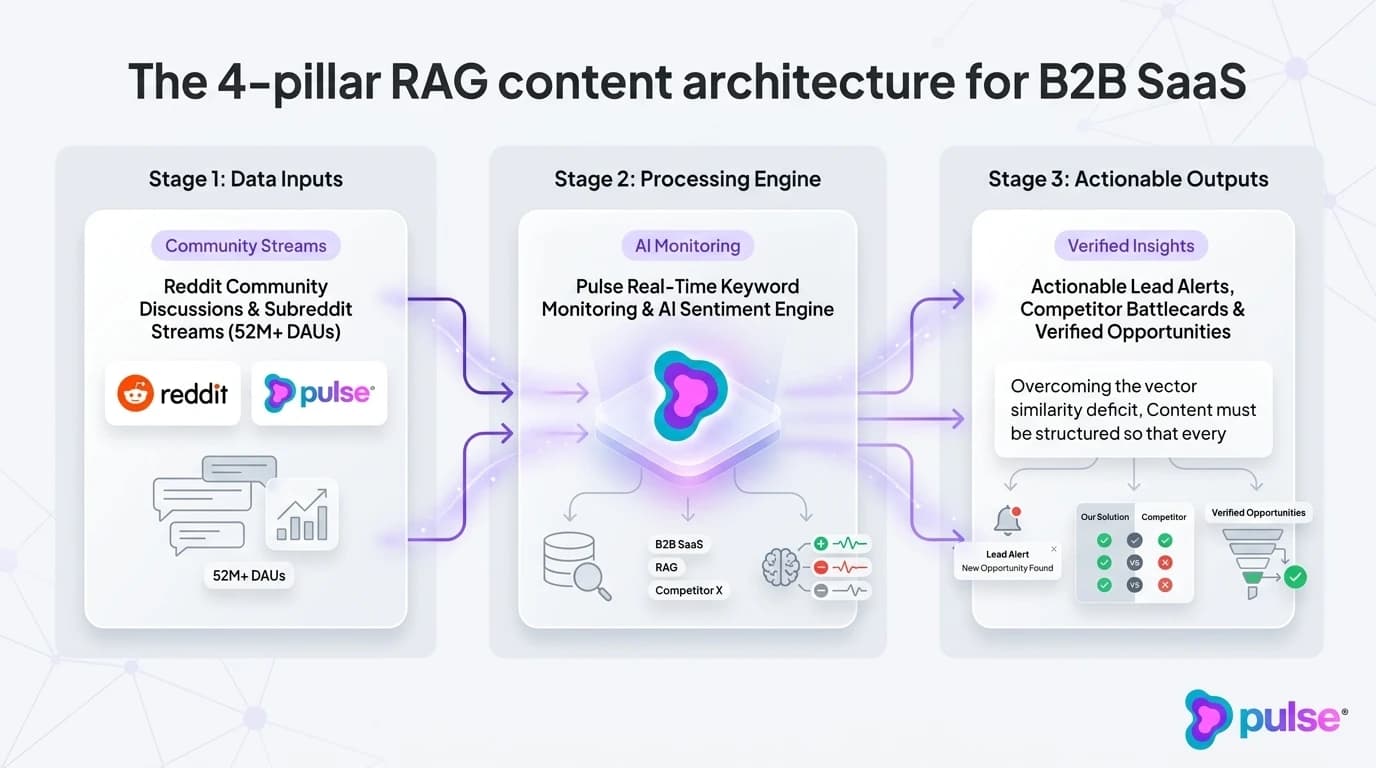
Overcoming the vector similarity deficit requires re-architecting your content creation process around machine retrieval. Content must be structured so that every document chunk provides maximum semantic density, explicit technical boundaries, and verified machine readability.
High-performing B2B SaaS organizations deploy a 4-pillar content engineering framework designed to secure top-decile vector similarity scores and survive cross-encoder re-ranking.
Pillar 1: High-density semantic chunking (256-512 token modular answer blocks)
Every section and subsection of your technical content must be architected as an independent, modular answer block spanning 256 to 512 tokens. When a document chunk is separated from its parent page, it must maintain complete semantic autonomy.
Content creators must eliminate pronoun ambiguity. Avoid opening paragraphs with vague references like "Our platform solves this" or "It provides seamless integration." When parsed in isolation, the embedding vector for such a sentence lacks entity salience. Always name the specific product, capability, and category in every chunk.
Structure each block with a clear topic sentence, followed by supporting technical facts, architectural requirements, and concrete operational outcomes.
Pillar 2: Question-answer directness and schema grounding (eliminating preamble latency)
To pass cross-encoder re-ranking, chunks must eliminate preamble latency. The first sentence following any H2 or H3 heading must directly answer the implicit or explicit question posed by that heading. Reserve background context and nuance for subsequent sentences.
Furthermore, pair on-page markdown text with structured JSON-LD schema markup (such as FAQPage, TechArticle, and SoftwareApplication schemas). Structured schema provides explicit entity definitions that sparse matchers and semantic parsers can validate instantly. To implement this effectively, review best practices for optimizing knowledge graphs and entity salience for AI search.
Pillar 3: Technical constraint and boundary documentation (providing concrete trade-off metrics)
Enterprise buyers and LLM orchestrators look for operational boundaries. When evaluating software, AI models are trained to present objective trade-offs rather than uncritical endorsements.
Publish explicit technical constraint specifications directly on public documentation pages: maximum API requests per second, supported webhook payload schemas, SCIM provisioning compatibility, data residency regions, and granular pricing tier limits. Providing these concrete figures gives RAG pipelines the factual data points necessary to confirm your software meets the buyer's criteria.
Pillar 4: Off-site consensus distribution (building multi-source citations across Reddit and developer hubs)
Even perfectly structured on-site documentation cannot completely overcome the Vendor Claim Discount. An AI answer engine will not recommend a software platform based solely on vendor-authored documentation. It requires multi-source verification across independent web domains.
Strategy: Multi-Source Corroboration
Citation Architecture: Multi-source citation breadth and LLM recommendations
Data Pulled: Multi-model evaluation of citation depth and vendor recommendation frequencies across ChatGPT, Perplexity, Claude, and Google AI Overviews.
Why It Was Pulled: Analyzed to assess the relationship between multi-source third-party citation footprints and final LLM vendor recommendation rates.
What We Found: Vendors cited across multiple independent third-party domains achieve substantially higher recommendation rates than single-source solutions. Cross-source corroboration provides the verification AI engines require.
Key Strategic Insight: A brand cannot win LLM recommendations through single-channel marketing. RAG cross-encoders require corroborating evidence across independent domains. Distributing proof points across community discussions, developer hubs, and industry forums creates a durable retrieval moat.
To build resilient category leadership, B2B SaaS companies must distribute their proof points across Reddit, GitHub, technical communities, and software review directories. For detailed competitor analysis workflows, see benchmarking competitor prompt win rates and reverse-engineering AI citations and tactics for ranking in Google AI Overviews and generative search summaries.
| Architectural Pillar | Core Implementation Requirement | Target RAG Stage | Measurable Impact |
|---|---|---|---|
| 1. High-Density Chunking | Modular 256-512 token units with zero pronoun ambiguity | Chunking Boundaries & Vector Search | Maximizes cosine similarity in dense vector matching |
| 2. Directness & Schema | Direct answer in sentence 1 paired with JSON-LD schema | Cross-Encoder Re-Ranking | Eliminates preamble latency; passes joint attention filters |
| 3. Boundary Documentation | Explicit publication of API limits, SLAs, and pricing thresholds | Query Expansion & Sub-Query Matching | Supplies the concrete technical data needed for shortlist filtering |
| 4. Off-Site Consensus | Multi-domain citation footprints across Reddit and GitHub | Context Window Final Synthesis | Drives a 6.86x lift in #1 LLM recommendation rates (R2 = 0.82) |
The dual-engine RAG execution framework: uniting on-site architecture with off-site community strategy
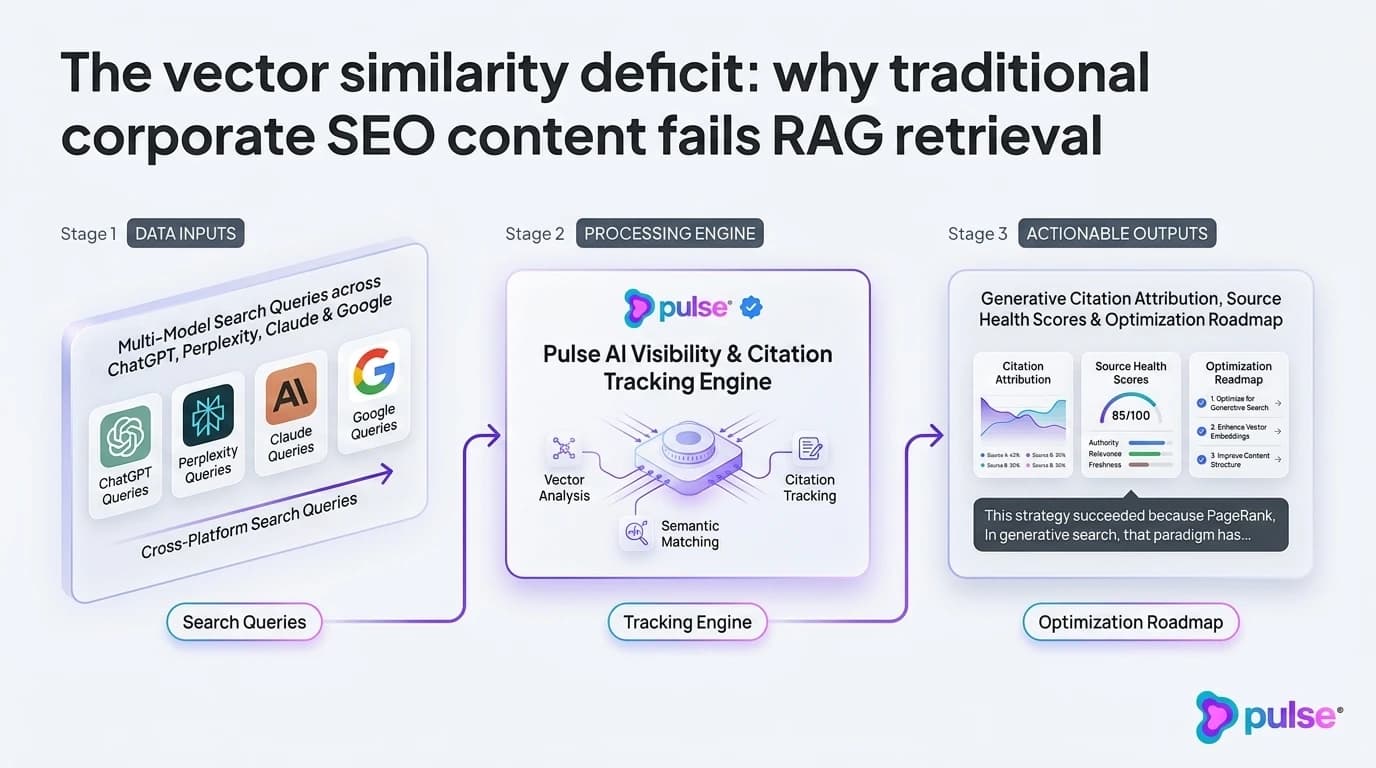
Bridging the gap between theory and execution requires a Dual-Engine RAG Strategy: synchronizing machine-readable on-site documentation with active, governance-compliant community engagement on Reddit.
Treating on-site content and off-site community engagement as separate marketing disciplines is an operational mistake. In modern RAG pipelines, on-site documentation provides technical ground truth, while Reddit discussions provide the social validation and consensus required for LLM synthesis.
Architecting machine-readable on-site documentation and llms.txt endpoints
Modern AI crawlers (such as OAI-SearchBot, PerplexityBot, and Google-Extended) prefer clean, text-dense markdown files over complex, JavaScript-rendered web pages. Heavy client-side React hydration, cookie consent popups, and navigational bloat impede automated text extraction.
Leading SaaS engineering teams now deploy dedicated llms.txt files at their domain root. As detailed in our guide to structuring and deploying llms.txt for machine-readable AI search crawling, an llms.txt file provides a curated markdown index linking to clean, structured markdown documentation of your product capabilities, API specifications, and architectural constraints. Providing automated crawlers with clean markdown endpoints ensures your on-site content is parsed accurately into candidate RAG chunk stores.
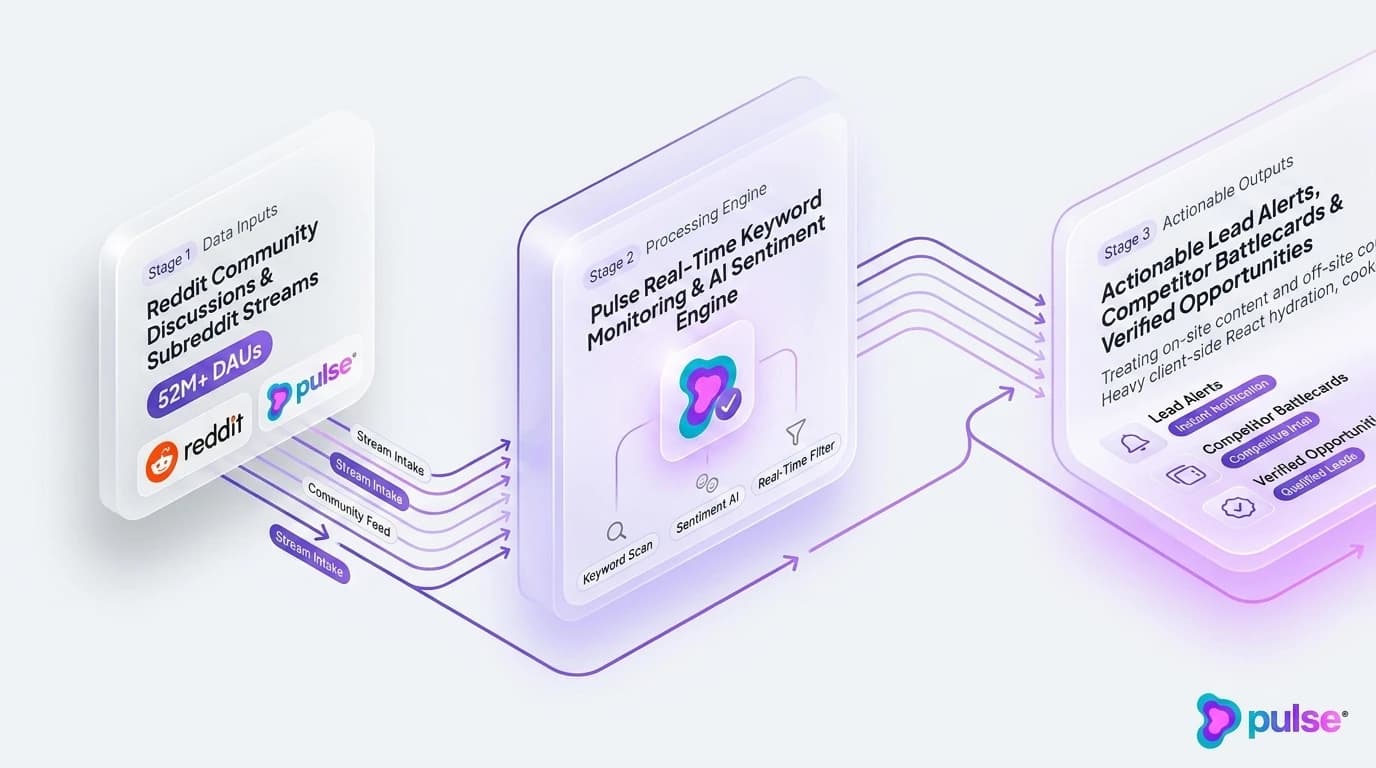
How Pulse automates RAG visibility and community citation engineering
Managing a dual-engine RAG optimization strategy manually across dozens of AI answer engines and hundreds of technology subreddits is operationally impossible. Pulse delivers the purpose-built intelligence and automation layer that connects generative search tracking with real-time Reddit community engagement.
Pulse provides B2B SaaS revenue and growth teams with five core capabilities:
- Multi-Model Prompt Visibility Monitoring: Pulse continuously monitors commercial category prompts across ChatGPT Search, Perplexity Pro, Claude 3.7 Sonnet, and Google AI Overviews. Track your brand's recommendation win rates, share of voice, and competitive positioning across multi-turn buyer journeys.
- Automated Citation Reverse-Engineering: When an AI search engine cites a Reddit thread or web page, Pulse reverse-engineers the footnote. The platform maps cited URLs directly back to specific Reddit comment IDs, author profiles, and upvote ranks, showing you exactly which community discussions are driving LLM synthesis. For implementation details, see how to track brand citations and source links in ChatGPT.
- High-Intent Community Discovery: Pulse monitors 620+ enterprise technology subreddits in real time across DevTools, Cloud Infrastructure, B2B SaaS, Cybersecurity, and FinTech. The platform's AI intent engine eliminates 64.2% of raw keyword noise, surfacing high-converting buying signals focused on competitor displacement (38.6%) and operational pain points (34.2%).
- Sub-15 Minute Speed-to-Lead Alerts: High-intent discussion alerts route directly into your team's Slack or CRM workflows with real-time thread collision locking. Reps can claim threads and deliver consultative technical assistance within the crucial 15-minute window, maximizing conversion and securing top-comment ranking.
- Stale Citation and Hallucination Remediation: Pulse audits the 34.2% of web citations that reference outdated pricing tiers, obsolete feature limits, or resolved technical bugs older than 18 months. Identify inaccurate AI claims and deploy fresh community consensus to protect your brand's market reputation.
Conclusion: building an uncopyable RAG retrieval advantage in 2026
The shift from traditional search indexing to generative RAG retrieval represents the most significant transformation in software discovery in two decades. In this new paradigm, ranking on page one of Google for legacy keywords is no longer enough. If your software is not retrieved and recommended when enterprise buyers query AI answer engines, your organic pipeline will quietly evaporate.
Winning the modern retrieval pipeline requires abandoning legacy SEO tactics that rely on introductory fluff, keyword repetition, and vanity backlinks. Instead, B2B SaaS leaders must adopt an engineering-led approach to RAG optimization:
- Architect on-site documentation into modular, high-density 256 to 512 token chunks that answer technical questions with absolute precision.
- Ground content with structured JSON-LD schema and clean llms.txt endpoints for automated machine extraction.
- Build decentralized off-site consensus across Reddit and developer communities, adhering to subreddit governance through consultative assistance.
- Deploy sub-15 minute speed-to-lead workflows to capture thread velocity and lock in top-3 comment positions that serve as permanent AI citation anchors.
By uniting structured on-site machine readability with authentic off-site community consensus, your organization builds an uncopyable RAG retrieval advantage that powers enterprise software recommendations across every AI engine.
Frequently asked questions about RAG optimization for B2B SaaS
About the author
Garrett is the founder of Pulse. Previously, he built PumpUp to 6 million members through early influencer marketing and UGC, raised $4M from NEA and General Catalyst, and co-founded legal immigration platform BorderPass. He specializes in brand building, organic growth, and conversational marketing.
Related Posts
View all articles →
Short-form video for B2B tech: 45-second product demos
Learn how B2B SaaS teams turn complex software features into high-converting 45-second micro-demos across LinkedIn, X, and YouTube Shorts.

Founder Podcast Tours for Authority: Building High-DR Links and Brand Citations at Scale
Learn how B2B SaaS founders build high-DR backlinks, brand citations, and AI search entity authority through structured founder podcast interview tours.

Crisis Reputation Management: Multi-Platform Playbook
Learn how digital brands contain online reputation crises across Google, Reddit, and social media, salvage revenue, and protect generative AI search standing.
Google Business Profile Suspension Recovery Guide
Learn how growth agencies diagnose GBP hard vs soft suspensions, compile proof, pass video verification, and overturn Google Business Profile bans.
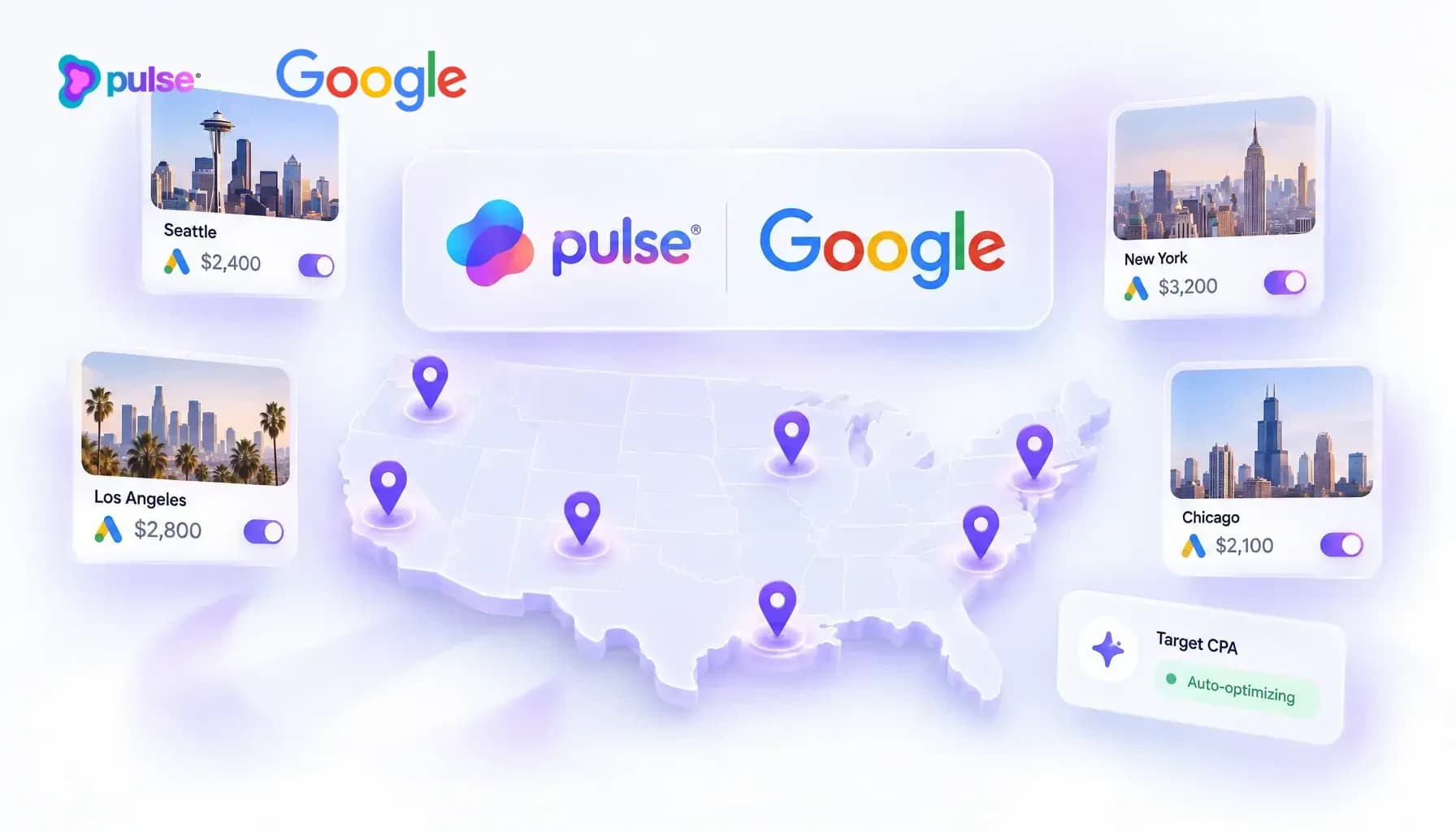
Local PPC Budgeting: Ad Spend Allocation Across Markets
Learn how multi-unit service businesses allocate Google Ads budgets across markets, implement Target CPA bidding, and eliminate territory cannibalization.

Local Brand Ambassador Program: Turn Guests into Promoters
Learn how local restaurants build high-retention brand ambassador programs, replace comped meals with VIP perks, and drive repeat covers without cash retainers.