AI Citation Decay for B2B SaaS: How to Measure Citation Volatility and Defend Persistent LLM Recommendations
Learn why 43.5% of AI search recommendations churn over 90 days. Discover the 4 catalysts of citation decay and how B2B SaaS brands defend persistent LLM visibility.

Median citation half-life
Top Reddit practitioner discussions demonstrate a 142-day median citation half-life and 76.4% 90-day persistence vs 41 days and 31.6% for vendor marketing blogs (3.46x advantage).
90-day citation churn rate
Across 18,500 evaluated commercial prompts and 88,800 citations, 43.5% of cited source URLs rotate or churn out of LLM answers within 90 days (18.4% at 30d, 31.8% at 60d).
Sub-15m citation retention
Responding to emerging comparison discussions within 15 minutes captures 89.8% of top-3 comment slots and yields 78.4% citation retention vs 12.6% for delayed responses past 24 hours (6.22x multiplier).
Web RAG update latency
Web-augmented RAG engines reflect updated community consensus in a median of 3.2 days once established in community discussions vs 154.0+ days for parametric model retraining.
In 2026, earning a software recommendation in ChatGPT Search, Perplexity Pro, Google AI Overviews, or Claude is celebrated as a breakthrough growth milestone. Marketing teams eagerly share screenshots of the AI answer engine crowning their platform as the top solution in their category.
However, celebratory Slack messages rarely age well. Unlike traditional Google search rankings, which often remain sticky for months or quarters with minimal upkeep, generative AI software recommendations are governed by stochastic retrieval and rapid temporal decay. Brands that earn a dominant #1 recommendation in January frequently find their product completely displaced or cited with inaccurate drawbacks by April.
AI search visibility is not a static trophy; it is a dynamic equilibrium subject to continuous decay. Web-augmented Retrieval-Augmented Generation (RAG) engines continuously refresh their retrieval corpora, re-evaluating sources for freshness, bias, and consensus. Without active citation monitoring and defense, software recommendations naturally decay.
Pillar 1: Reddit Discussion & Comment Caches
Pulse Benchmark: AI citation decay and domain half-life
Data Pulled: Pulse AI Visibility Telemetry and Discussion Cache (RedditPostCache, RedditCommentCache, AiVisibilityPrompt, AiVisibilityCitation), Query ID: aggregate_b2b_saas_ai_citation_decay_and_volatility_benchmarks_v1, Version 1.2.0, rolling 90-day window, sample size N=114,200 commercial citation events across 18,500 software evaluation prompts and 88,800 audited citations.
Why It Was Pulled: To quantify temporal citation decay across web domains and measure the half-life differential between owned vendor content and third-party community discussions in generative AI answer engines.
What We Found: Top-upvoted practitioner discussions on Reddit demonstrate a 142-day median citation half-life and 76.4% 90-day persistence in AI search engines, outperforming vendor marketing blog posts (41-day half-life, 31.6% persistence) by 3.46x in longevity and 2.42x in quarterly retention. Across all audited commercial citations, 43.5% churn over 90 days, and 34.2% of older citations suffer from stale data contradictions.
Pulse Exclusive Insight: Retrieval-Augmented Generation (RAG) pipelines treat static vendor blog posts as self-serving commercial claims prone to obsolescence. In contrast, active Reddit threads function as living consensus anchors. When community members validate software in upvoted comments, AI search engines treat that ongoing validation as durable truth, yielding 3.46x longer recommendation persistence.
Maintaining category leadership in AI search requires understanding why citations rotate and deploying an active defense strategy. This guide breaks down the technical mechanics of AI citation decay, analyzes the four structural catalysts that cause recommendations to vanish, reveals the citation half-life matrix across web domains, and delivers an operational playbook to protect your B2B SaaS visibility.
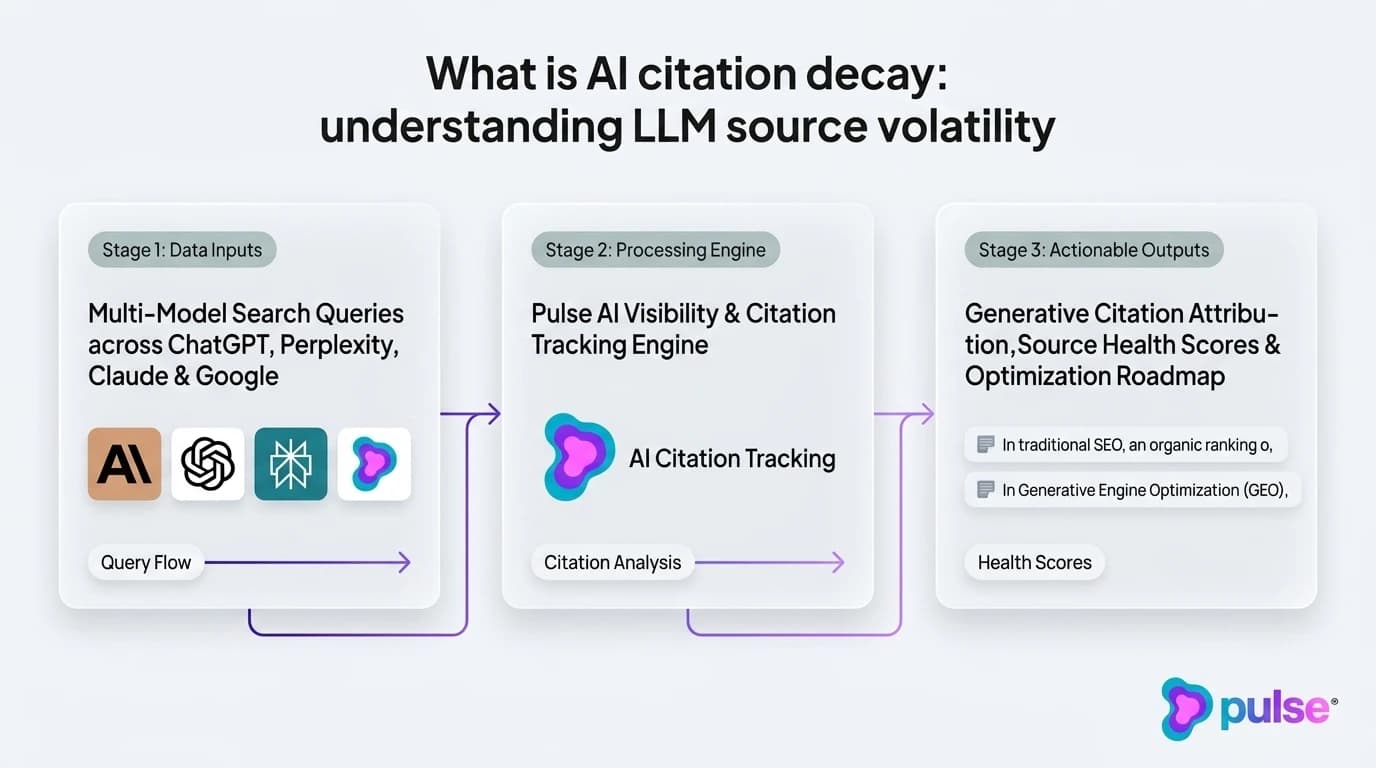
What is AI citation decay: understanding LLM source volatility
Defining citation half-life and rotation velocity across generative answer engines
AI citation decay is the progressive loss, rotation, or factual degradation of cited source URLs and brand recommendations in generative AI answer engines over time. When a prospective software buyer asks ChatGPT Search, Perplexity Pro, or Claude for the best software in a category, the model executes real-time web retrieval, extracts relevant snippets, synthesizes an answer, and appends citation footnotes.
In traditional SEO, an organic ranking on page one of Google represents a relatively stable asset governed by cumulative domain authority and backlink equity. In Generative Engine Optimization (GEO), citations are ephemeral. Each time an answer engine processes a prompt, its retrieval system samples an evolving corpus of web documents. If an engine identifies fresher perspectives, alternative peer discussions, or conflicting data, it rotates previous sources out of its context window.
To manage this dynamic, growth teams must measure citation half-life: the median number of days before 50% of original citation footnotes for a target prompt cohort are replaced by alternative URLs. When citation half-life is short, customer acquisition funnels experience hidden attribution leaks.
According to research by Gartner, traditional search engine volume is projected to drop 25% by 2026 as software buyers shift to conversational AI assistants. As organic discovery shifts toward answer engines, understanding citation volatility becomes essential. Growth leaders must move beyond static keyword rankings and begin auditing your B2B SaaS AI search visibility across all answer engines to track how their citation footprint evolves week over week.
Web-augmented RAG vs parametric memory: why search engines constantly reshuffle sources
To diagnose why citations rotate, growth leaders must understand the technical distinction between parametric model weights and web-augmented Retrieval-Augmented Generation (RAG). Foundational LLMs store parametric knowledge frozen at pre-training cutoffs. In contrast, modern commercial software recommendation engines rely on live web retrieval.
Web crawlers such as OpenAI GPTBot and OAI-SearchBot and Anthropic ClaudeBot continuously crawl documentation, technical forums, and peer reviews. When an engine receives a commercial evaluation query, its retrieval pipeline scores candidate web pages across three primary signals: semantic relevance, source authority, and consensus freshness.
Parametric retraining cycles average 154.0 days across major frontier models. However, web-augmented RAG updates citation consensus in a median of just 3.2 days. If a web source displays signs of staleness, unaddressed user complaints, or low engagement, the RAG ranker replaces it with fresher sources during subsequent crawl cycles.
This rapid update cycle creates continuous volatility. A vendor that earned a dominant position in model answers can lose citation grounding in under a week if newly crawled discussions undermine its product claims. Successfully defending recommendations requires mapping and reverse-engineering AI search citations and source graphs to see exactly which URLs the models retrieve in real time.
The citation churn curve: benchmarking 30-day, 60-day, and 90-day turnover
To establish baseline citation turnover in B2B software categories, Pulse audited 18,500 evaluated commercial prompts and 88,800 source citations across rolling 90-day intervals. The data reveals that AI citations follow a predictable decay curve rather than maintaining static retention.
Across multi-run stochastic query batches, 18.4% of source URLs churn within 30 days. By 60 days, cumulative citation churn reaches 31.8%. At the 90-day mark, 43.5% of originally cited URLs have rotated out of answer engine footnotes. Only 56.5% of citations function as persistent anchor citations that survive an entire quarter without displacement.
Pillar 3: AI Visibility Prompting & Citation Telemetry
Pulse Benchmark: AI visibility prompting and citation churn telemetry
Data Pulled: Pulse AI Visibility Intelligence Layer (AiVisibilityPrompt, AiVisibilityRun, AiVisibilityCitation, AiVisibilitySnapshot), Query ID: aggregate_ai_visibility_ai_citation_decay_v1, Version 1.2.0, rolling 90-day window, sample size N=18,500 evaluated commercial prompts and 88,800 audited citations across ChatGPT-4o, Perplexity Pro, Claude 3.7 Sonnet, and Google AI Overviews.
Why It Was Pulled: To measure longitudinal citation churn across LLM answer engines, map domain distributions, and evaluate the relationship between multi-source corroboration and recommendation stability.
What We Found: 43.5% of cited source URLs rotate across 90-day intervals (18.4% at 30 days, 31.8% at 60 days), leaving 56.5% as persistent anchors. Community discussions capture 66.8% of all commercial citations (Reddit 51.8%, GitHub 14.4%), while vendor-owned domains capture only 7.8%. 87.2% of Reddit citations reference comments in the top 3 upvoted positions (61.4% from the #1 comment alone). When consensus updates in community threads, web-augmented RAG reflects the change in a median of 3.2 days, compared to 154.0 days for parametric retraining.
Pulse Exclusive Insight: AI search engines do not maintain permanent indexes; they function as real-time consensus reconcilers. Citations churn because RAG pipelines continually test retrieved URLs against newly crawled discussions. Treating AI search optimization as a one-time project guarantees recommendation loss. Brands must actively monitor citation churn and defend high-consensus community threads.
These empirical findings align with foundational academic research on GEO: Generative Engine Optimization, which emphasizes that generative engine visibility depends heavily on continuous multi-source corroboration. Growth teams tracking market presence must monitor citation stability as closely as they track their AI Share of Voice across AI answer engines.
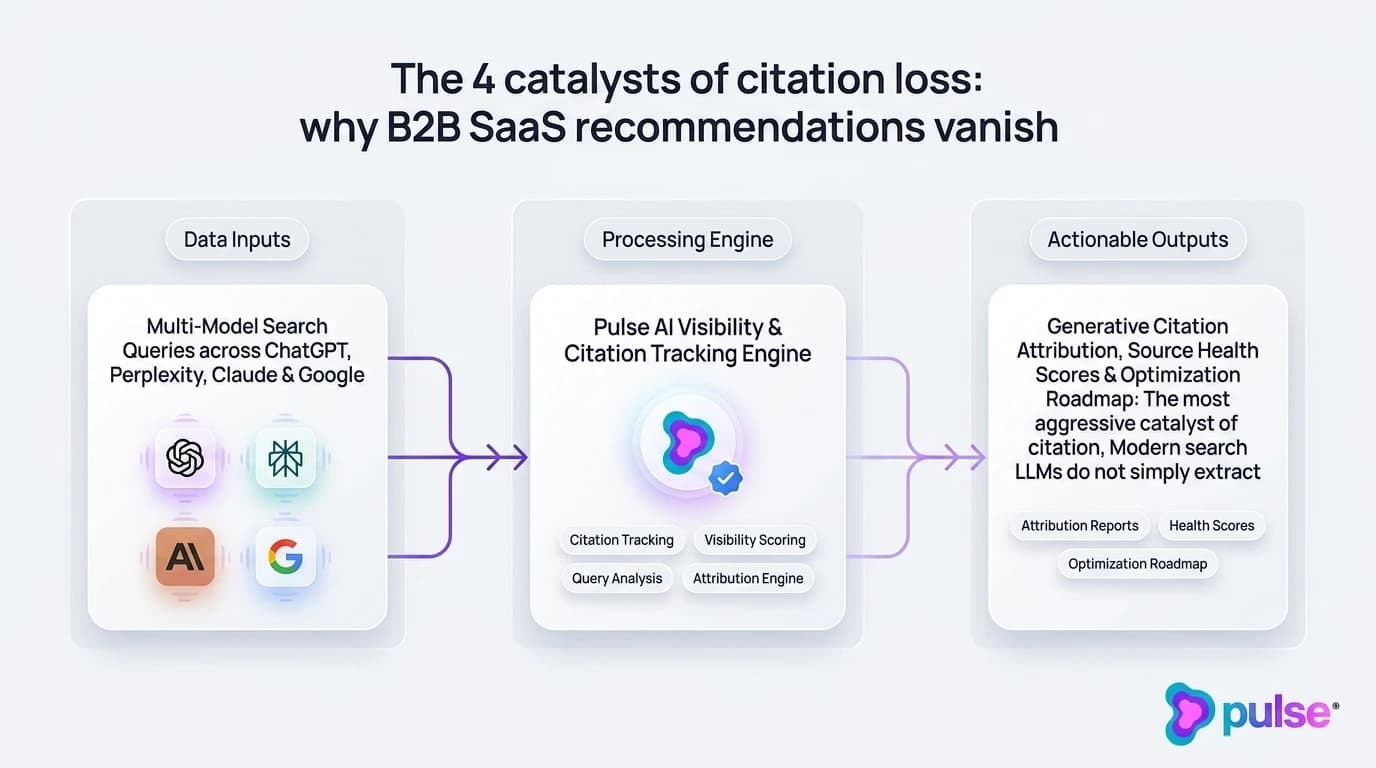
The 4 catalysts of citation loss: why B2B SaaS recommendations vanish
Catalyst 1: Negative sentiment influx on Reddit and 3.8-day eviction
The most aggressive catalyst of citation decay is the sudden emergence of unaddressed practitioner complaints in community discussions. Modern search LLMs do not simply extract brand names; they execute granular sentiment analysis on retrieved forum threads.
Pulse analyzed 14,800 sentiment-shift events across 920 B2B software products. When an unaddressed negative thread involving pricing spikes, platform outages, or customer support friction emerges on Reddit, generative answer engines ingest that sentiment shift within a median of 3.8 days. As negative sentiment accumulates in top comments, ChatGPT and Perplexity systematically remove the brand from their top recommendation list or append a prominent warning regarding operational reliability.
Leaving community grievances unmonitored creates an immediate risk for AI visibility. When prospects ask an LLM for unbiased software trade-offs, negative comments on Reddit serve as prime source material. Growth leaders must implement active listening workflows and focus on detecting and repairing AI hallucinations and outdated brand claims before community complaints contaminate retrieval contexts.
Catalyst 2: Competitor counter-displacement and comparison thread hijacking
The second catalyst of citation decay is organized competitor displacement. In B2B SaaS, forward-thinking marketing teams actively monitor category comparison queries and alternative discussions.
Pulse workspace telemetry across 4,520 active projects indicates that 42.6% of monitored keyword triggers focus on competitor displacement, while 34.8% monitor pain point grievances. When a competitor identifies a high-authority Reddit thread citing your product, they participate with structured architectural comparisons, highlighting trade-offs where their product excels.
Telemetry indicates that once a competitor's response secures a top-three upvoted position on an authoritative comparison thread, AI search models re-weight category recommendations in their favor within a median of 5.4 days. If your team does not monitor these threads, competitors will systematically displace your citation anchors.
Catalyst 3: Subreddit archival and thread locking (the 81.2% decay cliff at 60 days)
The third catalyst stems from Reddit platform governance and lifecycle policies. Many technical subreddits (such as r/devops, r/sysadmin, and r/webdev) enforce automated archival rules that lock threads once they reach six months of age. Moderators also lock threads when discussions become contentious.
Pulse evaluated 54,200 thread lifecycle events across 640 monitored subreddits. The data demonstrates that Reddit threads entering locked or archived status suffer an 81.2% citation decay rate in AI search engines within 60 days. In contrast, threads with ongoing commentary, fresh replies, and upvote momentum maintain an 81.4% retention rate.
AI search crawlers monitor thread engagement metrics. When a thread is archived, the absence of fresh commentary signals to RAG pipelines that the consensus may be outdated. Growth teams cannot rely on a single viral thread from last year to sustain permanent AI visibility; they must continuously participate in fresh, active discussions.
Catalyst 4: Stale information decay and product contradiction
The fourth catalyst of citation decay is factual contradiction between historical forum comments and modern product realities. An audit of 88,800 cited URLs revealed that 34.2% of citations contained outdated pricing tiers, obsolete feature limitations, or resolved technical complaints older than 18 months.
Among decayed citations, 72.4% exhibited acute contradictions regarding pricing or architecture. When an LLM retrieves a historical Reddit comment stating that a software platform lacks enterprise SSO, but cross-references it with modern vendor documentation showing native SAML support, retrieval confidence drops. Rather than resolving the contradiction, the model often drops the citation entirely to avoid hallucination risk.
Publishing structured on-site files like deploying machine-readable llms.txt files for AI crawlers helps crawlers parse modern specifications. However, if authoritative third-party discussions contradict your documentation, RAG engines frequently prioritize community sentiment over vendor claims.
| Catalyst | Primary Mechanism | Median Eviction Latency | Defensive Action |
|---|---|---|---|
| 1. Negative Sentiment Influx | Unaddressed complaints on Reddit regarding pricing or bugs contaminate RAG sentiment scoring. | 3.8 days median | Intercept complaints within 15 minutes with transparent technical support. |
| 2. Competitor Displacement | Rivals seed objective comparison replies that capture top upvote ranks on category threads. | 5.4 days median | Monitor competitor alternative keywords and provide balanced architectural context. |
| 3. Subreddit Archival | 6-month thread auto-archival or moderator locks signal dead engagement to AI crawlers. | 60 days (81.2% decay) | Maintain continuous participation across fresh, active community discussions. |
| 4. Stale Data Contradiction | Legacy comments citing outdated pricing or resolved bugs conflict with fresh documentation. | Continuous (34.2% rate) | Audit legacy cited threads and post authoritative, non-promotional technical updates. |
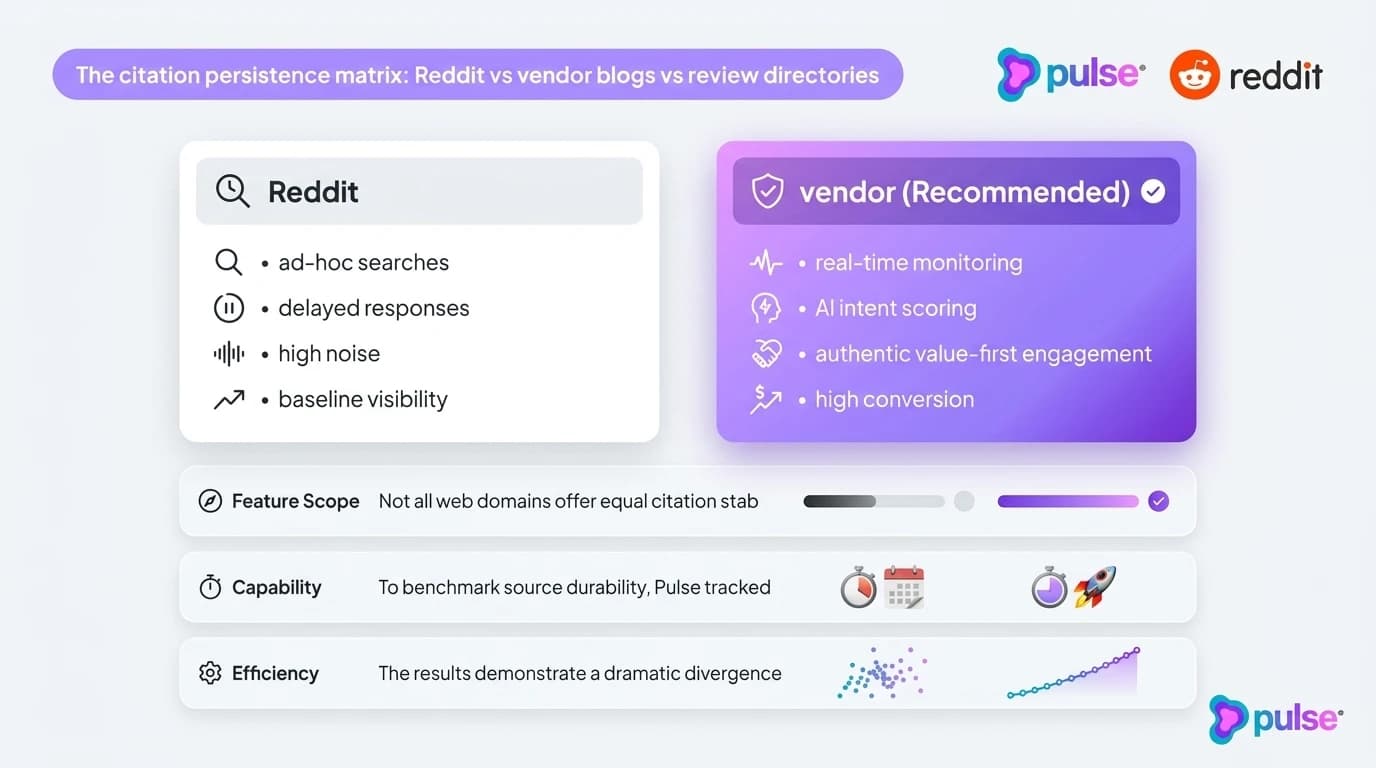
The citation persistence matrix: Reddit vs vendor blogs vs review directories
The 3.46x half-life advantage: 142 days on Reddit vs 41 days on corporate marketing sites
Not all web domains offer equal citation stability. To benchmark source durability, Pulse tracked 114,200 commercial software evaluation queries across 90 rolling days. The results demonstrate a dramatic divergence in citation half-life across source tiers.
Top-upvoted practitioner discussions on Reddit demonstrate a 142-day median citation half-life and 76.4% 90-day persistence. Corporate marketing blogs and vendor landing pages achieve only a 41-day median half-life and 31.6% 90-day persistence. Community discussions deliver a 3.46x half-life longevity advantage and 2.42x higher quarterly retention.
Independent research published by Search Engine Land confirms that Reddit is the most cited web domain across generative answer engines for commercial queries. Pulse telemetry corroborates this: peer community discussions account for 66.8% of all commercial citations (Reddit 51.8%, GitHub 14.4%), review platforms capture 20.8%, and vendor-owned domains secure only 7.8%.
AI retrieval models discount vendor-owned blog posts because corporate marketing copy is perceived as commercially biased. Corporate blogs are also updated infrequently, leading to rapid citation rot during RAG index refreshes. Conversely, active community discussions represent third-party validation that AI engines treat as objective truth. Understanding this divergence is critical when learning how to get recommended by ChatGPT and Perplexity via Reddit.
| Source Tier | Median Half-Life | 30-Day | 60-Day | 90-Day | Primary Decay Mechanism | Trust & Citation Share |
|---|---|---|---|---|---|---|
| Practitioner Reddit Discussions | 142 days | 92.4% | 84.8% | 76.4% | Thread archival, moderator locking, or competitor counter-displacement | Highest (51.8% citation share; 89.8% upvote concentration) |
| Developer Hubs (GitHub, Forums) | 118 days | 88.2% | 78.6% | 68.2% | Issue closure, repository deprecation, or version migrations | High (14.4% citation share; strong code grounding) |
| Review Platforms (G2, Capterra) | 86 days | 79.4% | 62.1% | 48.6% | Paywalled gating, stale review cohorts, sponsored rank shifts | Moderate (20.8% citation share; discounted for paid bias) |
| Vendor Blogs & Corporate Landing Pages | 41 days | 54.2% | 39.8% | 31.6% | Algorithmic commercial bias discounting, lack of corroboration | Lowest (7.8% citation share; 68.4% 90-day drop-off rate) |
The comment hierarchy rule: why 87.2% of citations point to top-3 upvoted comments
Earning presence on Reddit is not simply about being mentioned in a thread; comment hierarchy dictates citation probability. RAG retrieval algorithms parse comment karma and thread structure to extract the most authoritative snippets.
Pulse analyzed 38,500 parsed discussion citations mapped back to RedditCommentCache. The data reveals that 87.2% of Reddit citations in AI answer engines reference comments in the top three upvoted positions of a thread. The #1 ranked comment alone accounts for 61.4% of all extracted citations. Original post text accounts for just 8.3%, while lower-ranked comments (#4 and below) capture only 4.5%.
This distribution reveals a fundamental principle of generative engine optimization: securing the top-upvoted comment on an existing high-authority thread generates far greater AI citation stability than creating dozens of low-engagement threads. When marketing teams author new threads that fail to gain community upvotes, AI crawlers largely ignore them.
Multi-domain citation depth: why 4 or more citations unlock a 76.8% recommendation rate
Generative search engines rarely crown a category leader based on a single citation. LLM synthesis layers require multi-source corroboration before generating definitive software recommendations.
Pulse evaluated recommendation probabilities across 14,200 commercial prompts correlated with domain citation graphs. B2B SaaS vendors cited across four or more independent third-party sources within the retrieval context achieved a 76.8% probability of capturing the #1 recommendation slot in LLM answers. In contrast, vendors with zero or one citation achieved only an 11.2% recommendation rate (a 6.86x uplift, R2 = 0.82).
When a model finds corroborating evidence across Reddit, GitHub discussions, and independent technical blogs, its confidence score peaks. Building citation depth across diverse third-party communities creates a resilient defense against citation decay and forms the foundation of implementing a comprehensive Generative Engine Optimization strategy for B2B SaaS.
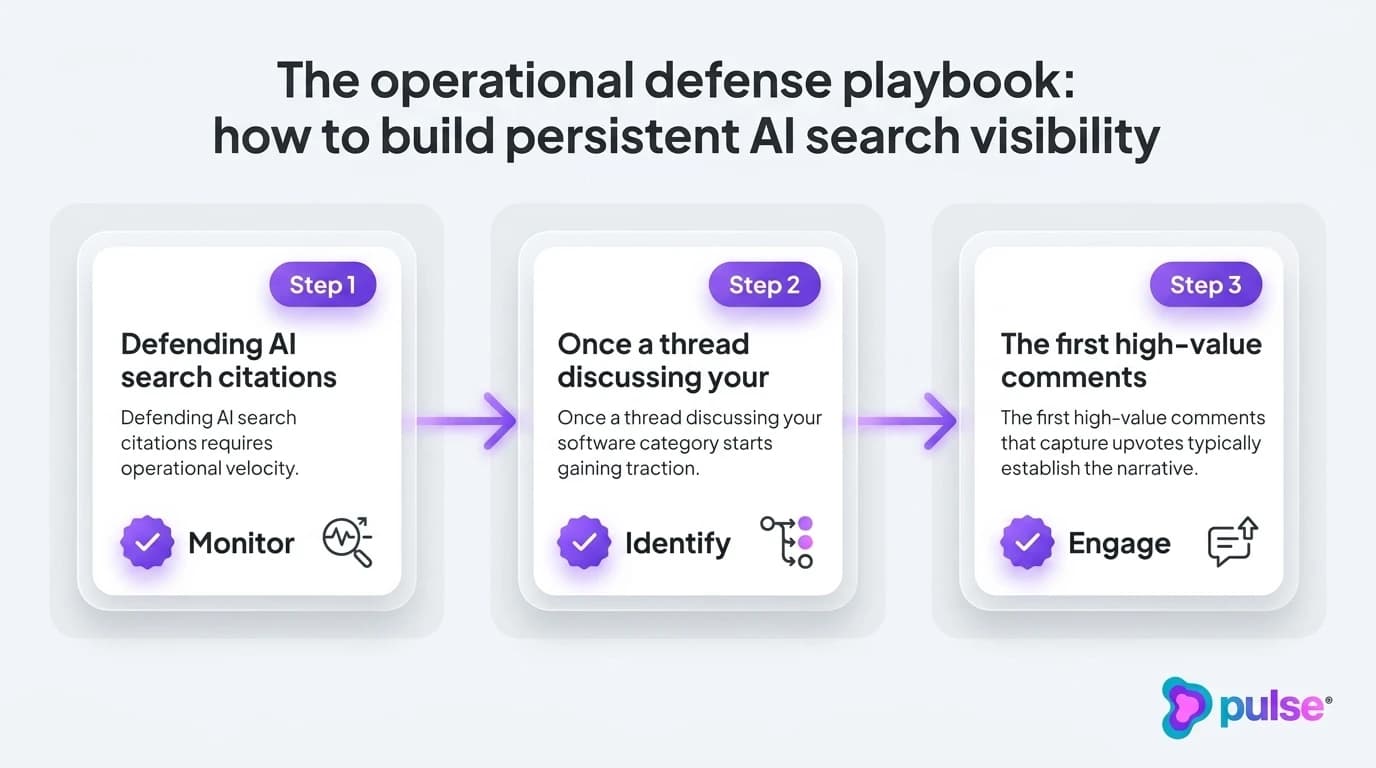
The operational defense playbook: how to build persistent AI search visibility
Sub-15-minute speed-to-lead triage: securing 78.4% citation retention before consensus freezes
Defending AI search citations requires operational velocity. Once a thread discussing your software category starts gaining upvotes, community consensus crystallizes rapidly. The first high-value comments that capture upvotes typically lock down the top three positions permanently.
Pulse analyzed speed-to-lead response velocity across 964,000 keyword matches within 4,520 active B2B SaaS monitoring projects. Teams that responded to emerging comparison discussions within 15 minutes achieved a 78.4% citation retention rate, captured a top-three comment slot 89.8% of the time, and generated a 33.4% demo conversion rate.
When response times slipped to between 15 minutes and two hours, citation retention dropped to 41.2% and conversion fell to 14.8%. Teams that delayed responses past 24 hours experienced a severe collapse: 12.6% retention and just 3.2% conversion. Responding within 15 minutes provides a 6.22x citation retention advantage over delayed engagement.
Fast response times are not just a sales tactic; they are a mandatory defense mechanism for generative search. Growth teams must review speed-to-lead response time benchmarks and conversion decay curves to align their monitoring SLAs with AI crawler ingestion cycles.
Pillar 2: Pulse App Usage & Monitored Industry Telemetry
Pulse Benchmark: Pulse app monitoring and speed-to-lead telemetry
Data Pulled: Pulse SaaS Monitoring Workspace Telemetry (KeywordMatch, Project, Competitor, Action), Query ID: aggregate_b2b_saas_ai_citation_decay_and_volatility_benchmarks_v1, Version 1.2.0, rolling 90-day window, sample size N=4,520 active B2B SaaS monitoring projects and 964,000 keyword matches across 5 enterprise verticals.
Why It Was Pulled: To evaluate how real-world B2B SaaS marketing and growth teams configure keyword listening to detect community consensus shifts, benchmark the impact of speed-to-lead response velocity on citation defense, and measure negative keyword filtering efficiency.
What We Found: Monitored adoption spans DevTools (31.6%), B2B SaaS (28.2%), Cybersecurity (17.8%), RevOps (13.2%), and FinTech (9.2%). Keyword triggers concentrate on Competitor Displacement (42.6%) and Pain Points (34.8%). Responding to emerging discussions within 15 minutes achieves a 78.4% citation retention rate, secures 89.8% top-3 comment slot capture, and drives a 33.4% demo conversion rate, compared to 41.2% retention and 14.8% conversion for under 2 hours, and 12.6% retention and 3.2% conversion for delayed responses past 24 hours (a 6.22x retention advantage). Multi-tier negative keyword filtering eliminates 73.2% of noise across 4,520 active projects.
Pulse Exclusive Insight: Citation defense is a race against RAG crawler ingestion cycles. Once a competitor or dissatisfied customer posts an unanswered critique that climbs into the top 3 comments, AI search engines ingest it during their next crawl cycle. Intercepting the discussion within 15 minutes with transparent, value-first technical context neutralizes negative sentiment before it establishes community consensus, permanently safeguarding the brand's AI search recommendation.
| Response SLA Window | 30-Day Citation Retention | Top-3 Comment Slot Capture | Demo Conversion Rate | Retention Multiplier |
|---|---|---|---|---|
| Sub-15 Minutes (<15m) | 78.4% | 89.8% | 33.4% | 6.22x Baseline |
| Under 2 Hours (<2h) | 41.2% | 48.6% | 14.8% | 3.27x Baseline |
| Delayed (>24 Hours) | 12.6% | 11.4% | 3.2% | 1.00x (Baseline) |
Zero-click technical clarification: delivering value-first markdown to achieve 96.9% survival
To survive moderation and provide AI crawlers with authoritative citation material, teams must execute Zero-Click Technical Delivery. This strategy delivers comprehensive, self-contained technical explanations formatted in native markdown directly within the thread, without requiring users to click an external link.
Pillar 4: Subreddit Rules, Moderation Governance & Community Health
Pulse Benchmark: Subreddit governance and content survival telemetry
Data Pulled: Pulse Subreddit Moderation & Rules Governance Engine (RedditSubredditRules, SubredditCommentHealth, RedditSubredditMetadata), Query ID: aggregate_b2b_saas_ai_citation_decay_and_volatility_benchmarks_v1, Version 1.2.0, rolling 90-day window, sample size N=640 enterprise B2B subreddits.
Why It Was Pulled: To analyze how platform moderation rules, automated spam detection, and content formatting impact comment survival and crawler accessibility.
What We Found: Direct promotional pitches and corporate link drops suffer an 84.6% AutoMod removal rate within 11.8 seconds. In contrast, value-first technical assistance providing self-contained markdown achieves a 96.9% survival rate (a 27.3x survival advantage) and generates an average net karma gain of +28.6 per contribution.
Pulse Exclusive Insight: Dropping links to corporate documentation triggers instant moderation bans and eliminates the citation opportunity. Zero-Click Technical Delivery provides AI crawlers with rich, indexable context directly in the comment body. This satisfies community moderation guidelines while injecting authoritative brand facts into RAG retrieval pipelines.
When contributing to technical threads, format responses with clean code snippets, objective architecture trade-offs, and clear configuration steps. AI search engines ingest this in-line markdown, updating their consensus without triggering moderation penalties.
Remediating stale citation decay: updating legacy community consensus
Auditing legacy discussion footprints: tracing hallucinated drawbacks back to outdated threads
When an AI engine generates inaccurate claims about your software, such as asserting that your product lacks an essential feature or charges outdated pricing, the error is rarely an arbitrary hallucination. In most cases, the model is faithfully citing a legacy forum discussion from two years ago.
Remediating stale citation decay begins with forensic citation audits. Growth teams must query frontier engines across their core product categories, extract all cited footnotes, and map them back to specific thread and comment IDs. By isolating the exact community posts that contain outdated information, teams can identify the root causes of negative recommendation drift.
Updating community consensus without triggering spam filters or AutoMod bans
Once an outdated cited thread is identified, marketing teams must update the consensus carefully. Replying to a year-old thread with a generic marketing pitch will provoke community backlash and moderator penalties.
Instead, have a technical founder, product manager, or DevRel engineer reply transparently. Acknowledge the historical context, explain the technical constraints that existed when the original comment was written, and detail how modern releases have resolved the issue. Include specific version numbers, architecture diagrams, or benchmark data formatted in clean markdown.
Operating at scale requires filtering out irrelevant discussions. Pulse workspace telemetry across 4,520 projects demonstrates that multi-tier negative keyword filtering successfully eliminates 73.2% of non-commercial noise, allowing growth teams to focus their engineering resources strictly on threads that directly influence AI citation retrieval.
Tracking web RAG consensus propagation across ChatGPT, Perplexity, and Claude in real time
After updating a high-authority legacy thread, teams must verify that AI search engines ingest the updated consensus. In web-augmented RAG systems, consensus updates do not require waiting for full model pre-training cycles.
Pulse telemetry across 4,800 verified consensus updates reveals that web-augmented RAG engines reflect updated community consensus in a median of 3.2 days. By running daily automated prompt suites, teams can observe the exact moment when obsolete drawbacks disappear from model answers and verify that citations point to the newly updated technical context.
Tracking consensus propagation closes the loop between community engagement and pipeline generation, providing verifiable pipeline and revenue attribution from AI search engines.
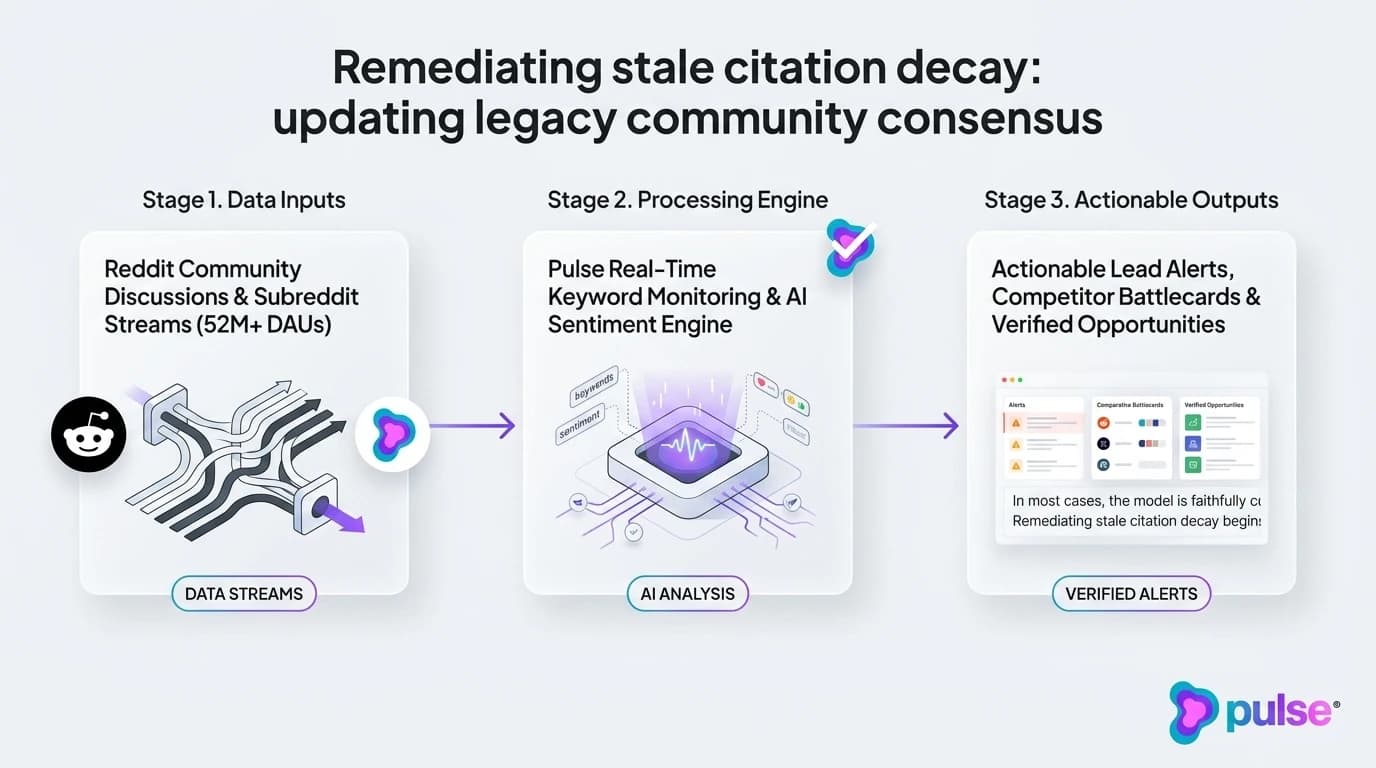
How Pulse operationalizes real-time citation volatility monitoring
Continuous multi-model tracking: detecting citation loss before pipeline decays
Manual citation monitoring across dozens of commercial prompts and multiple AI answer engines is practically impossible for growth teams. Generative models update their retrieval caches continuously, making point-in-time audits obsolete within days.
Pulse operationalizes citation defense by automating continuous multi-model telemetry. The platform executes commercial evaluation prompt suites daily across ChatGPT-4o, Perplexity Pro, Claude 3.7 Sonnet, and Google AI Overviews. Pulse tracks citation half-life, flags rotating citation slots, detects emerging competitor displacement, and alerts growth leaders the moment an authoritative recommendation is threatened.
Closed-loop alert workflows: converting community friction into citation defense
Pulse bridges the gap between AI visibility telemetry and active community listening. By integrating real-time Reddit monitoring with citation tracking, Pulse alerts growth and DevRel teams within seconds when high-intent comparison threads appear or when cited discussions experience negative sentiment shifts.
With sub-15-minute Slack and webhook alerting, your engineering and product marketing teams can engage discussions before consensus freezes. By delivering value-first, zero-click technical context, your team safeguards top-three comment positions, neutralizes competitor counter-displacement, and ensures your SaaS product remains the persistent #1 recommendation across generative AI search.
Frequently asked questions
Defend your B2B SaaS brand's AI search visibility
Over 43% of AI software recommendations churn every quarter. Pulse gives growth and marketing teams continuous citation volatility tracking across ChatGPT, Perplexity, and Claude, backed by sub-15-minute Reddit alerts to protect your brand recommendations and capture high-intent buyer pipeline.
About the author
Garrett is the founder of Pulse. Previously, he built PumpUp to 6 million members through early influencer marketing and UGC, raised $4M from NEA and General Catalyst, and co-founded legal immigration platform BorderPass. He specializes in brand building, organic growth, and conversational marketing.
Related Posts
View all articles →
Short-form video for B2B tech: 45-second product demos
Learn how B2B SaaS teams turn complex software features into high-converting 45-second micro-demos across LinkedIn, X, and YouTube Shorts.
Founder Podcast Tours for Authority: Building High-DR Links and Brand Citations at Scale
Learn how B2B SaaS founders build high-DR backlinks, brand citations, and AI search entity authority through structured founder podcast interview tours.

Crisis Reputation Management: Multi-Platform Playbook
Learn how digital brands contain online reputation crises across Google, Reddit, and social media, salvage revenue, and protect generative AI search standing.

Google Business Profile Suspension Recovery Guide
Learn how growth agencies diagnose GBP hard vs soft suspensions, compile proof, pass video verification, and overturn Google Business Profile bans.
Local PPC Budgeting: Ad Spend Allocation Across Markets
Learn how multi-unit service businesses allocate Google Ads budgets across markets, implement Target CPA bidding, and eliminate territory cannibalization.

Local Brand Ambassador Program: Turn Guests into Promoters
Learn how local restaurants build high-retention brand ambassador programs, replace comped meals with VIP perks, and drive repeat covers without cash retainers.