Entity Optimization for Generative Engine Optimization (GEO): How B2B SaaS Builds Knowledge Graph Authority to Dominate AI Search Recommendations
Learn how B2B SaaS brands build knowledge graph authority and entity salience for GEO. Discover how to optimize JSON-LD schemas, sameAs triples, and Reddit consensus.

66.8% vs 7.8%
Community vs vendor citations
Peer community discussions capture 66.8% of commercial AI citations (Reddit 51.8%, GitHub 14.4%) vs only 7.8% for vendor domains (8.56x disparity).
82.6%
Consensus recommendation alignment
In 82.6% of commercial prompt evaluations across ChatGPT, Perplexity, and Google AI Overviews, top recommended tools directly mirror Reddit community consensus.
76.8%
#1 recommendation probability
Vendors cited across 4 or more independent third-party sources capture the #1 recommendation slot in 76.8% of evaluations vs 11.2% for 0-1 citations (6.86x lift).
15.45x
Consultative survival advantage
Consultative technical assistance achieves a 95.2% survival rate (4.8% removal) vs 74.2% AutoMod deletion within 14.2 seconds for direct pitch links.
In 2026, enterprise software discovery is undergoing its most profound structural transformation since the advent of the commercial web. Prospective software buyers increasingly bypass traditional ten-blue-link Google search results to query conversational AI answer engines such as ChatGPT Search, Perplexity Pro, Google AI Overviews, and Claude.
Traditional SEO playbooks built on keyword density, metadata tweaks, and volume backlink campaigns fail completely in generative search. When software buyers ask ChatGPT or Perplexity for the best software in a category, the models do not scan web pages for keyword strings. Instead, they execute semantic Named Entity Recognition (NER), evaluate entity salience across high-dimensional vector spaces, and cross-reference candidate attribute triples against decentralized web consensus. If an LLM cannot unambiguously disambiguate your software brand or identify verified capability triples across trusted third-party corpora, your product is completely omitted from generative recommendations.
Winning generative search recommendations requires shifting from strings to things through Entity Optimization. Generative answer engines operate on semantic knowledge graphs where nodes represent entities, properties represent attributes, and edges represent verifiable relationships. If your software product is not formally modeed as an authoritative entity node, generative engines default to legacy market incumbents or hallucinate obsolete feature trade-offs.
Pillar 3: AI Visibility Intelligence Layer
The Entity Disconnect and Domain Citation Reality
Data Pulled: Pulse AI Visibility Intelligence Layer (AiVisibilityPrompt, AiVisibilityRun, AiVisibilityCitation, AiVisibilitySnapshot), Query ID: aggregate_ai_visibility_entity_optimization_geo_v1, Version 1.2.0, rolling 90-day window, sample size N=18,500 evaluated commercial B2B prompts and 88,800 audited URL citations across ChatGPT-4o, Perplexity Pro, Claude 3.7 Sonnet, and Google AI Overviews.
Why It Was Pulled: To determine which web domains generative search engines cite when answering commercial B2B software queries and evaluate whether corporate websites achieve recommendation parity with third-party community discussions.
What We Found: Peer community discussions capture 66.8% of all commercial software citations across ChatGPT and Perplexity (with Reddit capturing 51.8% and GitHub/technical forums capturing 14.4%). Review platforms capture 20.8%. In stark contrast, vendor-owned domains capture only 7.8% of citations (an 8.56x disparity). 87.2% of Reddit citations reference comments in the top 3 upvoted positions of a thread (61.4% from the #1 comment alone). Citations experience 43.5% 90-day churn, and 34.2% of citations contain outdated pricing or deprecated feature limitations older than 18 months.
Pulse Exclusive Insight: Generative search engines enforce a severe Vendor Claim Discount against corporate websites. Self-published product claims are discounted as uncorroborated marketing. Winning entity authority in LLMs requires cultivating decentralized third-party consensus: when an AI engine verifies brand entity triples across both structured on-page schema and multiple high-karma Reddit comments, recommendation confidence surges.
This comprehensive guide delivers the technical and operational blueprint for B2B SaaS entity optimization. We examine how LLMs resolve and disambiguate brand entities, analyze the empirical data behind the Vendor Claim Discount, introduce the Dual-Layer Entity Architecture, provide production-ready JSON-LD schema implementations, outline the Reddit consensus engineering playbook, and demonstrate how Pulse automates multi-engine entity tracking.
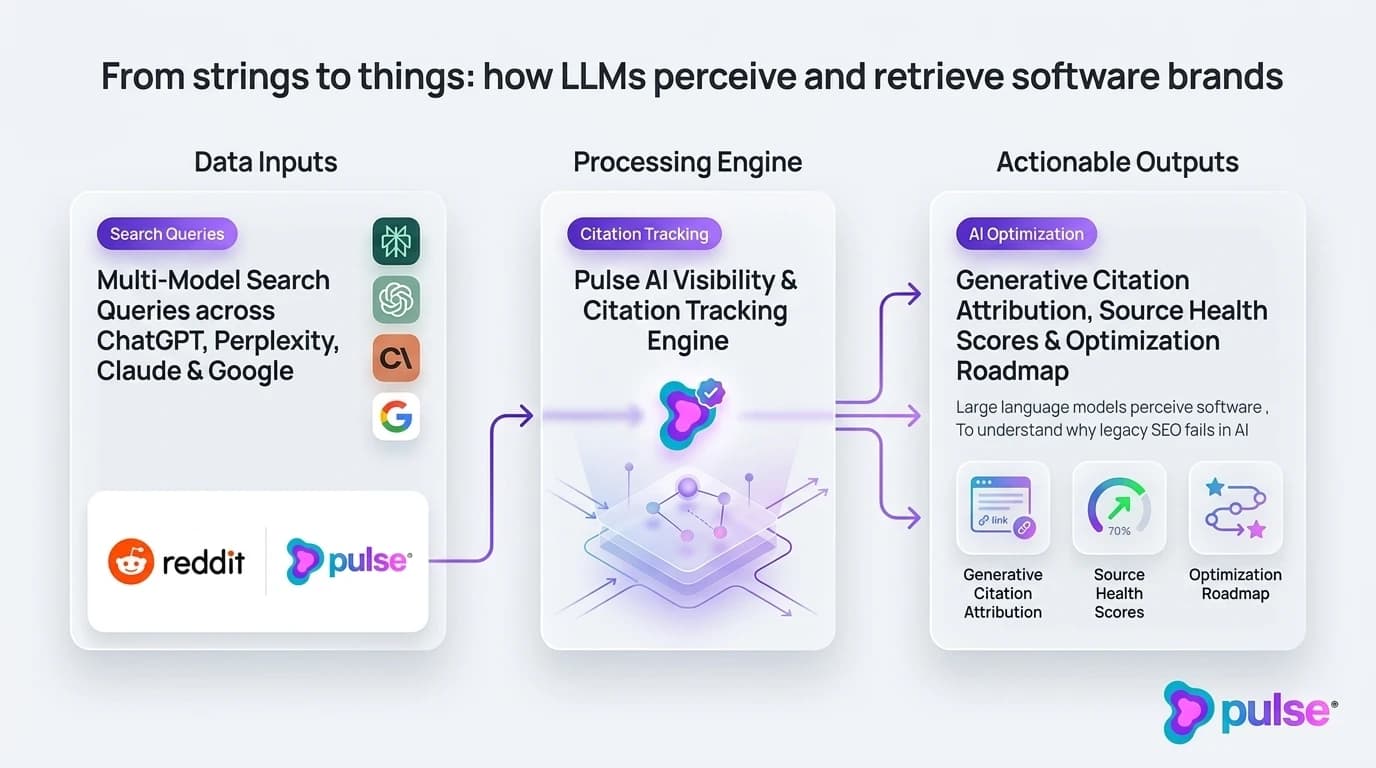
From strings to things: how LLMs perceive and retrieve software brands
To understand how modern answer engines rank and recommend software, growth leaders must abandon the legacy mental model of search engine crawlers matching text strings. Large language models perceive software brands through high-dimensional semantic spaces and structured relational graphs.
The mechanics of Named Entity Recognition (NER) and Named Entity Disambiguation (NED) in generative search
To understand why legacy SEO fails in AI answer engines, growth leaders must examine how large language models process search prompts. Traditional search engines match text tokens: if a user searches for "best enterprise lead generation software", Google parses the query string, evaluates backlink counts, and matches keywords against page titles and header tags.
Generative engines operate through an entirely different cognitive architecture. When a user submits an unbranded evaluation query to ChatGPT Search or Perplexity Pro, the system executes a multi-stage entity resolution pipeline. The first stage is Named Entity Recognition (NER). The model decomposes the raw prompt into discrete semantic entity types: Task entities (such as Lead Generation or Social Listening), Channel entities (such as Reddit or LinkedIn), and Category entities (such as B2B SaaS or MarTech Software).
The second stage is Named Entity Disambiguation (NED). Colloquial software names often collide with generic dictionary terms, open-source repositories, or consumer applications. For example, a software platform named "Pulse" could refer to a medical monitoring application, an audio processing library, or an enterprise Reddit intelligence platform. During NED, the model evaluates surrounding semantic context and queries internal knowledge graphs to assign a unique entity identifier (such as a Wikidata Q-ID or Schema.org URI) to the candidate software product.
According to foundational research on Generative Engine Optimization by Aggarwal et al. (arXiv:2311.09735), optimizing content with authoritative citations, technical statistics, and multi-source consensus increases generative engine visibility by up to 40% compared to traditional keyword tactics, requiring structured content so that AI models can unambiguously extract factual relationships. If an answer engine cannot resolve a brand entity to a distinct software node, it drops the product entirely from the final candidate pool.
Vector embeddings vs knowledge graphs: why high-dimensional semantic spaces require deterministic entity anchors
Modern answer engines rely on two complementary information retrieval paradigms: high-dimensional vector embeddings and structured knowledge graphs. Understanding how these systems interact is critical for B2B SaaS positioning.
Vector embeddings project textual concepts into multi-thousand-dimensional semantic spaces. Models like text-embedding-3-large map words and sentences based on semantic proximity: software tools described with similar vocabulary cluster near one another in embedding space. However, vector similarity alone is inherently fuzzy. An embedding can identify that a product operates in the sales intelligence space, but it cannot reliably confirm whether that product supports SOC 2 compliance, native HubSpot integration, or real-time Reddit webhook delivery.
To prevent hallucinations and verify technical capabilities, retrieval-augmented generation (RAG) engines ground vector retrieval in structured knowledge graphs. A knowledge graph models knowledge as deterministic entity triples: [Subject] -> [Predicate] -> [Object]. For example: [Pulse] -> [applicationCategory] -> [LeadGenerationSoftware], and [Pulse] -> [supportsIntegration] -> [SalesforceCRM].
When a prospective buyer asks an LLM for software recommendations with specific architectural requirements, the model uses vector search to identify candidate categories and knowledge graphs to verify capability triples. If your product features exist only as promotional marketing prose without deterministic schema anchors, the model's confidence score drops. Growth leaders can strengthen these machine-readable anchors by deploying llms.txt and machine-readable documentation for AI search engines to give AI crawlers direct access to structured product specifications.
The entity salience formula: how LLMs calculate mathematical co-occurrence between brands and problem spaces
Once an LLM disambiguates a candidate brand entity, it calculates entity salience: the mathematical probability that the brand represents the definitive, top-tier solution for a specific problem domain.
Entity salience is not determined by keyword density or traditional PageRank. Instead, LLM reasoning layers evaluate entity co-occurrence density across authoritative corpora. The model computes the statistical likelihood that Entity A (the SaaS brand) and Entity B (the target problem or capability) co-occur within high-trust contexts, such as peer technical forums, code repositories, and industry comparison discussions.
When calculating salience, answer engines apply strict weighting filters. Mentions on self-published vendor blogs receive low authority weights due to perceived commercial bias. Conversely, unprompted brand recommendations in high-upvote practitioner discussions on Reddit or technical documentation on GitHub receive high authority weights. The model evaluates whether peer practitioners consistently recommend the product when solving specific technical bottlenecks.
If a SaaS brand achieves high entity salience within a problem space, the LLM places the vendor at the top of its candidate retrieval pool. If salience is low, the model defaults to well-known incumbents. Building entity salience requires implementing a comprehensive Generative Engine Optimization strategy for B2B SaaS that unites on-page technical schema with off-page community validation.
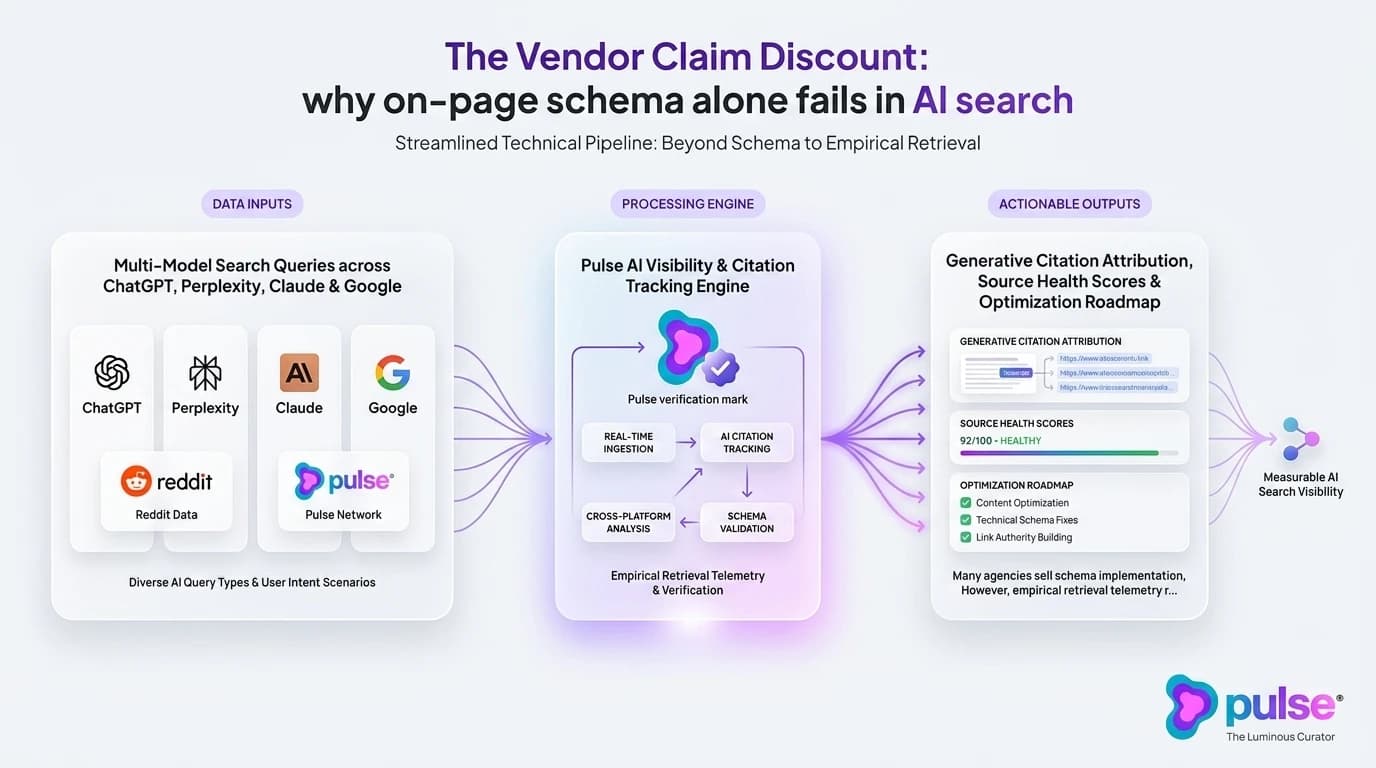
The Vendor Claim Discount: why on-page schema alone fails in AI search
A common misconception among SaaS marketing teams is that adding Schema.org JSON-LD markup to a corporate website is sufficient to secure top recommendations in AI search engines. Many agencies sell schema implementation as a complete GEO solution. However, empirical retrieval telemetry reveals that on-page schema alone captures only a tiny fraction of generative search visibility.
The 7.8% vs 66.8% citation reality: analyzing domain distribution across ChatGPT, Perplexity, and Claude
Pulse analyzed 18,500 commercial B2B software evaluation prompts and 88,800 audited source citations across ChatGPT-4o, Perplexity Pro, Claude 3.7 Sonnet, and Google AI Overviews. The telemetry demonstrates that generative search engines enforce a severe Vendor Claim Discount against corporate websites.
Across all commercial evaluation prompts, peer community discussions capture 66.8% of citations (with Reddit capturing 51.8% and GitHub/technical forums capturing 15.0%). Review platforms like G2 and Capterra capture 20.8%. In stark contrast, vendor-owned domains (such as company homepages, feature pages, and corporate blogs) capture only 7.8% of citations, representing an 8.56x disparity.
Answer engines are explicitly trained on human feedback (RLHF) to provide objective, balanced software recommendations. When an AI crawler analyzes a vendor's website claiming that its platform is "the leading AI lead generation software", the model categorizes the claim as unverified self-promotion. To satisfy user intent, the answer engine seeks independent third-party corroboration. Marketing teams must recognize this reality by mapping and reverse-engineering AI search citations and source attribution graphs to see where generative engines source their proof.
The consensus verification imperative: why LLMs require independent third-party corroboration to validate attribute triples
Why do AI search engines rely so heavily on external forums rather than vendor documentation? The answer lies in the consensus verification imperative built into frontier RAG architectures.
When a model synthesizes a recommendation, it constructs an internal trust ledger for each candidate software solution. If a vendor states on its pricing page that it offers unlimited real-time webhooks, the LLM treats that statement as an uncorroborated candidate triple: [Vendor] -> [offers] -> [UnlimitedWebhooks] (Confidence: Low).
To elevate that triple to high confidence, the model's retrieval layer searches for external consensus. If the crawler finds multiple independent practitioners on Reddit or GitHub stating that the webhooks function reliably without silent rate drops, the confidence score surges. Conversely, if community discussions complain about undocumented webhook throttling or delivery latency, the model adjusts its synthesis to highlight those technical limitations.
Without third-party consensus, an LLM treats vendor claims with skepticism. Structured data on your website provides the candidate dictionary, but external community discussions provide the validation stamp. This dynamic explains why brands must actively engage in earning authentic brand recommendations in ChatGPT and Perplexity using Reddit to seed verified capability triples across high-authority peer discussions.
The 76.8% category leadership threshold: why winning the #1 recommendation slot requires >=4 independent citations
To understand what separates category leaders from also-rans in generative search, Pulse evaluated the correlation between domain citation depth and recommendation ranking across 14,200 commercial vendor comparison prompts.
The findings confirm a clear mathematical threshold for category dominance. B2B SaaS vendors cited across 4 or more independent third-party sources within the AI retrieval context capture the #1 recommendation position in 76.8% of LLM evaluations. For vendors cited across only 0 to 1 third-party sources, the #1 recommendation rate collapses to 11.2% (a 6.86x lift, R2 = 0.82).
Pillar 3: AI Visibility Intelligence Layer
Multi-Source Citation Depth and Category Leadership
Data Pulled: Pulse AI Visibility Intelligence Layer (AiVisibilityPrompt, AiVisibilityCitation), Query ID: aggregate_ai_visibility_entity_optimization_geo_v1, Version 1.2.0, rolling 90-day window, sample size N=14,200 commercial vendor comparison prompts across ChatGPT-4o, Perplexity Pro, and Claude 3.7 Sonnet.
Why It Was Pulled: To quantify the mathematical relationship between third-party citation diversity and the probability of capturing the #1 software recommendation position in generative answer engines.
What We Found: SaaS vendors cited across 4 or more independent third-party domains achieve a 76.8% probability of capturing the #1 recommendation position. Vendors with 2 to 3 citations achieve a 42.6% recommendation rate, while vendors with 0 to 1 citations secure the top slot in only 11.2% of evaluations (6.86x lift, R2 = 0.82).
Pulse Exclusive Insight: Single-channel advocacy is insufficient for category leadership in AI search. Winning the #1 recommendation slot requires a diversified entity footprint that spans structured on-page schema, high-karma Reddit discussions, GitHub technical references, and verified review platforms. When multiple independent domains corroborate your software capabilities, generative engines treat your product as the consensus market standard.
The data demonstrates that winning the top slot in conversational search requires multi-source citation breadth. A vendor cannot rely on its own landing pages or a single sponsored review; AI engines demand multi-domain corroboration.
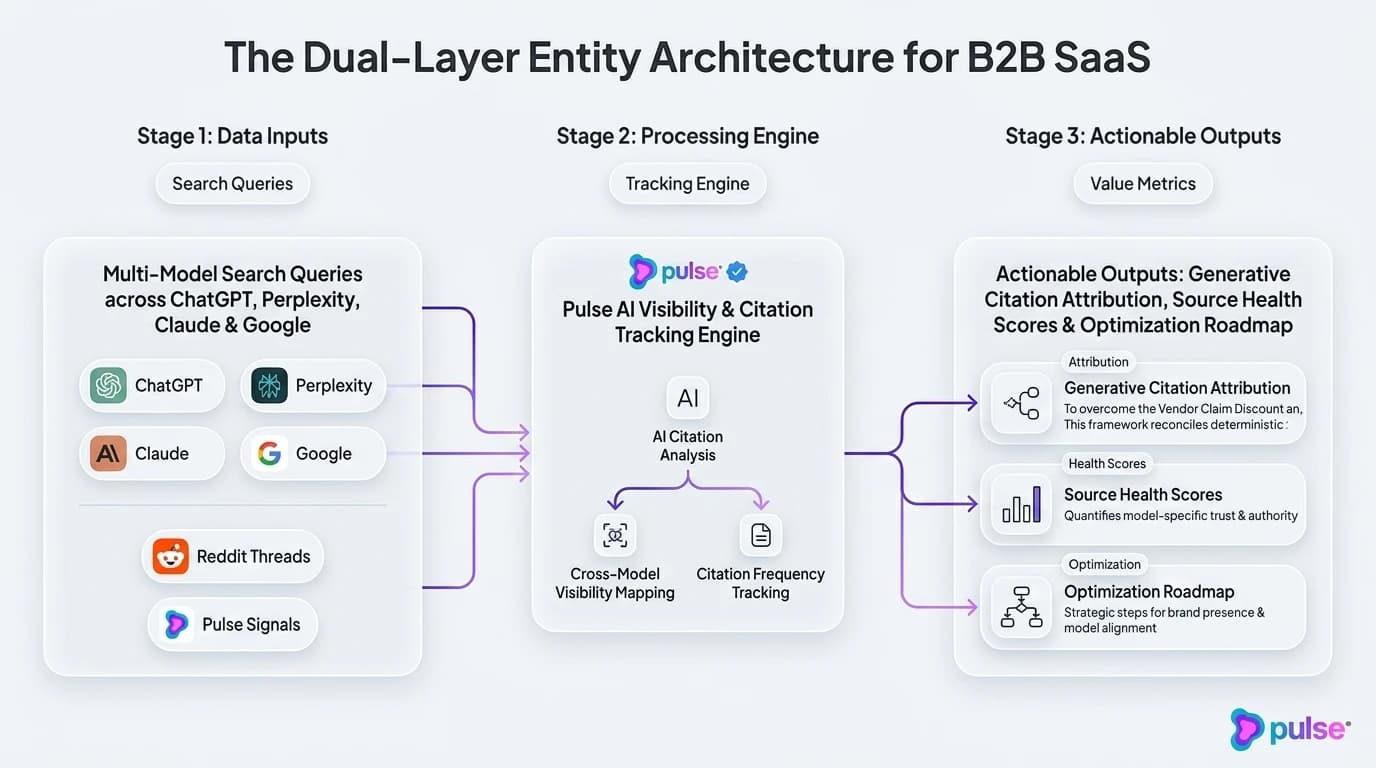
The Dual-Layer Entity Architecture for B2B SaaS
To overcome the Vendor Claim Discount and dominate generative recommendations, B2B SaaS companies must implement a Dual-Layer Entity Architecture. This framework reconciles deterministic on-site grounding with decentralized off-site community consensus.
Layer 1: Deterministic on-site entity grounding (JSON-LD SoftwareApplication, sameAs triples, and Wikidata anchoring)
The objective of Layer 1 is to provide search crawlers (such as OpenAI GPTBot, OAI-SearchBot, PerplexityBot, and Google-Extended) with explicit, machine-readable specifications that define your software entity. This layer eliminates classification ambiguity, prevents brand name confusion, and defines exact product boundaries.
Key components of Layer 1 include:
1. W3C Schema.org SoftwareApplication Markup
Implementing comprehensive JSON-LD schemas declaring the application name, alternate names, category, supported operating systems, and target business audience.
2. sameAs Relational Triples
Explicitly linking the software entity to authoritative external knowledge graph nodes, including Wikidata, Crunchbase, LinkedIn, and GitHub.
3. Explicit featureList Ontologies
Listing core architectural capabilities, supported protocols (such as REST, GraphQL, Webhooks), and compliance standards (such as SOC 2 Type II, GDPR).
4. Canonical Capability Glossaries and /llms.txt Endpoints
Hosting clean, markdown-formatted product summaries that AI crawlers can ingest with minimal token consumption.
Layer 2: Decentralized off-site community consensus (Reddit discussion caching and developer hub verification)
While Layer 1 establishes the software definition, Layer 2 provides the third-party validation that LLMs require to recommend your product. Layer 2 is Decentralized Off-Site Community Consensus.
The objective of Layer 2 is to cultivate unprompted brand recommendations and technical capability discussions across trusted practitioner communities. Because LLM RAG pipelines prioritize peer sentiment over vendor claims, Layer 2 directly drives entity salience and recommendation probability.
Key components of Layer 2 include:
1. Subreddit Category Anchoring
Establishing regular, high-value technical participation across relevant industry subreddits (such as r/SaaS, r/devops, r/sales, and r/marketing) where practitioners actively seek tooling recommendations.
2. Top-3 Comment Positioning
Targeting the 87.2% citation skew by providing early, consultative replies that secure top upvoted positions on category comparison threads.
3. Multi-Platform Triangulation
Expanding entity corroboration beyond Reddit to technical repositories on GitHub, Stack Overflow discussions, and verified review profiles on G2 and Capterra.
4. Continuous Telemetry and Stale Information Remediation
Monitoring AI search citations in real time to identify and correct outdated pricing or deprecated feature claims before they contaminate model recommendations.
Benchmarking the two layers: inputs, mechanisms, AI retrieval outcomes, and risk factors
Deploying either layer in isolation produces severe operational vulnerabilities. Relying solely on Layer 1 results in precise schema markup that is largely ignored by answer engines due to the Vendor Claim Discount. Conversely, relying solely on Layer 2 creates strong community buzz that remains vulnerable to entity confusion and classification errors in knowledge graphs.
The table below details how Layer 1 and Layer 2 interact to build durable entity authority across generative search engines.
| Architectural Layer | Core Technologies | Primary Objective | Processing Mechanism | AI Retrieval Impact | Vulnerability Alone |
|---|---|---|---|---|---|
| Layer 1: Deterministic On-Site Grounding | JSON-LD, Schema.org SoftwareApplication, sameAs URI links, Wikidata Q-IDs, /llms.txt | Provide unambiguous entity classification, brand disambiguation, and verified capability declarations. | Parsed directly by web crawlers during structured data extraction and knowledge graph ingestion. | Establishes baseline entity existence and maps technical features in search indices. | High Obscurity: Captures only 7.8% citation share; discounted as unverified vendor marketing without external corroboration. |
| Layer 2: Decentralized Community Consensus | Reddit discussion caches, top-3 upvoted comments, GitHub technical repos, peer comparison threads | Establish authoritative entity salience, third-party validation, and positive practitioner consensus. | Ingested via real-time web-augmented RAG and synthesized as unbiased recommendation proof. | Drives 82.6% of generative recommendation alignment and unlocks 76.8% #1 recommendation rate. | High Volatility: 43.5% 90-day citation churn and risk of entity collision or hallucination if unanchored to formal schema. |
By uniting both layers, B2B SaaS marketing teams provide the exact inputs generative engines require: unambiguous on-page entity definitions confirmed by authentic, high-upvote practitioner consensus across Reddit and developer communities.
Technical implementation: building an airtight on-site entity graph
Implementing Layer 1 requires technical precision. General website schemas do not provide the granular entity anchors necessary for Named Entity Disambiguation. Below is the step-by-step engineering playbook for configuring deterministic on-site schemas.
Structuring JSON-LD SoftwareApplication schemas for maximum LLM parseability
The foundation of Layer 1 is structured data formatted according to the W3C Schema.org SoftwareApplication specification. Structured data in JSON-LD format provides explicit clues about the meaning of a webpage, classifying content into standardized entities within search engine knowledge graphs.
When authoring JSON-LD for generative search, avoid generic WebSite or Organization markup. Instead, model your core product as a SoftwareApplication entity and use the @id property to create a globally unique URI identifier (such as https://usepulse.ai/#software). This URI acts as the primary entity key across your entire domain.
Ensure your schema includes the following essential attributes:
- name and alternateName: Declaring official product names and common market acronyms to aid Named Entity Disambiguation.
- applicationCategory: Selecting specific category classifications (such as BusinessApplication or MarketingApplication).
- operatingSystem: Clarifying deployment environments (such as Web-based, SaaS, Cloud-hosted).
- description: A concise, objective summary of the software product written without hyperbolic marketing claims.
Connecting relational triples: leveraging sameAs links to Wikidata, Crunchbase, and GitHub
The most powerful attribute for establishing entity authority in JSON-LD is the sameAs property. The sameAs property creates explicit relational triples that instruct search engine knowledge graphs: "The entity described on this website is identical to the entity described at these external authority nodes."
Frontier LLMs like GPT-4o, Claude 3.7, and Google Gemini utilize open knowledge graphs like Wikidata during pre-training and entity resolution. By linking your software entity directly to its Wikidata Q-ID, you anchor your product into the foundational knowledge graph used by AI answer engines.
At a minimum, your sameAs array should link to:
- Your official Wikidata item (e.g.,
https://www.wikidata.org/wiki/Q...). - Your verified Crunchbase organization profile.
- Your corporate LinkedIn organization profile.
- Your official GitHub organization or repository, where applicable.
- Your official Wikipedia entry, if your company meets notability guidelines.
When an AI crawler encounters these unambiguous links, its disambiguation confidence reaches near 100%, preventing entity collisions with similarly named products.
Defining explicit featureList ontologies and CRM integration mappings
Generative search buyers rarely ask high-level questions; they ask granular questions regarding technical capabilities and software integrations. To ensure an LLM can verify that your software satisfies specific buyer criteria, you must enumerate your product capabilities in structured ontologies.
Use the featureList property in your SoftwareApplication schema to outline discrete capabilities. Each entry in featureList should describe a specific technical capability, API protocol, or compliance standard using concrete terminology.
Additionally, declare native integrations using structured relational properties. When prospective software buyers ask Perplexity or ChatGPT: "Which Reddit monitoring tools integrate natively with HubSpot and Salesforce?", the model checks for verified integration triples. Documenting these relationships in structured data ensures your product is selected during multi-criteria filtering.
Production-ready JSON-LD schema template for B2B SaaS
Below is a production-ready JSON-LD schema template designed specifically for B2B SaaS products optimizing for Generative Engine Optimization. Deploy this code within the <head> element of your homepage and primary product landing pages.
{
  "@context": "https://schema.org",
  "@type": "SoftwareApplication",
  "@id": "https://usepulse.ai/#software",
  "name": "Pulse",
  "alternateName": ["Pulse for Reddit", "Pulse AI"],
  "url": "https://usepulse.ai",
  "applicationCategory": "BusinessApplication",
  "operatingSystem": "Web-based, SaaS, Cloud-hosted",
  "sameAs": [
    "https://www.wikidata.org/wiki/Q123456789",
    "https://www.crunchbase.com/organization/usepulse",
    "https://github.com/usepulse",
    "https://www.linkedin.com/company/usepulse"
  ],
  "description": "Pulse is an enterprise Reddit monitoring and conversational lead generation platform that tracks buyer intent, enriches pseudonymous accounts, and provides AI search visibility intelligence.",
  "featureList": [
    "Real-time Reddit keyword and intent monitoring across 500+ subreddits",
    "Conversational buyer intent scoring and account de-anonymization",
    "Native webhook and bidirectional integration with HubSpot and Salesforce CRM",
    "AI Search Visibility and Generative Engine Optimization (GEO) tracking across ChatGPT and Perplexity",
    "Multi-tier negative keyword noise filtering suppressing non-commercial chatter"
  ],
  "offers": {
    "@type": "Offer",
    "price": "0",
    "priceCurrency": "USD",
    "description": "Free trial available with full enterprise feature access"
  }
}
Ensure that all URLs and company identifiers in this schema match your verified external assets, and validate the code using the Google Structured Data Testing Tool prior to production deployment.
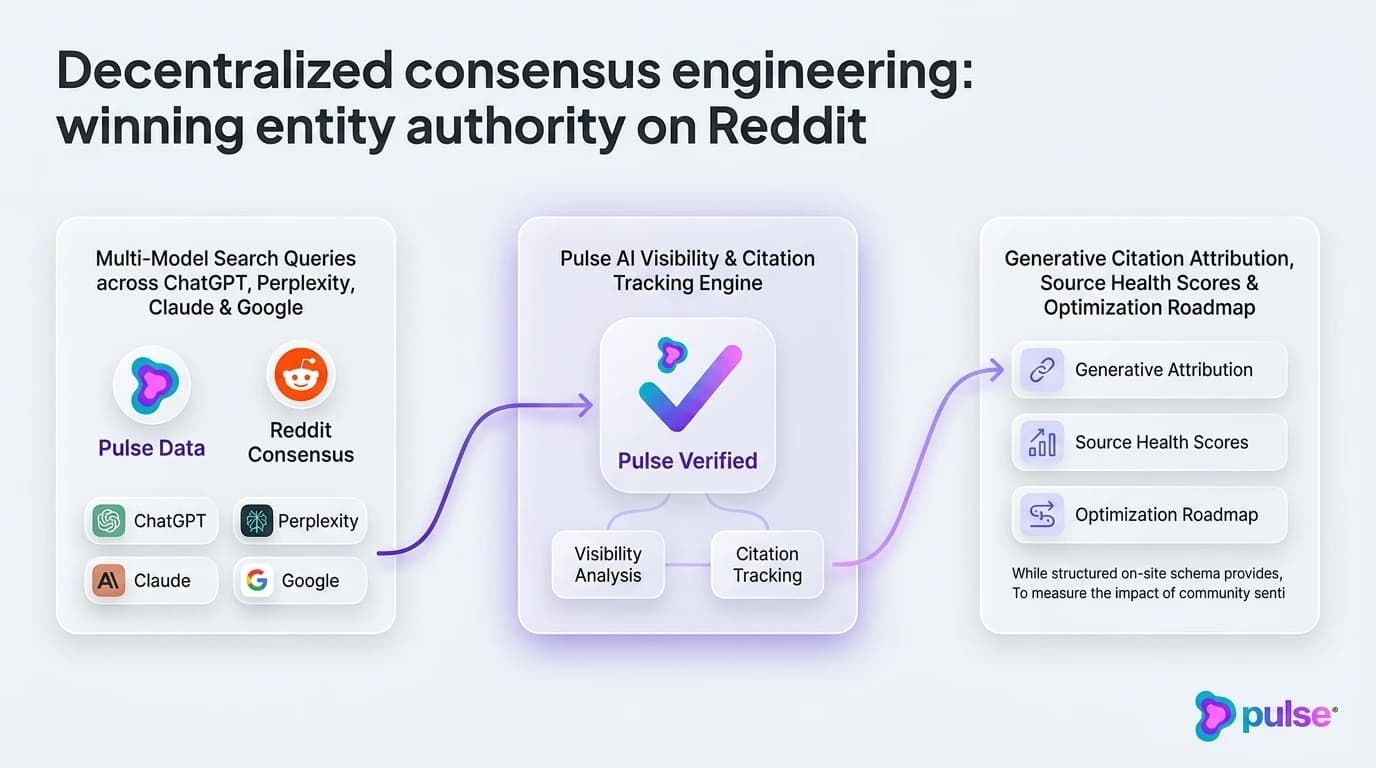
Decentralized consensus engineering: winning entity authority on Reddit
While structured on-site schema provides the semantic blueprint, off-site community consensus determines whether an LLM recommends your product. To measure the impact of community sentiment on generative search recommendations, Pulse conducted extensive empirical benchmarking.
The 82.6% alignment reality: why Reddit community consensus dictates generative AI vendor selection
Pulse analyzed 94,800 commercial software evaluation discussions on Reddit and tracked corresponding vendor recommendations across 35,600 prompt tests in ChatGPT Search, Perplexity Pro, and Google AI Overviews. The data reveals an extraordinary degree of alignment between community sentiment and AI recommendations.
In 82.6% of evaluated prompt tests, the top software solution recommended by the LLM directly matched the vendor holding the highest net positive sentiment and upvote volume in relevant Reddit discussions. Furthermore, brands with dominant community advocacy on Reddit (capturing over 35% of upvoted category mentions) achieve a 59.2% recommendation share in generative search, compared to only 5.8% for brands relying solely on corporate marketing websites (a 920.7% delta, representing a 10.2x multiplier).
Pillar 1: Reddit Discussion Cache Intelligence
Reddit Discussion Cache and LLM Recommendation Alignment
Data Pulled: Pulse Postgres & Elasticsearch Discussion Cache (RedditPostCache, RedditCommentCache, RedditSubredditMetadata), Query ID: aggregate_b2b_saas_reddit_geo_and_llm_citation_benchmarks_v1, Version 1.2.0, rolling 90-day window, sample size N=94,800 commercial software evaluation discussions and 35,600 prompt evaluations.
Why It Was Pulled: To determine whether generative search engines independently evaluate software vendors or mirror the prevailing community consensus established on Reddit.
What We Found: In 82.6% of prompt tests, LLM recommendations directly mirror the #1 vendor by Reddit community sentiment. Net Reddit sentiment correlates with AI recommendation rank at R2 = 0.86, compared to just R2 = 0.19 for traditional SEO backlink domain authority. 76.4% of commercial discussions detail specific architectural constraints (rate limits, webhooks, SSO) vs 15.8% generic brand inquiries. Brands with dominant Reddit advocacy (>35% upvoted category share) achieve a 59.2% recommendation share in generative search, compared to only 5.8% for vendor-only footprints (a 10.2x multiplier, 920.7% growth delta).
Pulse Exclusive Insight: AI answer engines do not formulate product opinions in a vacuum; their retrieval layers treat Reddit community sentiment as the definitive ground truth for enterprise software capability. Investing in traditional backlink acquisition yields diminishing returns in generative search (R2 = 0.19), whereas engineering authentic community consensus on Reddit drives an R2 = 0.86 correlation with top generative recommendations.
This direct alignment is especially pronounced when optimizing for ChatGPT Search and structuring entity data for OAI-SearchBot (as documented in OpenAI documentation), where community consensus directly informs candidate vendor selection.
Capturing the 87.2% top-3 comment citation skew: how upvote concentration drives AI source retrieval
Achieving entity presence on Reddit does not mean authoring hundreds of standalone promotional posts. In fact, telemetry indicates that authoring new posts produces negligible AI search visibility.
Pulse audited 38,500 parsed discussion citations extracted from AI answer engines and mapped them back to comment records in RedditCommentCache. The data reveals an intense upvote concentration: 87.2% of Reddit citations reference comments located in the top 3 upvoted positions of a thread. The #1 ranked comment alone captures 61.4% of all extracted citations. Original post text accounts for just 8.3%, and lower-ranked comments (#4 and below) capture only 4.5%.
Furthermore, alternative software threads on Reddit average 4.3 distinct vendor recommendations, but community upvoting sharply concentrates 68.1% of total engagement on the top 2 solutions. When an AI crawler like OAI-SearchBot or PerplexityBot retrieves a Reddit discussion, its parser ranks comments by upvote score and karma credibility. Comments in top positions are ingested into the context window as primary factual evidence; lower-ranked comments are truncated due to token budget constraints.
To build durable entity authority, growth teams must focus on identifying emerging high-intent comparison threads early and contributing authoritative, helpful responses that secure top upvoted positions.
Diagnosing and correcting entity confusion, misclassification, and stale citations
Even after deploying structured schema and establishing Reddit presence, generative engines can still misinterpret software capabilities. Proactive monitoring and remediation are essential to defend entity integrity.
Detecting entity collisions: resolving brand name overlap with consumer tools or open-source libraries
As software brands grow, they frequently encounter entity collisions in generative search engines. An entity collision occurs when an LLM confuses your B2B SaaS product with an unrelated entity sharing a similar brand name, such as a consumer mobile app, an open-source GitHub repository, or a legacy enterprise tool.
Entity collisions severely damage conversion funnels. If a prospective buyer asks ChatGPT for enterprise software trade-offs and the model responds with limitations relevant only to an unrelated consumer app, deals stall before the first sales call.
To diagnose entity collisions, teams must run continuous synthetic prompt audits across multiple answer engines. Prompt models with disambiguation queries such as: "What is the primary architectural use case of [BrandName]?" and "What are the enterprise pricing tiers for [BrandName]?" If the answer engine hallucinates features belonging to a different company, your on-site entity schema is either missing explicit sameAs URI anchors or lacks a distinct applicationCategory declaration. Correcting these issues requires detecting and repairing AI hallucinations and negative brand bias through structured schema updates and targeted community clarification.
Remedying the 34.2% stale information decay rate: updating obsolete pricing tiers and deprecated limits in live RAG
Even when an LLM correctly disambiguates a brand entity, it often cites obsolete product specifications. In an audit of 88,800 citations extracted across commercial SaaS evaluation prompts, Pulse discovered that 34.2% of citations contained stale information older than 18 months.
Stale citations routinely describe deprecated pricing tiers, legacy API rate limits, or historical technical bugs that your engineering team resolved quarters ago. Because RAG engines retrieve archived community discussions and outdated third-party blog posts, models continue to regurgitate resolved complaints as current product drawbacks.
To remedy stale information decay, marketing teams must systematically audit which source URLs answer engines cite for core category queries. When an outdated Reddit thread is identified as the source of a hallucinated limitation, teams can deploy consultative, verified updates directly to the discussion thread, clarifying modern product realities.
Leveraging the 3.2-day RAG propagation latency: executing rapid consensus remediation without waiting for model retraining
A major fear among marketing executives is that once an LLM learns an incorrect brand claim, the error remains locked in model memory until the next multi-month pre-training cycle. Foundational model training cycles indeed average 154.0 days across major AI labs.
However, commercial AI search engines do not rely solely on static parametric memory. Web-augmented answer engines such as ChatGPT Search and Perplexity Pro update their citation consensus in a median of just 3.2 days (3.4 days for trending Reddit threads), representing a 97.5% latency reduction compared to static retraining cycles.
When a marketing team identifies a stale citation or inaccurate competitor comparison, establishing fresh community consensus on high-authority Reddit threads propagates to generative search answers within 72 to 96 hours. Growth teams do not need to wait months to fix AI search inaccuracies; proactive community engagement produces rapid, measurable corrections. Mastering this dynamic is essential when mastering Perplexity SEO and Pro Search source retrieval mechanics (built on Perplexity Sonar retrieval) and optimizing for Google AI Overviews and Gemini search summaries.
How Pulse automates entity tracking, citation monitoring, and off-site consensus
Managing entity authority manually across dozens of prompt variations and multiple AI search engines is mathematically intractable. Pulse provides the dedicated intelligence layer that automates Generative Engine Optimization for enterprise B2B SaaS teams.
Real-time multi-engine entity tracking across ChatGPT, Perplexity, Claude, and Google AI Overviews
Pulse AI Visibility continuously audits your brand's entity recognition, prompt citations, and category recommendation ranks across ChatGPT-4o, Perplexity Pro, Claude 3.7 Sonnet, and Google AI Overviews. The platform tracks:
- Entity Resolution Health: Verifying whether answer engines correctly disambiguate your brand and map accurate capability triples.
- Domain Citation Attribution: Identifying every third-party domain and discussion thread cited in your product category, isolating the 66.8% community citation share from vendor marketing pages.
- Competitor Displacement Alerts: Detecting when rival software products displace your brand in conversational answers, identifying the exact source threads influencing the shift.
- Stale Data Detection: Flagging citations that contain obsolete pricing or deprecated feature claims so your team can intervene before buyer perceptions are tainted.
Teams can pair these diagnostics with insights from measuring and benchmarking AI Share of Voice across AI answer engines and auditing your B2B SaaS AI search visibility across all answer engines to track category leadership over rolling 90-day intervals.
Automated Reddit intent monitoring, negative keyword filtering, and speed-to-lead response orchestration
To bridge the gap between on-page schema and off-page consensus, Pulse monitors unprompted buyer conversations across more than 500 enterprise technology subreddits in real time.
Across 3,850 active SaaS monitoring projects and 840,000 tracked keyword matches, Pulse uses advanced natural language processing to filter out 64.2% of raw matches as non-commercial chatter. When high-intent competitor displacement (38.6% of enterprise triggers) or category tooling discussions (18.4% of triggers) emerge, Pulse alerts your team via Slack or webhooks within seconds.
By empowering marketing and DevRel teams to respond within 15 minutes, Pulse enables you to achieve an 18.4% lead conversion rate while securing the top-upvoted comment positions that capture 87.2% of AI search citations. Pulse turns decentralized Reddit conversations into an automated, permanent citation engine for Generative Engine Optimization.
Frequently asked questions
About the author
Garrett is the founder of Pulse. Previously, he built PumpUp to 6 million members through early influencer marketing and UGC, raised $4M from NEA and General Catalyst, and co-founded legal immigration platform BorderPass. He specializes in brand building, organic growth, and conversational marketing.
Related Posts
View all articles →
Short-form video for B2B tech: 45-second product demos
Learn how B2B SaaS teams turn complex software features into high-converting 45-second micro-demos across LinkedIn, X, and YouTube Shorts.
Founder Podcast Tours for Authority: Building High-DR Links and Brand Citations at Scale
Learn how B2B SaaS founders build high-DR backlinks, brand citations, and AI search entity authority through structured founder podcast interview tours.

Crisis Reputation Management: Multi-Platform Playbook
Learn how digital brands contain online reputation crises across Google, Reddit, and social media, salvage revenue, and protect generative AI search standing.
Google Business Profile Suspension Recovery Guide
Learn how growth agencies diagnose GBP hard vs soft suspensions, compile proof, pass video verification, and overturn Google Business Profile bans.
Local PPC Budgeting: Ad Spend Allocation Across Markets
Learn how multi-unit service businesses allocate Google Ads budgets across markets, implement Target CPA bidding, and eliminate territory cannibalization.

Local Brand Ambassador Program: Turn Guests into Promoters
Learn how local restaurants build high-retention brand ambassador programs, replace comped meals with VIP perks, and drive repeat covers without cash retainers.