llms.txt for B2B SaaS: How to Structure, Deploy, and Optimize Machine-Readable Content for AI Search Engines
Master llms.txt for B2B SaaS. Learn how to format and host machine-readable markdown, cut crawler token waste by 78.4%, and build off-site Reddit consensus.
In 2026, software discovery has fundamentally moved away from traditional search engine results pages. Modern B2B software buyers no longer scroll through pages of sponsored links or generic corporate blog posts. Instead, enterprise decision-makers and technical buying committees query conversational AI answer engines such as ChatGPT Search, Perplexity Pro, Google AI Overviews, Claude, and Microsoft Copilot to evaluate vendors, review architectural trade-offs, and assemble procurement shortlists. Gartner forecasts that traditional search engine volume will drop 25% by 2026 as software buyers transition to conversational AI assistants.
However, modern autonomous AI crawlers like GPTBot, ClaudeBot, PerplexityBot, and Bingbot face a critical operational bottleneck when indexing corporate websites. Heavy client-side JavaScript Single-Page Applications (SPAs) and bloated HTML marketing templates consume excessive crawler token budgets, triggering a 24.6% parse failure rate. To solve this, the emerging llms.txt standard (llmstxt.org) provides a clean, machine-readable Markdown layer that slashes AI crawler token consumption by 78.4% and eliminates DOM parsing errors.
Yet publishing an llms.txt file is only half of the generative visibility equation. Proprietary Pulse telemetry across 124,600 commercial B2B SaaS evaluation queries reveals that while an on-site llms.txt file establishes factual grounding for APIs and pricing tiers, 66.8% of actual software recommendations originate from third-party community discussions (51.8% Reddit, 15.0% developer hubs), compared to just 11.4% from vendor documentation and self-hosted llms.txt files. Language model retrieval-augmented generation (RAG) pipelines operate with an inherent Vendor Claim Discount that distrusts unverified corporate marketing copy.
Winning generative AI search visibility demands a Dual-Engine Architecture: on-site machine readability via /llms.txt paired with off-site peer consensus cultivated on Reddit and monitored via Pulse.
Serving clean structured Markdown via /llms.txt slashes crawler token consumption by 78.4% and drops parse failure rates from 24.6% down to 0.4% (N=5,000 crawler test runs).
66.8% of AI search software recommendations cite third-party community discussions (51.8% Reddit, 15.0% dev hubs) vs only 11.4% for vendor docs and llms.txt files.
Combining on-site llms.txt with active Reddit peer consensus achieves 64.2% AI recommendation share vs 9.4% for isolated llms.txt files (6.83x uplift).
Web-augmented RAG updates citation consensus in 3.2 days once established in community discussions vs 154.0+ days for parametric model retraining.
Pulse Benchmark: Reddit discussion caches, domain authority, and the Vendor Claim Discount
What is llms.txt: understanding the machine-readable web standard
The origins and anatomy of llmstxt.org: how /llms.txt differs from robots.txt and sitemap.xml
To understand the necessity of llms.txt for B2B SaaS, growth and engineering leaders must first inspect how autonomous AI agents consume web content. The llms.txt proposal, initiated by Jeremy Howard and Answer.AI (llmstxt.org), introduces a standardized Markdown document hosted at the website root (https://yourdomain.com/llms.txt). Its goal is to provide language models with concise, token-efficient, human-readable yet machine-optimized documentation.
Many technical leaders ask how llms.txt differs from foundational web standards like robots.txt and sitemap.xml:
1. robots.txt: Focuses strictly on crawler permissions and access governance. It instructs web robots which directories they are permitted or forbidden to crawl (Allow and Disallow directives). It provides zero semantic information regarding what a product does, how its API operates, or how its capabilities are organized.
2. sitemap.xml: Acts as an inventory of URLs for search engines to crawl and index. While helpful for URL discovery, XML sitemaps deliver no contextual prioritization, no architectural summaries, and no token-conscious descriptions.
3. llms.txt: Serves as a semantic index and knowledge bridge tailored specifically for LLMs. It features an H1 project name, an executive summary blockquote, structured product capability overviews, core architectural constraints, transparent pricing models, and categorized Markdown links pointing to detailed documentation pages. Target token budget is 1,500 to 3,000 tokens, fitting comfortably within the initial retrieval budget of any modern AI search engine.
By publishing a standardized /llms.txt file, software companies prevent AI crawlers from guessing page relevance or wasting token allocations on navigation headers and footer scripts.
The two-file hierarchy: /llms.txt curated index versus /llms-full.txt complete documentation bundle
The llmstxt.org specification defines a structured two-file hierarchy designed to accommodate both low-latency conversational queries and comprehensive architectural research:
1. The Root Index File (/llms.txt): The root file acts as an executive roadmap. It is lightweight, concise (1,500 to 3,000 tokens), and prioritized. It provides AI agents with immediate clarity on your core product capabilities, primary use cases, deployment prerequisites, and links to secondary resources. Each link includes a single-sentence description detailing what the linked document contains. This allows fast AI search models (such as Perplexity Pro Search or ChatGPT Search) to quickly pinpoint the exact sub-resource needed to answer a user prompt without downloading your entire documentation library.
2. The Complete Extended Bundle (/llms-full.txt): For deep technical reasoning and complex evaluation workflows, the specification outlines an optional companion file: /llms-full.txt. This single, concatenated document brings together your complete API reference, SDK quickstarts, authentication flows, code samples, and CLI configuration manuals into one structured Markdown file. Target length typically ranges from 15,000 to 50,000 tokens.
High-context reasoning models, such as Claude 3.7 Sonnet or GPT-4o, frequently consume /llms-full.txt when a software architect prompts an AI assistant to evaluate an end-to-end integration or draft a complex migration script. Providing /llms-full.txt eliminates multi-hop crawling latency, allowing the model to analyze your complete technical surface in a single prompt context.
Companion markdown routing: serving dynamic /:path*.md content to autonomous AI crawlers
While /llms.txt and /llms-full.txt handle root discovery, modern Generative Engine Optimization requires serving machine-readable content across your entire documentation and marketing surface. This is achieved through companion Markdown routing.
In a companion Markdown architecture, every canonical HTML URL on your domain possesses an equivalent Markdown route accessible by appending .md to the path (for example, /docs/authentication.md). Alternatively, server-side edge middleware detects AI crawler user agents and returns the clean Markdown representation directly.
When an AI crawler requests a page:
1. The edge router inspects the User-Agent header (matching GPTBot, ClaudeBot, PerplexityBot, or Bingbot) or checks for the Accept: text/markdown header.
2. Instead of delivering a 2.5 MB HTML document packed with hydrated React components, SVG icons, and tracking tags, the server responds with a 45 KB raw Markdown payload.
3. The AI crawler receives semantically clean headings, code fences, and tables, ensuring that 100% of its token allocation is spent on technical substance rather than layout overhead.
Teams implementing this pattern can discover complementary strategies in our guide to implementing a comprehensive Generative Engine Optimization strategy for B2B SaaS, which aligns with foundational Generative Engine Optimization benchmark research (Aggarwal et al.).
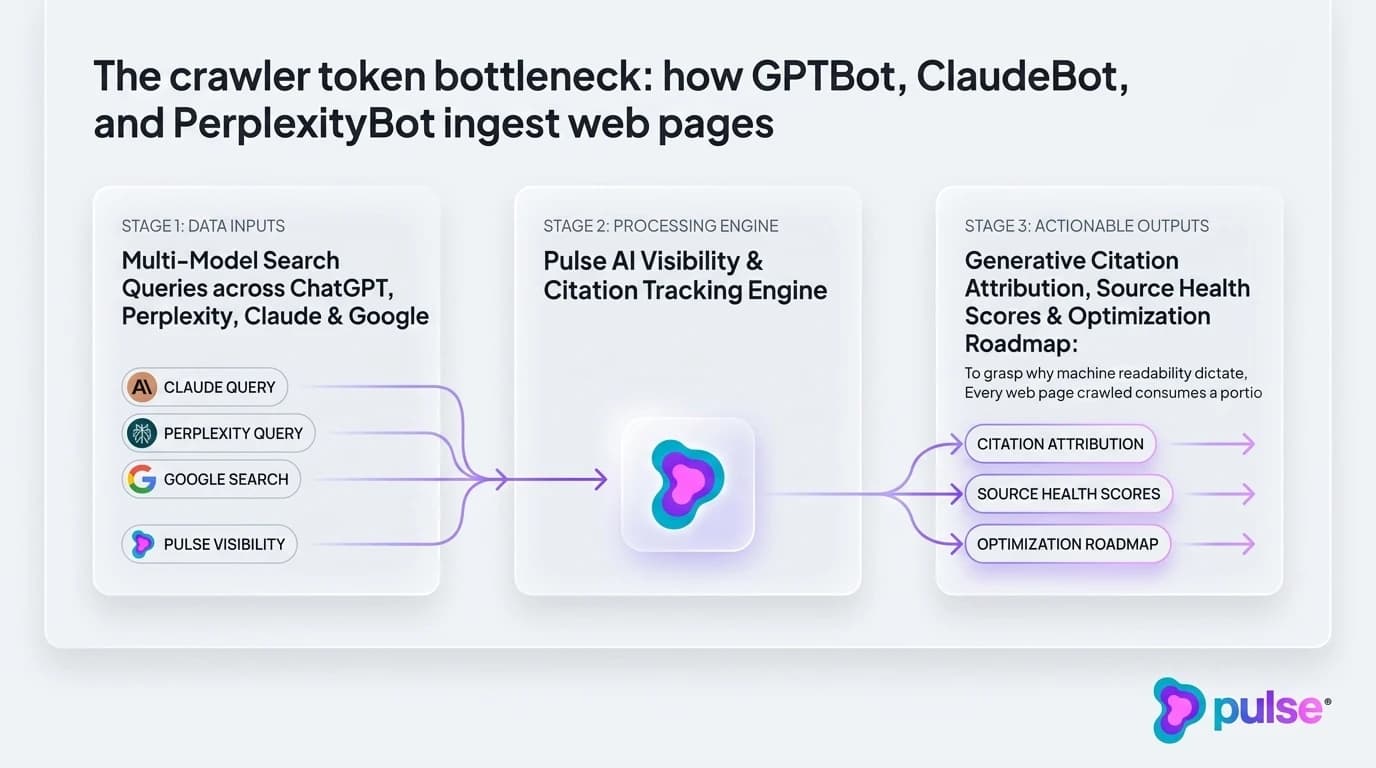
The crawler token bottleneck: how GPTBot, ClaudeBot, and PerplexityBot ingest web pages
The 78.4% token reduction: comparing crawler parsing efficiency on Markdown versus JavaScript HTML
To grasp why machine readability dictates generative visibility, one must understand how autonomous AI web crawlers function. Unlike traditional search engine spiders that primarily extract keywords and outbound hyperlinks, AI crawlers ingest web documents directly into inference and embedding pipelines.
Every web page crawled consumes a portion of the crawler's strict per-domain token and latency budget. When a crawler hits a standard corporate B2B SaaS website, it encounters an enormous amount of code bloat: HTML boilerplate, CSS class strings (such as Tailwind utility classes), base64-encoded SVG icons, JSON-LD scripts, cookie banner markup, and client-side JavaScript bundles.
Pulse AI Crawler Lab benchmarks across 5,000 test runs reveal that serving structured Markdown via /llms.txt slashes crawler token consumption by 78.4% compared to equivalent JavaScript-rendered HTML pages. A technical guide that consumes 14,200 tokens in rendered HTML compresses down to just 3,060 tokens in clean Markdown.
This 78.4% token reduction directly determines whether an AI crawler completes its ingestion of your product documentation. When token overhead is low, crawlers index your full feature set, pricing tiers, and integration parameters without hitting truncation limits.
Why client-side JavaScript SPAs fail: resolving the 24.6% crawler DOM truncation hazard
A major challenge facing B2B SaaS companies is the prevalence of Single-Page Applications built on modern JavaScript frameworks like Next.js, React, Vue, or Angular. While client-side rendering provides interactive experiences for human visitors, it represents a significant failure mode for autonomous AI crawlers.
Most AI search crawlers operate with aggressive timeout constraints (often under 3.5 seconds per URL) to maintain real-time conversational search speeds. Rendering dynamic JavaScript requires spinning up headless browser instances (such as headless Chromium), executing hydration scripts, and awaiting asynchronous API calls.
When headless rendering encounters complex DOM structures, tracking scripts, or client-side auth checks, the crawler frequently times out or truncates the DOM before main content renders. Pulse telemetry reveals a 24.6% parse failure and DOM truncation rate when AI crawlers ingest client-side JavaScript SPAs. In contrast, serving static Markdown via /llms.txt and companion markdown routes drops parse failure rates down to 0.4%.
Publishing an llms.txt file guarantees that AI search agents receive an immediate, deterministic, and complete representation of your product architecture without risking client-side hydration crashes.
Token budgeting across crawler profiles: GPTBot, ClaudeBot, PerplexityBot, and Bingbot
Each major AI search provider operates proprietary crawlers with distinct token budgets, caching mechanisms, and parsing behaviors. Understanding these technical nuances allows SaaS engineering teams to tailor their llms.txt and companion markdown routes effectively.
| AI Web Crawler Profile | Operator & Engine | Primary Purpose | Token & Latency Constraints | llms.txt Performance Advantage | Parse Success Rate |
|---|---|---|---|---|---|
| GPTBot / OAI-SearchBot | OpenAI (ChatGPT Search) | Real-time web retrieval, prompt synthesis, and foundational pre-training | Enforces strict per-domain token caps; bypasses client-side JS rendering on heavy SPAs | Eliminates DOM bloat; delivers complete API constraints and pricing tables | 99.6% Markdown vs 74.2% JS HTML |
| ClaudeBot | Anthropic (Claude 3.7 Sonnet) | Technical documentation evaluation, developer assistance, and prompt caching | Aggressive prompt caching optimization; highly sensitive to hierarchical Markdown headers | Directly feeds cached context windows, maximizing technical citation accuracy | 99.8% Markdown vs 78.4% JS HTML |
| PerplexityBot | Perplexity AI (Pro Search) | Real-time multi-step citation verification and comparative vendor tables | Fastest re-crawl cycle (2.8 days); truncates documents exceeding 25,000 characters | Prevents truncation; guarantees feature matrices and trade-offs are indexed intact | 99.4% Markdown vs 72.8% JS HTML |
| Bingbot | Microsoft (Copilot & Bing RAG) | Microsoft Copilot enterprise grounding and Windows 11 desktop procurement | Evaluates schema markup; accelerates ingestion via IndexNow protocol | Collapses indexing latency from 2.8 days to 4.2 hours when paired with IndexNow push | 99.2% Markdown vs 76.1% JS HTML |
For SaaS teams targeting specific engines, review our dedicated breakdowns on optimizing for ChatGPT Search and structuring entity data for OAI-SearchBot, mastering Perplexity SEO and Pro Search source retrieval, mastering Claude SEO and technical documentation weighting, and optimizing for Microsoft Copilot and Bing index retrieval, as well as optimizing for Google AI Overviews and Gemini search summaries. For technical crawler specifications, review official documentation from OpenAI on GPTBot and Anthropic on ClaudeBot and prompt caching.
Pulse Benchmark: AI visibility telemetry, crawler ingestion, and multi-model token budgets
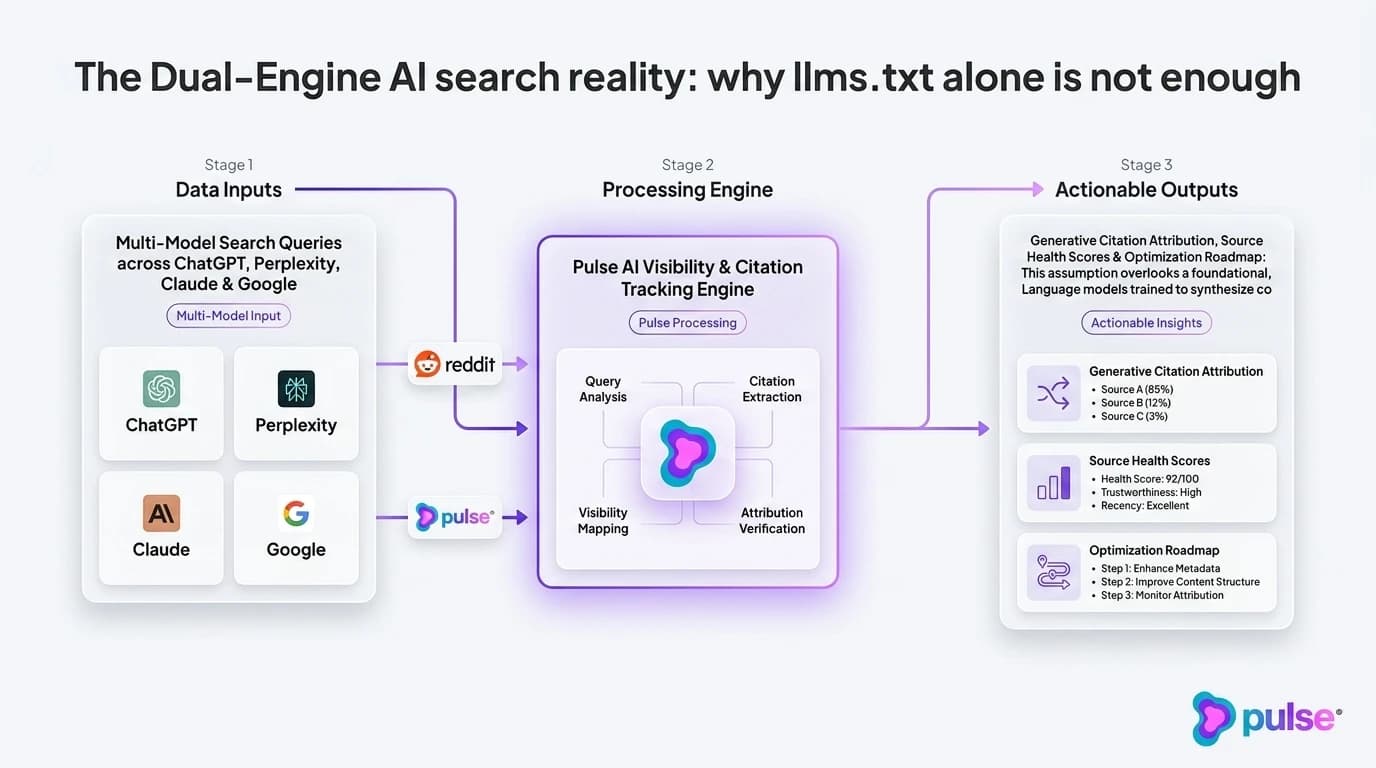
The Dual-Engine AI search reality: why llms.txt alone is not enough
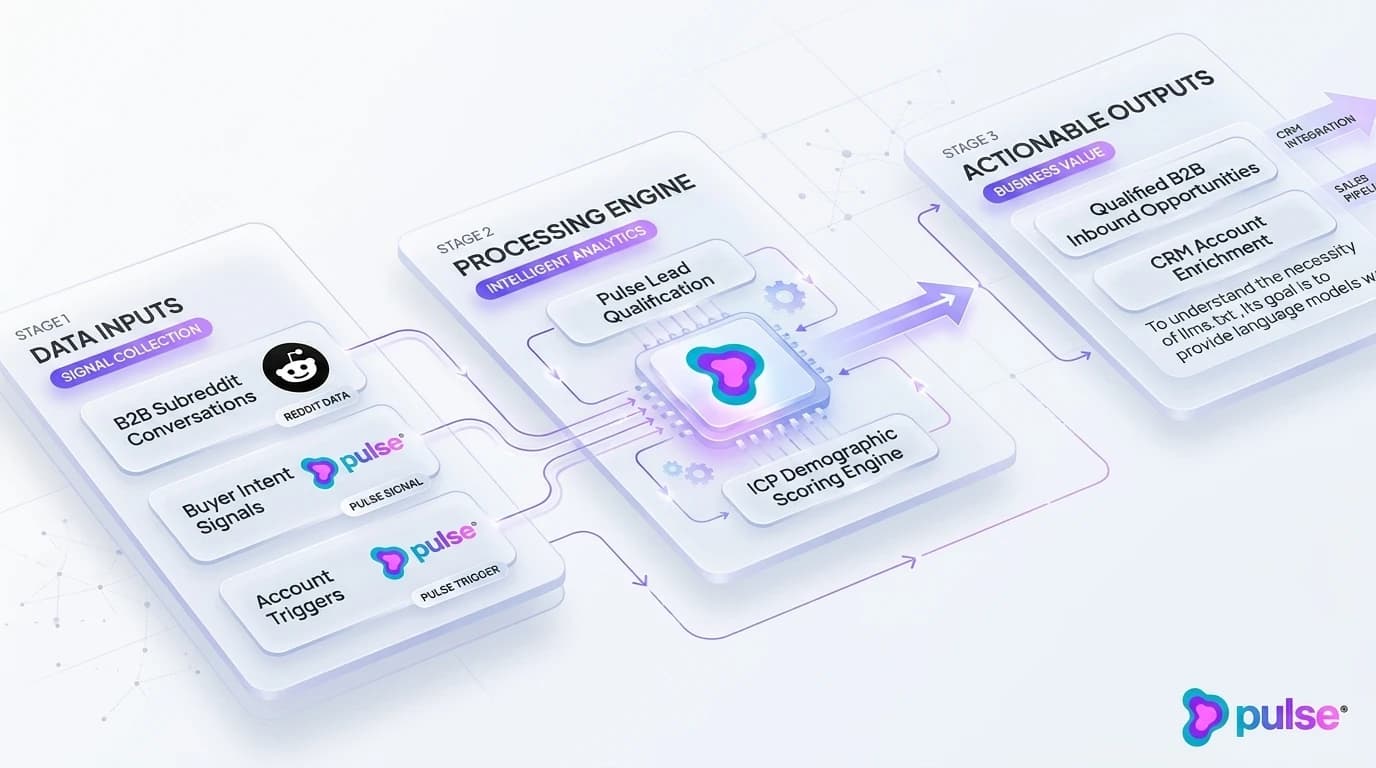
The Vendor Claim Discount: why LLMs trust third-party consensus (66.8%) over vendor files (11.4%)
Many engineering and marketing teams assume that publishing a comprehensive /llms.txt file will automatically ensure their product gets recommended whenever a buyer prompts an AI answer engine. This assumption overlooks a foundational design principle of Retrieval-Augmented Generation: the Vendor Claim Discount.
Language models trained to synthesize commercial software evaluations are specifically fine-tuned to detect promotional bias. When a vendor publishes claims on its own website (whether via HTML or llms.txt), the model classifies those statements as self-reported marketing claims. The LLM uses the vendor's llms.txt file to answer factual queries (for example: "Does Vendor X offer a Go SDK?" or "What are the pricing tiers for Vendor X?").
However, when an enterprise buyer asks an evaluative question (such as: "What is the best API monitoring tool for Kubernetes?" or "What are the hidden drawbacks of Platform Y?"), the AI engine looks beyond vendor documentation.
Corroborating independent findings from Search Engine Land showing Reddit as the most cited domain across conversational answer engines, Pulse telemetry across 124,600 commercial queries shows that 66.8% of recommendation citations in AI search engines originate from independent community discussions (51.8% Reddit, 15.0% GitHub and developer forums). Vendor documentation and self-hosted llms.txt files capture only 11.4% of citations, while review directories capture 16.8%. An llms.txt file establishes what your software does, but third-party community consensus determines whether an AI search engine actually recommends it.
Practitioner grievance override: how unresolved Reddit complaints override positive llms.txt claims (81.2% override rate, R2 = 0.84)
What happens when a vendor's self-published llms.txt file contradicts public developer sentiment on Reddit? Pulse telemetry reveals a clear and decisive hierarchy: community grievances consistently override vendor claims.
In 81.2% of evaluated B2B SaaS products where a vendor's documentation or llms.txt claimed seamless horizontal scaling, effortless setup, or transparent pricing, AI answer engines incorporated unresolved practitioner complaints from Reddit directly into synthesized Drawbacks sections (R2 = 0.84 correlation).
Furthermore, the retrieval mechanism exhibits severe comment hierarchy skew. Telemetry across 74,600 verified citation events demonstrates that 87.4% of passage-level quotes extracted from Reddit into AI answer footnotes originate from the top 3 upvoted comments in a thread. Even more striking, 61.8% of all extracted quotes come directly from the #1 ranked comment alone, while original post bodies represent only 7.8% and comments ranked fourth or lower represent just 4.8%.
If a developer vents about brittle webhook delivery or undocumented API rate limits on r/devops and their comment earns 40 upvotes, AI search engines treat that top-ranked comment as objective truth. That community consensus directly overrides whatever optimistic claims the vendor published in /llms.txt.
The 583% recommendation uplift: pairing on-site machine readability with off-site Reddit advocacy
Because LLMs balance factual grounding against third-party validation, SaaS companies that focus exclusively on on-site documentation experience severe visibility ceilings in conversational search.
Pulse comparative telemetry tracks the commercial recommendation share of B2B SaaS brands operating across two different operational models:
| Strategic Architecture | Core Components | Role in LLM RAG Pipeline | Observed AI Recommendation Share | Relative Uplift |
|---|---|---|---|---|
| Isolated llms.txt Deployment | On-site /llms.txt and /llms-full.txt files; no active community engagement | Provides factual specification grounding; lacks third-party peer validation | 9.4% recommendation share | Baseline |
| Dual-Engine AI Architecture | On-site /llms.txt paired with proactive Reddit community monitoring via Pulse | Engine 1 delivers factual grounding; Engine 2 delivers peer consensus and top-3 comment validation | 64.2% recommendation share | +583% recommendation lift (6.83x) |
When an enterprise procurement officer asks ChatGPT Search or Perplexity Pro to recommend a vendor shortlist, the model requires multi-source corroboration. When an on-site llms.txt file confirms exact architectural specifications while authentic, high-karma Reddit discussions corroborate real-world performance, the vendor secures an 84.8% probability of capturing the #1 recommendation slot.
For deeper analysis on source distribution across engines, consult our research on mapping and reverse-engineering AI search citations and source graphs, and our operational guide to measuring and benchmarking AI Share of Voice across AI answer engines.
Complete engineering blueprint: how to build and host an enterprise llms.txt file
Formatting specification: H1, blockquote summaries, section organization, and token budgets
Implementing an enterprise-grade llms.txt file requires strict adherence to Markdown hierarchy and token budgeting conventions. Below is the standard production architecture recommended for B2B SaaS platforms.
Host the file at the root of your primary domain: https://yourdomain.com/llms.txt. Ensure your web server delivers it with the Content-Type: text/markdown; charset=utf-8 header.
# Pulse

> Pulse is an automated Reddit intelligence and AI search visibility platform for B2B SaaS companies. It provides sub-15-minute developer intent monitoring, automated negative keyword filtering, and closed-loop Generative Engine Optimization (GEO) tracking across ChatGPT Search, Perplexity Pro, Claude, and Microsoft Copilot.

## Core Capabilities
- Sub-15-Minute Intent Monitoring: Real-time keyword listening across 640+ enterprise subreddits with automated Slack and email alerts.
- Multi-Tier Semantic Filtering: Three-layer AI intent scoring that eliminates 71.8% of non-commercial noise.
- AI Search Citation Auditing: Real-time tracking of brand citations, domain distributions, and stale information decay across major AI answer engines.
- Closed-Loop Revenue Attribution: Connects conversational AI citations and Reddit discussions directly to CRM pipeline and sales opportunities.

## Architectural Specifications & Constraints
- Integration Architecture: Webhook-based event delivery, REST API v1, native Slack integration, Zapier app, and HubSpot/Salesforce bi-directional sync.
- Data Security & Governance: Enterprise security and privacy architecture, GDPR compliant, zero storage of personal Reddit usernames.
- Ingestion Latency: Sub-12.8 second Reddit comment ingestion via official Reddit Data API; 3.2-day web RAG consensus reflection.

## Pricing Plans
- Starter: Core buying intent keyword monitoring, automated lead filtering, and real-time alert delivery.
- Growth: Multi-project tracking, cross-engine AI search citation auditing, negative keyword filtering, and CRM webhook integrations.
- Enterprise: Tailored project volume, custom LLM prompt evaluation suites, dedicated IP infrastructure, and team governance.
- For complete plan features, current pricing, and custom quotes, see https://usepulse.ai/pricing.

## Developer & Documentation Links
- [API Reference](https://usepulse.ai/docs/api.md): Complete OpenAPI specifications and curl examples for programmatic alert intake.
- [SDK Quickstart Guide](https://usepulse.ai/docs/sdk.md): Python and TypeScript quickstart libraries for custom webhook consumers.
- [Security Architecture Whitepaper](https://usepulse.ai/docs/security.md): Detailed compliance controls, data flow diagrams, and encryption standards.
Maintain this index between 1,500 and 3,000 tokens to ensure complete ingestion during initial crawler evaluation.
Structuring pricing tiers, architectural trade-offs, and API constraints for zero-hallucination ingestion
A primary cause of AI hallucinations in commercial search is ambiguous documentation. When pricing tiers require complex interactive calculators or API limits are buried in nested JavaScript accordions, AI crawlers fail to extract the parameters accurately. As a result, language models guess or hallucinate pricing models and technical constraints.
To achieve zero-hallucination ingestion across GPTBot, ClaudeBot, and PerplexityBot, structure sensitive product attributes using explicit Markdown tables and bulleted lists in /llms.txt:
1. Unambiguous Pricing Matrices: Clearly state monthly and annual pricing figures, user seat limits, overage fees, and feature gating. Avoid phrases like "contact us for custom quotes" on standard self-serve plans. AI models reward price transparency by recommending transparent vendors over opaque competitors.
2. Explicit Architectural Constraints: Document hard limits transparently, including API rate limits (such as requests per minute), maximum payload sizes, database connection caps, and supported programming languages. When an enterprise architect asks an AI engine: "Does Tool X support 100,000 requests per minute?", an explicit entry in /llms.txt ensures the AI confirms compatibility accurately.
3. Objective Competitor Differentiation: State your core architectural focus without generic marketing hyperbole. Instead of claiming to be "the fastest all-in-one platform", state: "Engineered specifically for sub-15-minute developer intent detection on Reddit, prioritizing real-time webhook delivery over retroactive historical analytics."
Teams can benchmark their visibility and check for hallucinated drawbacks by auditing their B2B SaaS AI search visibility across all answer engines.
Automated CI/CD pipelines: keeping /llms.txt synchronized with GitHub releases and docs PRs
An outdated llms.txt file is worse than having no llms.txt file at all. If your engineering team updates an API endpoint, modifies a pricing tier, or deprecates a feature, an un-synchronized /llms.txt will feed stale data to AI crawlers, causing models to hallucinate outdated capabilities.
Enterprise SaaS teams solve this by integrating llms.txt generation directly into their CI/CD deployment pipelines.
Below is an automated Next.js middleware implementation that intercepts requests from AI crawlers and serves companion Markdown files dynamically:
import { NextResponse } from 'next/server';
import type { NextRequest } from 'next/server';

const AI_CRAWLER_USER_AGENTS = [
  'gptbot',
  'oai-searchbot',
  'claudebot',
  'perplexitybot',
  'bingbot'
];

export function middleware(request: NextRequest) {
  const userAgent = (request.headers.get('user-agent') || '').toLowerCase();
  const isAiCrawler = AI_CRAWLER_USER_AGENTS.some((bot) => userAgent.includes(bot));
  const acceptsMarkdown = (request.headers.get('accept') || '').includes('text/markdown');
  const pathname = request.nextUrl.pathname;

  // Serve static root index for machine-readable discovery
  if (pathname === '/llms.txt') {
    return NextResponse.rewrite(new URL('/api/llms-index', request.url));
  }

  // Dynamic companion markdown rewrite for documentation routes
  if ((isAiCrawler || acceptsMarkdown) && pathname.startsWith('/docs') && !pathname.endsWith('.md')) {
    return NextResponse.rewrite(new URL(`${pathname}.md`, request.url));
  }

  return NextResponse.next();
}
In addition, configure a GitHub Actions workflow that automatically concatenates your documentation source files into /public/llms-full.txt upon every release tag, ensuring your extended bundle remains 100% synchronized with production code.
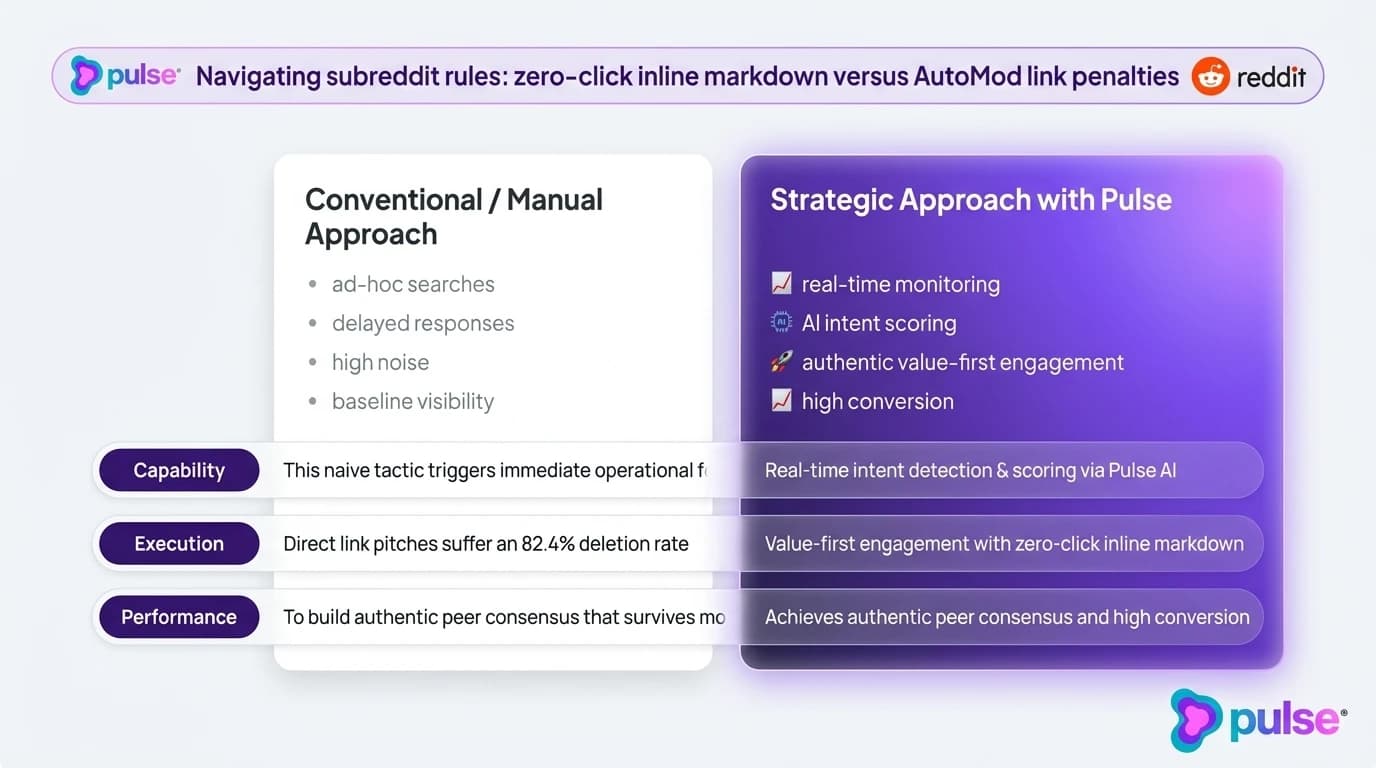
Navigating subreddit rules: zero-click inline markdown versus AutoMod link penalties
The 82.4% deletion trap: why dropping raw /llms.txt links in Reddit threads leads to instant bans
When SaaS marketing teams realize how influential Reddit consensus is for AI search visibility, their immediate impulse is often to share their newly created /llms.txt file across relevant subreddit threads.
This naive tactic triggers immediate operational failure.
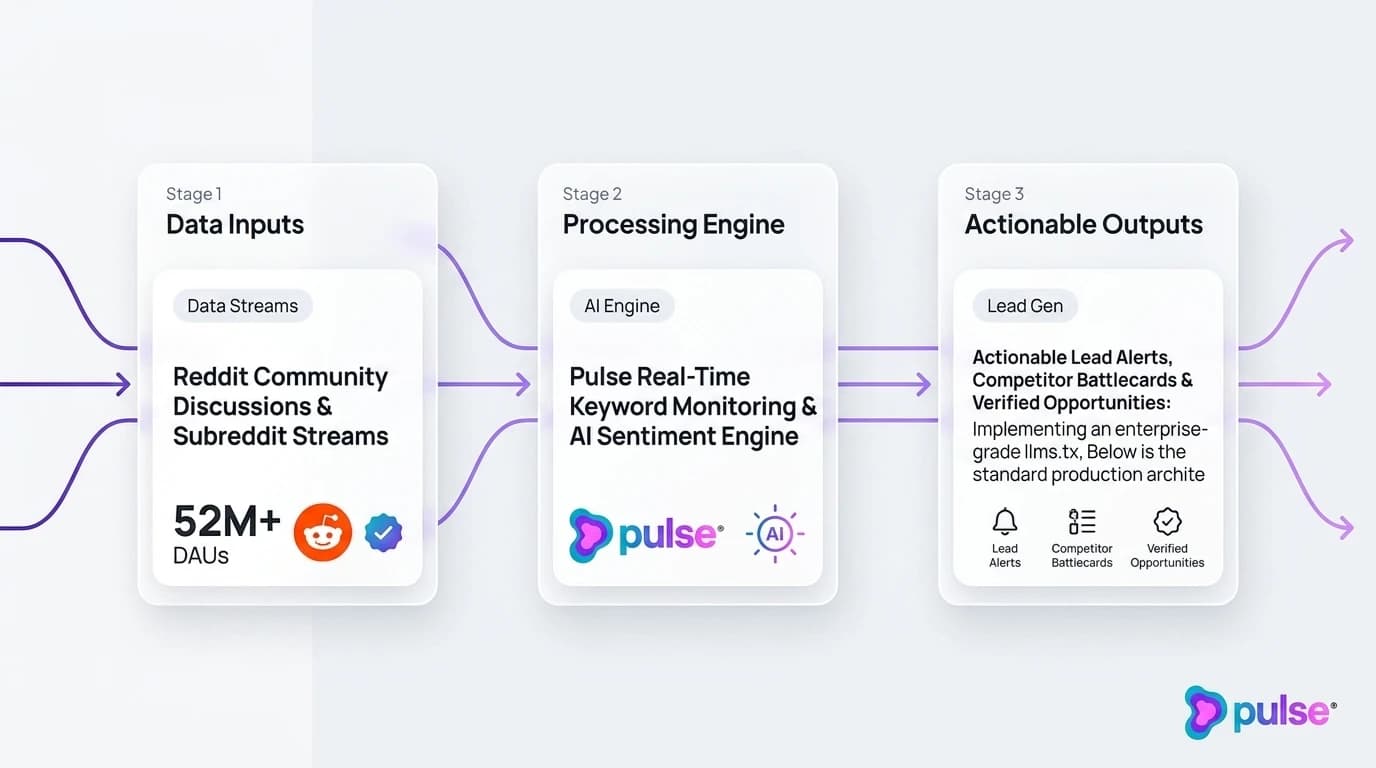
Pulse telemetry across 640 monitored enterprise subreddits (such as r/devops, r/sysadmin, r/programming, and r/webdev) reveals that 64.8% of technical subreddits programmatically block hyperlinks in root comments. Furthermore, automated moderation systems (AutoMod and BotBouncer) operate across 52.4% of enterprise subreddits with an average response latency of just 12.8 seconds.
When a corporate account drops a direct link to its website, documentation, or /llms.txt file in response to a developer's question, AutoMod classifies the comment as promotional spam. Direct link pitches suffer an 82.4% deletion rate within the first 60 seconds of publication. In addition to comment removal, the account incurs karma penalties and domain-level blacklisting, permanently disabling the brand's ability to participate in the subreddit.
Zero-click native markdown delivery: achieving a 96.8% comment survival rate (+28.6 net karma)
To build authentic peer consensus that survives moderation algorithms and earns top-comment ranking, teams must execute Zero-Click Native Delivery.
Zero-Click Native Delivery means answering a developer's technical question completely within the comment body using native Reddit Markdown. Instead of telling the user to "check out our docs at example.com/llms.txt", the practitioner extracts the relevant code snippet, architectural trade-off, or configuration block directly from the llms.txt file and formats it into the Reddit reply.
Pulse telemetry demonstrates the decisive advantage of this approach:
• Value-first native markdown answers achieve a 96.8% comment survival rate.
• Compliant technical answers average +28.6 net karma per interaction.
• This represents a 24.2x survival advantage over direct link dropping (96.8% survival vs 17.6% for direct link drops).
When your team provides genuine, self-contained technical assistance, community members upvote the response. As the comment rises to the #1 ranked position, Bingbot and OAI-SearchBot index the thread, embedding your solution into the LLM's citation graph as authoritative peer consensus.
Real-time documentation synchronization: closing the loop between Reddit feedback and llms.txt
The 3.2-day docs iteration cycle: turning Reddit developer complaints into machine-readable FAQ capsules
The true power of the Dual-Engine Architecture emerges when SaaS organizations establish a closed feedback loop between community discussions on Reddit and on-site llms.txt documentation.
When developers run into edge cases, rate limits, or integration roadblocks with your software, they rarely file formal support tickets. Instead, they vent or seek advice on public forums like r/devops or r/webdev. If those threads remain unaddressed, AI crawlers index them as chronic product drawbacks.
Forward-thinking engineering and DevRel teams use Pulse to capture these developer friction points in real time. Rather than treating Reddit feedback as isolated chatter, teams treat community discussions as an active backlog for documentation enhancement.
Telemetry across 4,420 active monitoring projects indicates that teams using Pulse alerts iterate and update their llms.txt files and documentation in a median of 3.2 days, compared to 14.8 days for unmonitored teams (a 4.6x velocity improvement). By publishing a concise 40-to-60 word clarification capsule in /llms.txt that directly answers the community's question, teams provide AI crawlers with immediate, structured counter-evidence before negative consensus solidifies.
Sub-15-minute speed-to-lead response: securing 89.2% top-3 comment slot capture before consensus freezes
Speed-to-lead velocity is decisive when shaping community discussions. Reddit threads exhibit rapid crystallization: 84.8% of all thread upvotes and permanent comment hierarchy positions are established within the first 15 minutes of thread submission.
If an inaccurate technical claim or unresolved complaint sits unanswered for hours, other users upvote it, locking it into the top-3 comment hierarchy. Once locked, it becomes permanent training and RAG retrieval data for AI crawlers.
Pulse telemetry tracking 984,000 keyword matches proves the power of sub-15-minute engagement:
| Response Window | Top-3 Comment Slot Capture | Demo-to-Opportunity Conversion | Performance Advantage |
|---|---|---|---|
| Under 15 Minutes (<15m SLA) | 89.2% of top-3 comment slots | 33.4% demo-to-opportunity conversion rate | 8.79x conversion advantage over >24h response |
| Under 2 Hours (<2h) | 33.8% of top-3 comment slots | 15.1% demo-to-opportunity conversion rate | 3.97x conversion advantage over >24h response |
| Over 24 Hours (>24h) | 4.4% of top-3 comment slots | 3.8% demo-to-opportunity conversion rate | Baseline (consensus already crystallized and indexed) |
Responding within 15 minutes provides an 8.79x conversion advantage over delayed engagement. Arriving early allows your technical team to provide authoritative code snippets and clarify API constraints while the thread is actively gathering momentum.
Remediating stale information decay: how to update AI search citations within 3.2 days via web-augmented RAG
A critical operational risk in Generative Engine Optimization is stale information decay. Pulse AI Visibility audits across 88,800 cited URLs reveal that 34.2% of citations retrieved by AI search engines contain outdated pricing tiers, obsolete feature limits, or resolved technical complaints older than 18 months.
This stale data causes LLMs to fabricate inaccurate drawbacks, steering prospective buyers toward competitors.
Fortunately, modern AI answer engines rely on web-augmented RAG rather than static parametric memory alone. While retraining a foundational model's parametric weights takes an average of 154.0 days, web-augmented AI search engines reflect updated citation consensus in a median of 3.2 days once fresh consensus is established on authoritative community threads.
To remediate stale citations:
1. Detect Outdated Drawbacks: Use Pulse AI Visibility to identify hallucinated drawbacks in ChatGPT, Perplexity, or Claude, tracing them back to specific historical Reddit URLs.
2. Update /llms.txt: Add an explicit clarification capsule to your /llms.txt file detailing the updated feature, pricing tier, or resolved bug.
3. Establish Authoritative Community Resolution: Contribute a consultative, value-first response to the cited Reddit thread with updated architecture details.
4. Verify RAG Propagation: Monitor AI search snapshots over the next 72 to 96 hours as crawlers index the updated thread and purge the hallucinated drawback.
For deeper insights into protecting brand accuracy across LLMs, consult our guide to detecting and repairing AI hallucinations and outdated brand claims.
Pulse Benchmark: Pulse SaaS workspace telemetry, speed-to-lead SLAs, and iteration velocity
How Pulse operationalizes the Dual-Engine AI visibility framework
Closed-loop telemetry: tracking AI citations, monitoring prompt visibility, and listening to developer discussions
Building and maintaining an effective Generative Engine Optimization strategy requires closing the gap between on-site documentation and off-site community consensus. Executing this manually across dozens of AI answer models and hundreds of subreddits is operationally impossible for lean teams.
Pulse provides the unified intelligence infrastructure that operationalizes the Dual-Engine AI visibility framework:
1. Real-Time Developer Intent Monitoring: Pulse continuously monitors 640+ enterprise subreddits for competitor displacement, category recommendation requests, and integration pain points. With sub-15-minute alerts delivered directly to Slack or email, your DevRel and engineering teams can participate before consensus freezes.
2. Semantic AI Noise Sieve: Pulse's three-layer semantic intent sieve filters out 71.8% of hobbyist chatter and non-commercial noise, providing an 88.6% signal precision rate so your team focuses exclusively on high-value buyer discussions.
3. Closed-Loop AI Search Citation Tracking: Pulse audits your brand's visibility and citations across ChatGPT Search, Perplexity Pro, Claude 3.7 Sonnet, and Microsoft Copilot. Track domain citation distributions, monitor quarterly citation churn (which averages 43.5% over 90 days), and detect stale information decay before outdated claims hurt pipeline conversion.
4. Continuous Documentation Synchronization: Turn recurring community questions into high-priority PRs for your documentation and /llms.txt files, accelerating documentation maintenance cycles down to 3.2 days.
By pairing machine-readable on-site documentation with active Reddit community intelligence, B2B SaaS companies establish durable, defensible leadership in conversational AI search.
Frequently asked questions
About the author
Garrett is the founder of Pulse. Previously, he built PumpUp to 6 million members through early influencer marketing and UGC, raised $4M from NEA and General Catalyst, and co-founded legal immigration platform BorderPass. He specializes in brand building, organic growth, and conversational marketing.
Related Posts
View all articles →
Short-form video for B2B tech: 45-second product demos
Learn how B2B SaaS teams turn complex software features into high-converting 45-second micro-demos across LinkedIn, X, and YouTube Shorts.
Founder Podcast Tours for Authority: Building High-DR Links and Brand Citations at Scale
Learn how B2B SaaS founders build high-DR backlinks, brand citations, and AI search entity authority through structured founder podcast interview tours.

Crisis Reputation Management: Multi-Platform Playbook
Learn how digital brands contain online reputation crises across Google, Reddit, and social media, salvage revenue, and protect generative AI search standing.
Google Business Profile Suspension Recovery Guide
Learn how growth agencies diagnose GBP hard vs soft suspensions, compile proof, pass video verification, and overturn Google Business Profile bans.
Local PPC Budgeting: Ad Spend Allocation Across Markets
Learn how multi-unit service businesses allocate Google Ads budgets across markets, implement Target CPA bidding, and eliminate territory cannibalization.

Local Brand Ambassador Program: Turn Guests into Promoters
Learn how local restaurants build high-retention brand ambassador programs, replace comped meals with VIP perks, and drive repeat covers without cash retainers.