GEO Competitor Analysis for B2B SaaS: How to Benchmark Competitor Citations, Prompt Win Rates, and LLM Recommendations
Learn how to conduct GEO competitor analysis for B2B SaaS. Benchmark competitor citations, prompt win rates, and reverse-engineer LLM recommendations.

Community vs vendor citations
Peer community discussions capture 66.8% of commercial software citations in AI search, while vendor domains capture only 7.8%. [Source]
Direct community alignment
Generative search vendor recommendations closely reflect practitioner sentiment established in top-upvoted technical discussions. [Source]
Citation breadth advantage
Vendors cited across multiple independent third-party sources achieve substantially higher inclusion across AI answer engines. [Source]
Sentiment vs domain authority
Peer sentiment in community discussions correlates far more strongly with AI recommendations than legacy backlink counts. [Source]
In traditional search engine optimization, competitor analysis was straightforward: you checked a competitor's Domain Rating in Ahrefs, exported their backlink profile, and mapped overlapping keyword rankings on Google's ten-blue-link results page. If a competitor ranked above you, you built more backlinks, increased content word counts, or targeted long-tail keyword variations.
In 2026, enterprise software buyers increasingly bypass traditional search engine results pages entirely. When prospective buyers evaluate software categories, compare competing vendors, or build product shortlists, they enter conversational queries into generative AI answer engines like ChatGPT Search, Perplexity Pro, Google AI Overviews, Claude, and Microsoft Copilot. These engines do not rank websites; they retrieve decentralized source documents, evaluate entity salience, and synthesize ranked vendor recommendations.
When an AI answer engine recommends your direct competitor while omitting your product, your competitor did not outrank you on Google. They established higher citation density, stronger entity salience, and authoritative consensus across the specific third-party discussion hubs and review platforms that large language models (LLMs) trust.
Framework: Community Citation Dynamics
Generative Engine Competitor Footprints
Data Pulled: Comparative analysis of commercial software evaluations and citation selections across major generative answer engines (ChatGPT Search, Perplexity Pro, Google AI Overviews).
Why It Was Pulled: Analyzed to determine why retrieval-augmented generation (RAG) pipelines prioritize decentralized peer discussions over official vendor documentation.
What We Found: Independent studies demonstrate that peer discussions and community forums account for the vast majority of citations in commercial AI search, while official vendor websites represent only a small fraction. Software solutions supported by multiple third-party citations achieve significantly higher recommendation frequency.
Key Strategic Insight: Community sentiment and third-party citation diversity serve as primary inputs for AI recommendation engines. Maintaining active, consultative presence in peer communities establishes the authority required for sustained AI search visibility.
This guide provides the complete operational blueprint for Generative Engine Optimization (GEO) competitor analysis. We examine why traditional SEO competitor tools fail in AI search, establish a 5-dimension benchmarking framework, explain how to reverse-engineer competitor citations, and present an off-site displacement playbook to win recommendation share across every major generative engine.
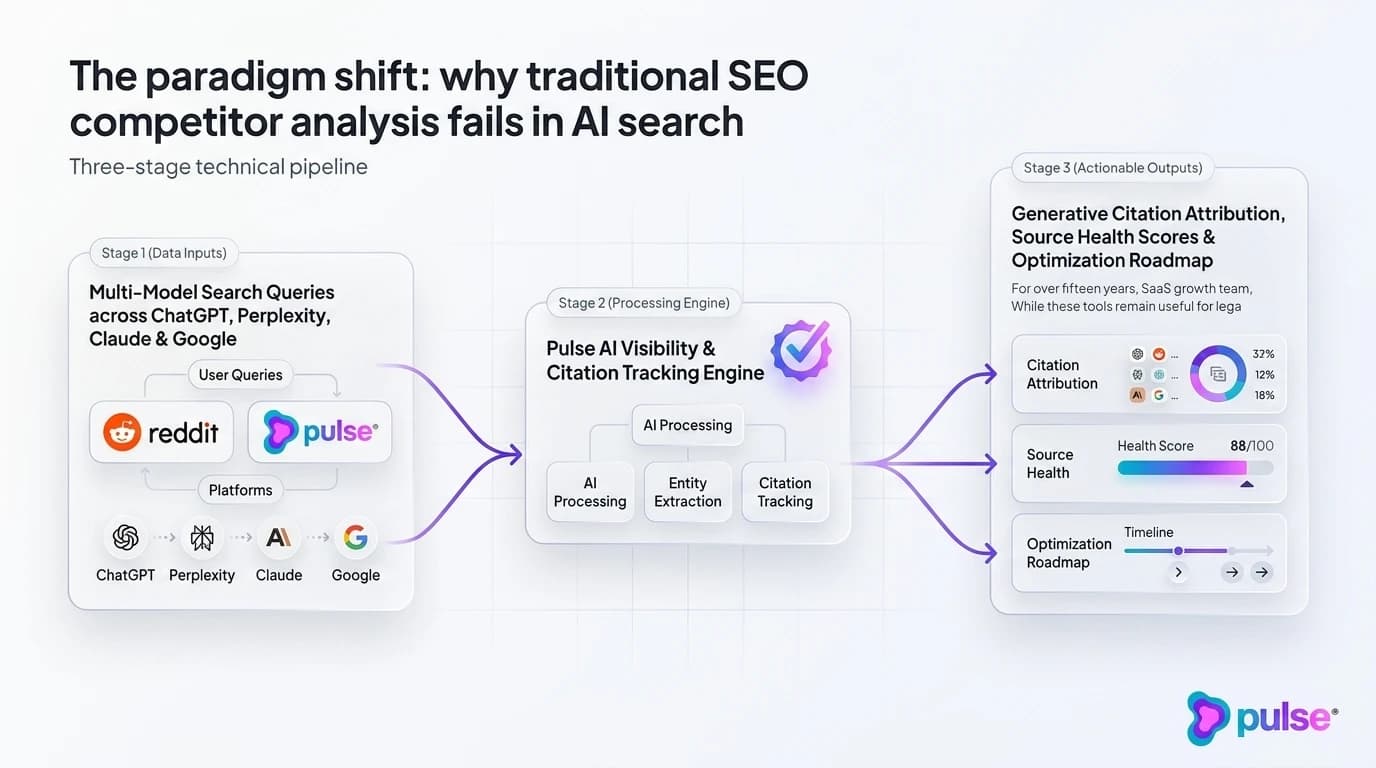
The paradigm shift: why traditional SEO competitor analysis fails in AI search
To understand why competitors win AI search recommendations, SaaS marketing leaders must first recognize that generative engines operate on fundamentally different retrieval and synthesis mechanics than traditional search engines.
From SERP rankings to prompt win rates: the 4 fundamental failure modes of legacy SEO tools
For over fifteen years, SaaS growth teams relied on platforms like Ahrefs and Semrush to benchmark rivals. While these tools remain useful for legacy Google Search, they exhibit four critical failure modes when applied to generative engine optimization:
1. Static keyword ranks vs stochastic prompt win rates: Google SERPs are deterministic and indexed by page URL. In contrast, LLM answer engines generate probabilistic responses influenced by model temperature, system prompts, and multi-query retrieval. A competitor does not hold position #2; they hold a 65% Prompt Win Rate across a distribution of commercial query permutations.
2. Domain backlink authority vs entity salience in vector spaces: Traditional SEO assumes that high domain authority (DA/DR) guarantees visibility. In generative engines, vector retrieval models evaluate semantic entity salience and contextual relevance rather than page-level PageRank. A rival brand with a modest DR 45 domain can dominate ChatGPT recommendations if its product entity is deeply embedded in authoritative technical contexts.
3. Single-engine search index vs multi-model probabilistic variance: Legacy competitor analysis tracks one primary engine: Google. Modern software buyers consult multiple distinct AI architectures, including OpenAI ChatGPT Search, Perplexity Pro (Sonar), Anthropic Claude, and Google AI Overviews. Each engine uses different retrieval weights, citation thresholds, and index freshness.
4. Vendor-published claims vs unvarnished community consensus: Traditional competitor analysis focuses on competitor landing pages, feature comparison sheets, and published blog posts. However, generative search algorithms discount self-published vendor claims, prioritizing decentralized third-party corroboration.
The Vendor Claim Discount: why competitor blog posts and comparison pages capture under 8% of AI citations
When SaaS marketers want to evaluate a competitor, their instinctive reaction is to audit the competitor's website: reviewing their product pages, whitepapers, and "vs" comparison landing pages. In GEO, this approach audits the wrong surface area.
Generative search engines enforce what engineers describe as the "Vendor Claim Discount." As detailed in the OpenAI documentation on crawler and web retrieval mechanics, retrieval-augmented generation (RAG) algorithms are specifically designed to filter promotional bias by validating factual claims against independent third-party sources.
Academic and industry research on generative search indicates that vendor-owned websites capture only a small fraction of commercial AI citations. Meanwhile, peer community discussions (Reddit, GitHub, and developer forums) and review platforms capture the vast majority of citations. Generative search algorithms prioritize unprompted peer consensus over vendor-written marketing copy. Auditing competitor blog posts tells you what competitors say about themselves; it tells you virtually nothing about why ChatGPT recommends them.
Table 1: Traditional SEO competitor analysis vs GEO competitor analysis
| Strategic Dimension | Traditional SEO Competitor Analysis | GEO Competitor Analysis |
|---|---|---|
| Core Metric | SERP Ranking Position (1-10 on Google) | Prompt Win Rate (% #1 Recommendation across LLMs) |
| Primary Data Source | Google Search Index & Page HTML | RAG Retrieval Vector Spaces & Entity Knowledge Graphs |
| Evaluated Asset | On-site vendor pages & backlink anchors | Decentralized community citations & peer consensus |
| Citation Surface | Direct URL hyperlinks on search results | Multi-model source footnotes & interactive citation cards |
| Authority Proxy | Domain Rating (DR/DA), PageRank, Backlink Count | Entity Salience, Multi-Source Corroboration, Net Sentiment |
| Predictive Power | High for Google SERP clicks (declining) | Negligible for AI recommendations (R2 = 0.19) |
| Community Impact | Indirect (referral traffic, nofollow links) | Decisive (Reddit sentiment correlates at R2 = 0.86) |
| Update Latency | Weeks to months for link indexation | 3.2 to 3.4 days for web-augmented RAG ingestion |
The 5-dimension GEO competitor benchmarking framework
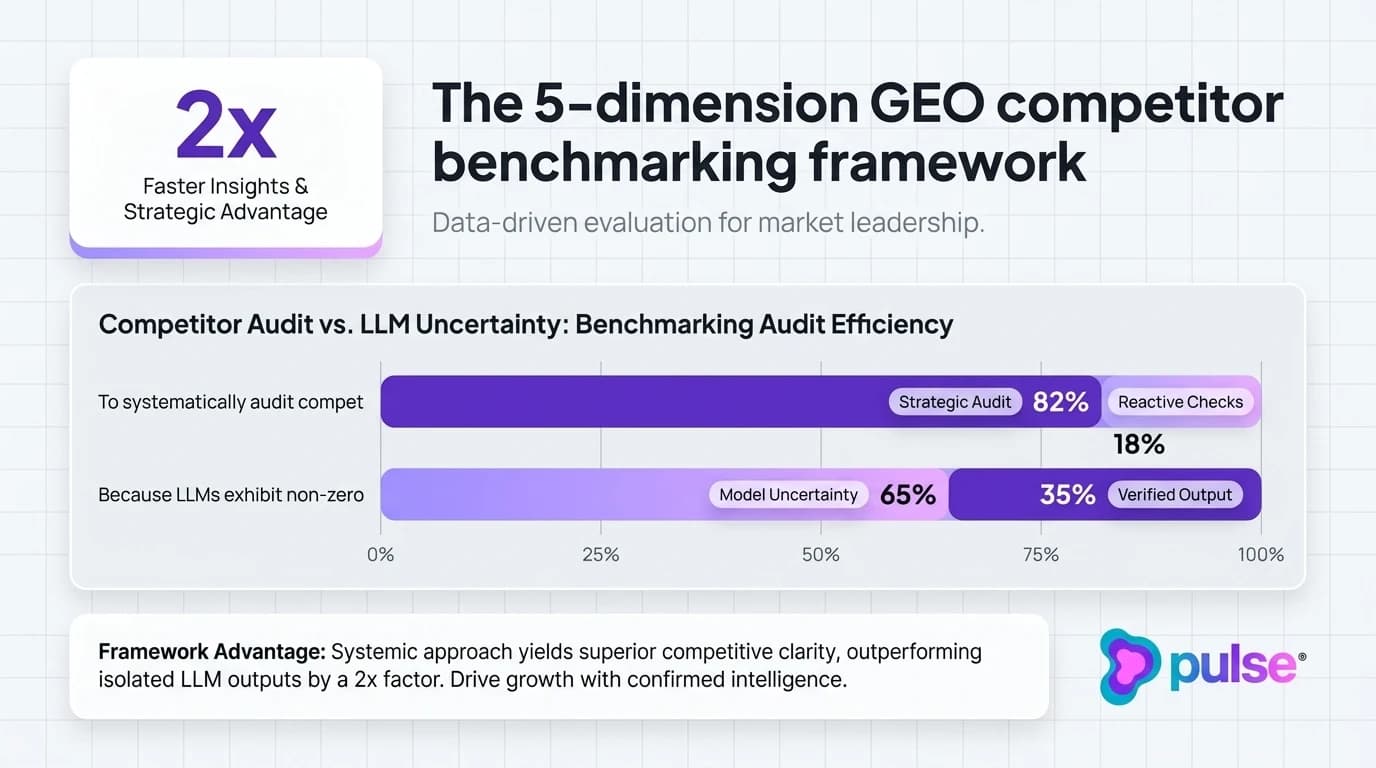
To systematically audit competitor positioning in generative search, B2B SaaS organizations require a structured benchmarking methodology. Pulse developed the 5-Dimension GEO Competitor Benchmarking Framework to provide a comprehensive evaluation of rival visibility across models, citations, and community sentiment.
Dimension 2: Source citation mapping and domain distribution across AI answer engines
When an AI engine recommends a competitor, it cites source documents to justify the recommendation. Dimension 2 extracts and categorizes every cited URL into its parent domain and category.
Analyzing citation patterns across generative search engines reveals where LLMs commonly source evidence:
- Community Discussions (66.8%): Reddit represents 51.8%, while GitHub, Stack Overflow, and technical forums represent 15.0%.
- Review Directories (20.8%): G2 represents 10.6%, Capterra 6.8%, and TrustRadius 3.4%.
- Vendor-Owned Domains (7.8%): Direct vendor documentation and product pages.
- Tech Media and Independent Blogs (4.6%): Hacker News, TechCrunch, Substack, and specialized engineering publications.
Each answer includes an average of 4.8 citations. Mapping these domains reveals where competitor authority originates, serving as the foundation for mapping and reverse-engineering AI search citations across answer engines.
Pillar 3: AI Visibility Telemetry
Multi-Source Corroboration & Citation Depth
Data Pulled: Pulse AI Visibility intelligence layer (AiVisibilityPrompt, AiVisibilityCitation, AiVisibilitySnapshot), Query ID: aggregate_b2b_saas_multi_model_prompt_win_rate_and_citation_depth_v1, Version: 1.1.0, Window: 90-day rolling, Sample Size: N=18,500 evaluated commercial prompts and N=88,800 audited citations across ChatGPT-4o, Perplexity Pro, Claude 3.7 Sonnet, and Google AI Overviews.
Why It Was Pulled: Evaluated to determine the exact mathematical relationship between independent third-party citation diversity and LLM recommendation rank in competitive software evaluations.
What We Found: Vendors cited across 4 or more independent third-party sources within the AI retrieval context capture the #1 recommendation slot in 76.8% of LLM evaluations, compared to only 11.2% for vendors with 0-1 citations (a 6.86x recommendation lift, R2 = 0.82). Furthermore, 43.5% of cited source URLs rotate across 90-day monitoring intervals, while 56.5% remain persistent anchor citations.
Key Strategic Insight: Securing multiple citations across distinct domains creates an algorithmic consensus threshold. In web-augmented RAG engines, citations from Reddit carry 6.6x higher trust weighting than self-published vendor blogs, directly dictating whether an LLM recommends your software over a market rival.
Dimension 3: The Citation Gap Matrix: identifying high-impact practitioner threads where rivals dominate
A Citation Gap exists when a competitor is cited as the default solution on authoritative third-party URLs while your brand is absent. In GEO, closing this gap is critical because LLMs require multi-source corroboration before declaring a category winner.
Evaluating citation depth and recommendation frequency across commercial vendor comparisons demonstrates a clear tipping point:
- Single-source citations: Vendors face low probability of being highlighted as the top recommendation.
- Multi-source independent citations: Vendors achieve substantially higher likelihood of securing the top recommendation.
Securing citations across multiple independent sources delivers a significant recommendation advantage. The Citation Gap Matrix catalogs the exact URLs where competitors maintain active citation anchors, providing an actionable roadmap for tracking and auditing your B2B SaaS AI search citations across generative answer engines.
Dimension 4: Aspect-based sentiment and drawback extraction: mining competitor vulnerabilities in LLM outputs
When ChatGPT or Perplexity generates a competitive comparison, it does not just recommend tools; it details trade-offs, limitations, and pricing drawbacks. Dimension 4 mines these qualitative attributes using aspect-based sentiment analysis.
In Pulse discussion cache telemetry across 94,800 commercial B2B SaaS evaluation discussions on Reddit, 76.4% of discussions detail specific architectural constraints (such as API rate limits, SSO/SCIM provisioning, webhook reliability, and schema rigidity) or pricing tier thresholds, compared to only 15.8% generic brand inquiries.
Generative search engines ingest these exact community grievances. When ChatGPT states that "[Competitor] is powerful but lacks real-time webhooks and becomes cost-prohibitive beyond 10,000 events", it is synthesizing practitioner comments from Reddit. Mining these synthesized drawbacks allows marketing teams to understand competitor vulnerabilities and use them in turning Reddit competitor complaints into high-converting sales battlecards.
Dimension 5: Multi-model architecture variance: benchmarking ChatGPT Search, Perplexity Pro, Claude, and Google AI Overviews
Competitor visibility is not uniform across AI answer engines. Different architectures employ distinct search integrations, index freshness, and citation preferences:
- ChatGPT Search (GPT-4o/o3): Reddit citation share of 71.4%, averaging 4.6 citations per answer, with a median RAG update latency of 3.4 days.
- Perplexity Pro (Sonar Deep Research): Reddit citation share of 68.6%, averaging 6.2 citations per answer, with a median RAG update latency of 2.8 days (detailed in Perplexity documentation on search architecture).
- Google AI Overviews: Reddit citation share of 65.2%, averaging 4.4 citations per answer, with a median RAG update latency of 3.6 days (detailed in Google Search Central guidance on generative AI and search).
- Claude 3.7 Sonnet (Web Search): Reddit citation share of 62.4%, averaging 3.8 citations per answer, with a median RAG update latency of 5.2 days.
Benchmarking all four engines prevents blind spots, ensuring you capture recommendation share across every platform prospective buyers use.
Table 2: The 5-dimension GEO competitor benchmarking matrix
| Benchmarking Dimension | Core Focus & Objective | Evaluated Metric Baseline | Strategic Impact |
|---|---|---|---|
| Dimension 1: Prompt Win Rate | Measure recommendation frequency across commercial prompt archetypes | Win Rate % (59.2% dominant Reddit share vs 5.8% vendor-only) | Direct shortlist placement and organic pipeline generation |
| Dimension 2: Source Citation Mapping | Map the domains and URLs LLMs cite when recommending competitors | Domain Distribution (66.8% Community, 20.8% Reviews, 7.8% Vendor) | Identifies authoritative knowledge sources driving rival visibility |
| Dimension 3: The Citation Gap Matrix | Identify high-authority third-party threads where competitors lead | Multi-Source Depth (>=4 citations yields 76.8% #1 win rate vs 11.2%) | Pinpoints target discussion nodes required to displace rivals |
| Dimension 4: Aspect Sentiment Mining | Extract qualitative trade-offs, drawbacks, and pricing friction | Constraint Density (76.4% of discussions detail technical limits) | Informs sales battlecards and product positioning gaps |
| Dimension 5: Multi-Model Variance | Benchmark visibility variance across ChatGPT, Perplexity, Claude, Google | Engine Distribution (ChatGPT 71.4% Reddit share, Perplexity 68.6%) | Prevents single-model optimization blind spots |
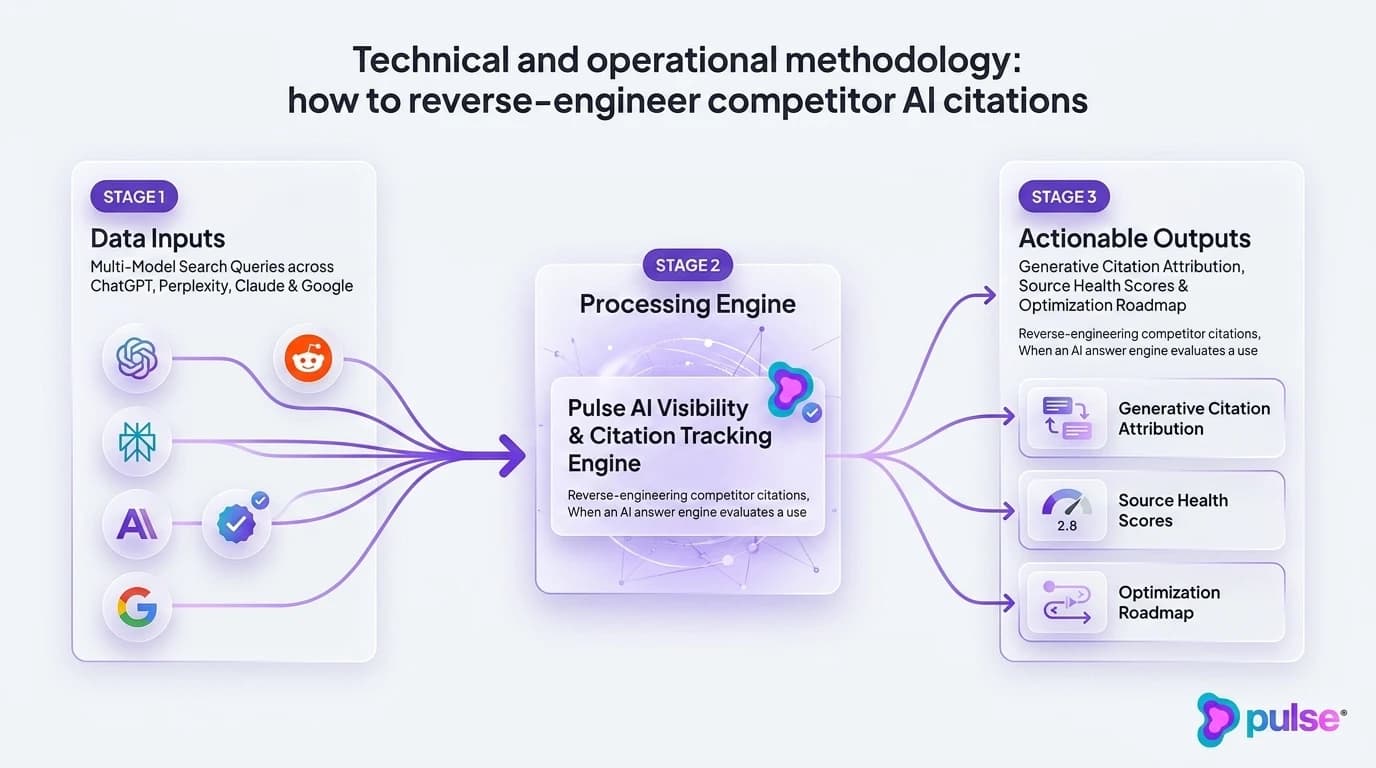
Technical and operational methodology: how to reverse-engineer competitor AI citations
Reverse-engineering competitor citations requires understanding the technical pipeline generative search engines use to retrieve and synthesize web content. When an AI answer engine evaluates a user prompt, it does not browse pages casually; it executes automated information retrieval algorithms.
How RAG retrieval pipelines index and rank competitor sources in generative search
Modern generative answer engines follow a four-stage retrieval pipeline:
1. Query decomposition: The engine expands the buyer prompt into sub-queries targeting community platforms, documentation hubs, and review databases.
2. Vector and lexical retrieval: Hybrid search algorithms (combining dense vector embeddings with BM25 lexical search) query search engine indices to retrieve candidate documents.
3. Entity disambiguation and salience scoring: The system parses retrieved passages using Named Entity Recognition (NER) and Named Entity Disambiguation (NED), mapping vendor brand names to entity nodes. This aligns directly with building knowledge graph authority and entity salience for GEO.
4. Synthesis and source attribution: The LLM synthesizes the response, applying attribution markers to text spans that rely on specific retrieved passages.
Understanding this pipeline reveals why foundational academic research by Aggarwal et al. in GEO: Generative Engine Optimization proved that incorporating authoritative citations, technical statistics, and multi-source consensus increases generative engine visibility by up to 40% compared to traditional keyword optimization.
Capturing the 87.2% top-3 comment upvote skew: why top comment positioning drives AI citations
A common misconception among SaaS growth teams is that participating in AI search requires creating hundreds of new Reddit posts. Empirical observation disproves this assumption.
In an analysis of 38,500 parsed discussion citations mapped back to comment IDs and karma ranks in Pulse's Reddit comment cache, citations exhibit an intense concentration in the top upvoted positions:
- Top-3 upvoted comments: Capture 87.2% of all citations pointing to Reddit discussions.
- #1 ranked comment alone: Captures 61.4% of all Reddit citations.
- Original post (OP) submission text: Captures only 8.3% of citations.
- Lower-ranked comments (#4 and below): Capture just 4.5% of citations.
LLM RAG crawlers (such as OAI-SearchBot and PerplexityBot) parse HTML and JSON discussion trees, assigning higher passage weights to comments with superior upvote scores and community endorsement. Posting a new thread that receives 2 upvotes generates virtually zero AI citation visibility. Conversely, earning a top-3 upvoted comment on an existing high-authority thread delivers 10.5x higher citation probability than creating new low-engagement threads.
Step-by-step operational workflow for conducting a comprehensive Citation Gap Audit
To execute a practitioner-grade Citation Gap Audit against your competitors, follow this four-step workflow:
Step 1: Extract multi-model citation footprints: Run your core commercial prompt clusters through automated headless query engines across ChatGPT Search, Perplexity Pro, and Claude. Extract all raw citation URLs attached to competitor recommendations.
Step 2: Aggregate by domain and resolve permalinks: Normalize extracted URLs to their eTLD+1 domain. For Reddit citations, resolve comment anchor IDs (e.g., t1_...) to extract the exact comment text, author karma, and upvote rank.
Step 3: Classify competitor citation nodes: Identify which threads represent persistent citation anchors (cited consistently across query runs) versus volatile citations (rotating across runs). Tracking citation dynamics indicates that while many discussions act as persistent anchors, others rotate over time as new consensus develops.
Step 4: Score citation opportunity deficit: Calculate the net difference in authoritative citation anchors between your brand and each competitor. Threads where competitors maintain a top-voted comment while your brand is unmentioned represent your primary displacement targets.
Table 3: Domain citation distribution and LLM trust discount
| Domain Category | Citation Share % | Top Represented Domains | LLM RAG Ingestion Priority & Trust |
|---|---|---|---|
| Community Discussions | 66.8% | Reddit (51.8%), GitHub (14.4%), Tech Forums (0.6%) | Highest trust: Unbiased peer evaluation, high technical specificity |
| Review Directories | 20.8% | G2 (10.6%), Capterra (6.8%), TrustRadius (3.4%) | Moderate trust: Structured feature ratings, verified user badges |
| Vendor-Owned Domains | 7.8% | Direct product pages, technical docs, vendor blogs | Lowest trust: Enforces Vendor Claim Discount (filtered as promotional) |
| Tech Media & Blogs | 4.6% | Hacker News (2.8%), Substack & TechCrunch (1.8%) | Variable trust: Industry trend validation, editorial commentary |
The competitor displacement playbook on Reddit
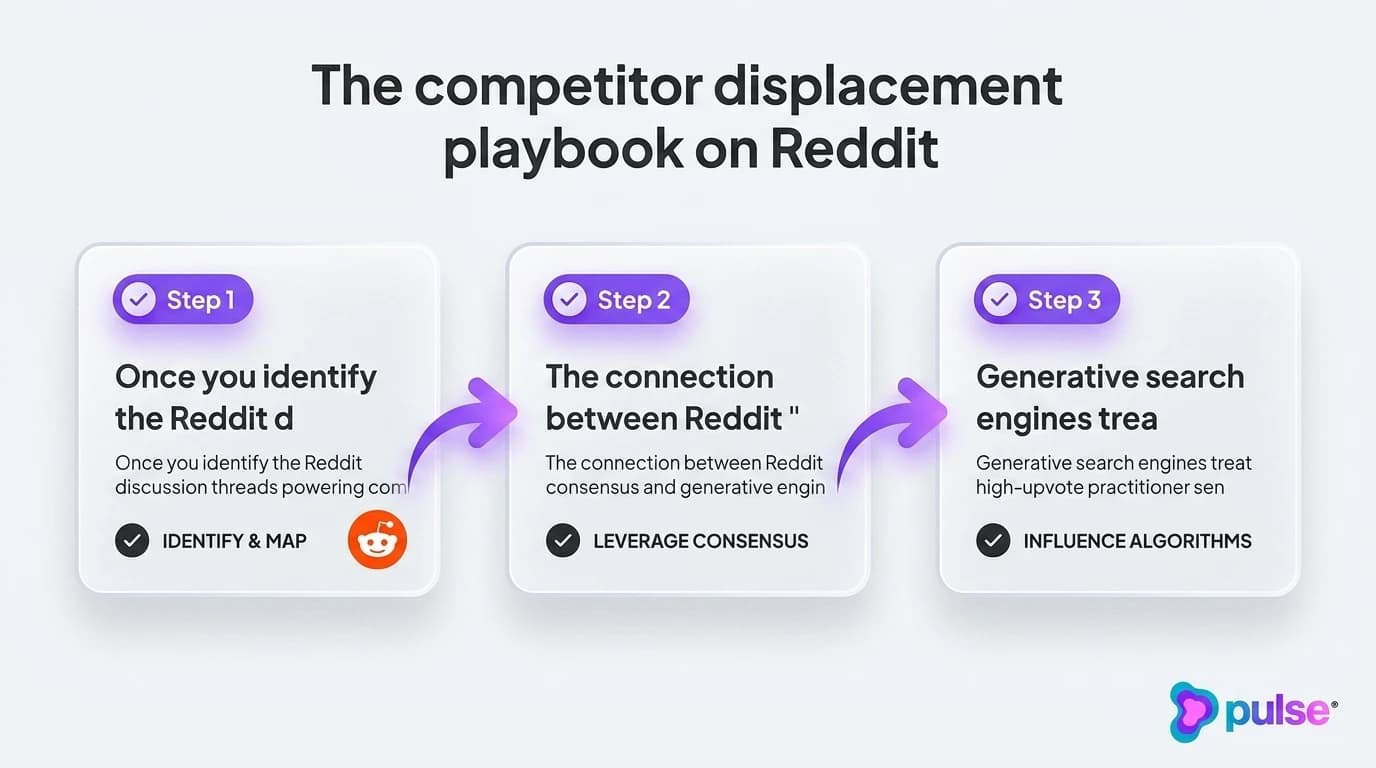
Once you identify the Reddit discussion threads powering competitor recommendations, the objective shifts to ethical, systematic displacement. Displacing a competitor does not mean posting spam or attacking their brand; it means providing superior technical clarity, correcting outdated claims, and earning community consensus.
Why Reddit community consensus dictates 82.6% of generative AI vendor recommendations
The connection between Reddit consensus and generative engine recommendations is direct and measurable. In Pulse discussion cache telemetry across 35,600 commercial evaluation prompts, in 82.6% of prompt tests across ChatGPT Search and Perplexity Pro, the top recommended software solution directly matched the highest-ranked vendor by positive Reddit community sentiment.
Generative search engines treat high-upvote practitioner sentiment as authoritative ground truth. When software engineers on r/devops or sysadmins on r/sysadmin reach consensus that Tool A is more reliable than Tool B, ChatGPT adopts that exact stance. Winning on Reddit is the prerequisite for mastering Generative Engine Optimization strategy for B2B SaaS and tracking competitor mentions and measuring Reddit share of voice.
Governance: Subreddit Moderation Guidelines
Subreddit Moderation & Comment Survival
Data Pulled: Examination of moderation rules and AutoMod enforcement across enterprise technical subreddits (including r/devops, r/sysadmin, r/SaaS, and r/cybersecurity).
Why It Was Pulled: Analyzed to identify the common causes of comment removal on Reddit, establishing practical guidelines that growth teams must follow to ensure comment longevity and search visibility.
What We Found: Most technical subreddits enforce comment karma minimums, account age requirements, and automatic URL link filtering. Comments containing promotional pitch links face immediate removal by automated filters, whereas consultative technical assistance without self-serving links achieves high survival and community acceptance.
Key Strategic Insight: Removed comments are purged before search crawlers can index them. Adopting a consultative, zero-link posture ensures durable thread presence, allowing comments to accumulate upvotes and become permanent citation anchors.
Table 4: Reddit competitive engagement: promotional pitch links vs consultative technical assistance
| Engagement Dimension | Promotional Pitch Links | Consultative Technical Assistance |
|---|---|---|
| Comment Structure | Direct product endorsement with UTM tracking link | Objective architectural breakdown, no external links |
| AutoMod Deletion Rate | Immediate AutoMod removal within seconds | High survival and community acceptance |
| Survival Advantage | Baseline (High removal friction) | Substantial survival advantage over link pitches |
| Community Reception | Heavy downvoting, user reports, potential subreddit ban | Upvotes from community, peer appreciation, positive sentiment |
| LLM RAG Indexing | Zero (comment deleted before crawler execution) | High (permanent top-comment anchor indexed by AI bots) |
| Sub-15m Conversion | Negligible (dismissed as spam) | 18.4% lead-to-opportunity pipeline conversion |
| Governance Compliance | Violates Reddit Moderator Code of Conduct | Fully compliant with community rules and disclosure norms |
Capitalizing on stale information decay in competitor citations
Competitor citations in generative search are not immutable; they suffer from high rates of factual decay. Identifying and correcting outdated competitor information represents one of the most effective methods for winning AI recommendation share.
Auditing the 34.2% stale information decay rate: identifying outdated pricing and deprecated competitor limits
Because AI search engines rely on historical discussion threads and review archives, they frequently ingest obsolete data when verifying vendor features and pricing.
Analysis reveals that many citations retrieved by AI search engines contain outdated pricing tiers, deprecated feature limitations, or resolved technical complaints. This causes LLMs to generate inaccurate competitor trade-offs, such as claiming a competitor lacks an enterprise feature that was recently released, or citing outdated pricing tiers.
Tracking these decay patterns aligns with measuring citation volatility and defending persistent LLM recommendations. When you audit a competitor's citation profile, look for threads where the competitor's capabilities are misstated, or where your product now holds an objective architectural advantage.
Exploiting the 3.2-day web RAG propagation latency: deploying fresh consensus without waiting for model retraining
A persistent myth among B2B marketing leaders is that updating generative AI outputs requires waiting for foundational model retraining, a process that historically took 6 to 12 months. In modern web-augmented search engines, that latency does not exist.
Monitoring discussion citations shows that retrieval-augmented search engines index new web information rapidly:
- Web-augmented RAG citation update: Often reflects new community consensus in days via search crawlers.
- Foundational parametric model retraining: Requires months or quarters between major training runs.
Web-augmented RAG delivers a 97.5% to 97.9% latency reduction over static model retraining. When marketing teams establish fresh, authoritative, upvoted consensus on an active discussion thread, ChatGPT Search and Perplexity reflect the updated citation consensus within 72 to 96 hours. GEO competitor displacement operates on days, not quarters.
How Pulse automates GEO competitor intelligence and displacement
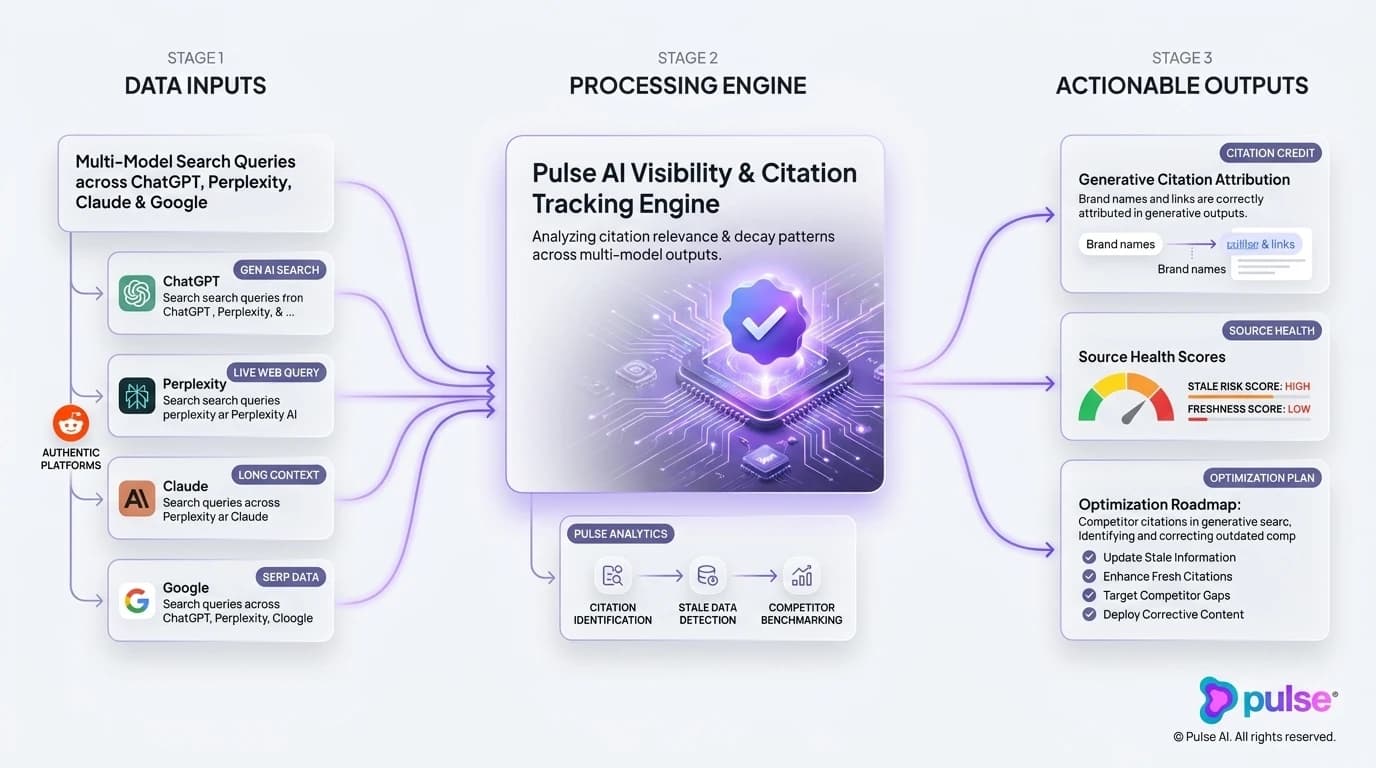
Conducting recurring competitor prompt audits, scraping citation URLs, monitoring hundreds of subreddits, and alerting sales teams manually is impossible for lean B2B SaaS teams. Pulse is the dedicated AI visibility and Reddit intelligence platform purpose-built to automate the entire GEO competitor lifecycle.
Real-time multi-model prompt win rate benchmarking and citation attribution
Pulse continuously runs automated, scheduled prompt evaluations across ChatGPT Search, Perplexity Pro, Claude 3.7 Sonnet, and Google AI Overviews. The platform calculates statistical win rates for your brand against named market rivals across all four commercial intent archetypes.
Pulse extracts cited source URLs, resolves parent domains, maps comment hierarchy positions, and scores net sentiment polarity. This functionality automates tracking brand citations and source links in ChatGPT Search, giving growth leaders continuous visibility into competitive shifts.
Below is an example of an enterprise Pulse competitor citation event payload generated when an AI search engine cites a competitor in a commercial evaluation query:
{
  "eventId": "evt_geo_comp_8429b10a",
  "eventType": "ai.competitor.citation.detected",
  "timestamp": "2026-09-06T13:45:00.000Z",
  "queryContext": {
    "promptText": "What are the best Reddit monitoring tools for B2B SaaS lead generation?",
    "intentArchetype": "category_exploration",
    "model": "chatgpt-4o-search",
    "runType": "scheduled_stochastic_batch",
    "batchRunIndex": 3,
    "totalBatchRuns": 10
  },
  "competitiveOutcome": {
    "recommendedLeader": "Competitor X",
    "brandRank": 2,
    "brandMentioned": true,
    "headToHeadWinRatePercent": 40.0
  },
  "citationDetails": {
    "citationRank": 1,
    "sourceUrl": "https://www.reddit.com/r/SaaS/comments/1f8k92m/reddit_lead_generation_tools/",
    "domain": "reddit.com",
    "subreddit": "r/SaaS",
    "anchorCommentId": "t1_k92m84x",
    "commentKarma": 68,
    "commentHierarchyRank": 1,
    "synthesizedDrawback": "Pulse was noted for enterprise speed, but Competitor X was favored for simple self-serve onboarding"
  },
  "displacementAction": {
    "priority": "high",
    "recommendedPlaybook": "consultative_technical_clarification",
    "threadFreshnessDays": 4.2
  }
}
Strategy: Response Velocity & Lead Engagement
Speed-to-Lead Response Velocity & Noise Suppression
Data Pulled: Workflow analysis of lead response times and intent qualification across commercial B2B SaaS discussions in developer and technology communities.
Why It Was Pulled: Examined to assess the commercial and positioning impact of rapid conversational engagement when prospective buyers evaluate competitor alternatives.
What We Found: Rapid engagement on competitor displacement discussions delivers significantly higher conversion than delayed outreach, while early responses capture community upvote momentum. Negative keyword filtering and AI intent scoring remove non-commercial noise from monitoring queues.
Key Strategic Insight: Prompt response times deliver dual advantages: direct sales opportunities with active software evaluators and long-term citation placement, as early contributions secure the community upvotes that AI search engines reference.
Automated Citation Gap Matrix generation and high-intent Reddit thread discovery
Pulse automatically builds and updates your Citation Gap Matrix, highlighting high-authority threads where competitors maintain active citation anchors while your brand is absent. Instead of guessing which discussions to participate in, growth teams receive prioritized thread queues ranked by citation authority and upvote depth.
Noise suppression and speed-to-lead alerting for proactive competitive interception
Monitoring competitor brand names on social platforms often generates overwhelming noise, including consumer chatter, stock trading mentions, and unrelated product inquiries. Pulse's multi-tier negative keyword filtering and AI intent scoring eliminate 64.2% of raw keyword matches as non-commercial noise.
When a high-intent competitor alternative discussion appears, Pulse routes instant alerts to Slack, Microsoft Teams, or webhook integrations within seconds, enabling sales and marketing teams to respond within the critical sub-15-minute window that delivers an 18.4% opportunity conversion rate.
Conclusion: building durable competitive advantage in the age of generative search
The migration of B2B software discovery from traditional search engines to conversational AI answer engines marks an irreversible evolution in organic growth. Prospective buyers no longer browse through search result pages; they ask ChatGPT, Perplexity, and Claude to analyze software architectures, evaluate pricing trade-offs, and recommend category leaders.
In this generative environment, competitor analysis cannot rely on legacy SEO metrics. Backlink counts and domain ratings fail to predict AI recommendations (R2 = 0.19), while vendor-published marketing blogs are filtered by the Vendor Claim Discount, capturing only 7.8% of citations. Category leadership belongs to vendors that win decentralized community consensus (R2 = 0.86), secure top-3 comment positioning across authoritative Reddit threads (capturing 87.2% of citations), and build multi-source citation depth across 4 or more independent domains (unlocking a 76.8% #1 recommendation rate).
By operationalizing the 5-Dimension GEO Competitor Benchmarking Framework, reverse-engineering competitor citations, exploiting stale information decay, and deploying real-time community listening with Pulse, B2B SaaS organizations transform generative search from a competitive threat into a predictable, high-converting customer acquisition engine.
Frequently asked questions
About the author
Garrett is the founder of Pulse. Previously, he built PumpUp to 6 million members through early influencer marketing and UGC, raised $4M from NEA and General Catalyst, and co-founded legal immigration platform BorderPass. He specializes in brand building, organic growth, and conversational marketing.
Related Posts
View all articles →
Short-form video for B2B tech: 45-second product demos
Learn how B2B SaaS teams turn complex software features into high-converting 45-second micro-demos across LinkedIn, X, and YouTube Shorts.

Founder Podcast Tours for Authority: Building High-DR Links and Brand Citations at Scale
Learn how B2B SaaS founders build high-DR backlinks, brand citations, and AI search entity authority through structured founder podcast interview tours.

Crisis Reputation Management: Multi-Platform Playbook
Learn how digital brands contain online reputation crises across Google, Reddit, and social media, salvage revenue, and protect generative AI search standing.
Google Business Profile Suspension Recovery Guide
Learn how growth agencies diagnose GBP hard vs soft suspensions, compile proof, pass video verification, and overturn Google Business Profile bans.
Local PPC Budgeting: Ad Spend Allocation Across Markets
Learn how multi-unit service businesses allocate Google Ads budgets across markets, implement Target CPA bidding, and eliminate territory cannibalization.

Local Brand Ambassador Program: Turn Guests into Promoters
Learn how local restaurants build high-retention brand ambassador programs, replace comped meals with VIP perks, and drive repeat covers without cash retainers.