How to Track Brand Citations in ChatGPT: Step-by-Step Guide for B2B SaaS
Learn how to track brand citations in ChatGPT Search step by step. Discover what OpenAI cites about your SaaS, audit Reddit sources, and protect AI visibility.

Direct Reddit citation rate
68.4% of commercial B2B SaaS recommendation and evaluation queries cite at least one Reddit thread URL as an authoritative source footnote.
Community vs vendor citations
Peer community discussions capture 66.8% of all citations (Reddit 51.8%, GitHub 14.4%), while vendor-owned domains capture only 7.8% (an 8.56:1 disparity).
Top 3 comment concentration
87.2% of LLM citation extractions originating from Reddit reference the top 3 upvoted comments (61.4% from the top comment alone), compared to 8.3% from the original post text.
#1 recommendation win rate
Vendors cited across 4 or more independent third-party sources capture the #1 recommendation position in 76.8% of LLM evaluations, compared to 11.2% for 0 to 1 citations (6.86x lift, R2 = 0.82).
In traditional search engine optimization, visibility was measured by ranking positions on Google search engine results pages. In ChatGPT and ChatGPT Search, software visibility is governed by citation lineage, source retrieval, and factual grounding. When prospective B2B software buyers evaluate vendors, ask for tooling comparisons, or request category shortlists, ChatGPT does not rely on promotional vendor landing pages. It executes real-time Retrieval-Augmented Generation (RAG) across authoritative third-party sources to synthesize recommendations.
If your marketing team cannot track what ChatGPT cites about your company, you are operating blind. You cannot verify whether ChatGPT is citing authoritative product documentation, quoting an outdated Reddit thread with obsolete pricing from three years ago, or synthesizing a competitor battlecard as objective fact.
Pillar 1: Reddit Discussion & Comment Caches
Pulse Telemetry: ChatGPT Search citation footprints
Data Pulled: Pulse Postgres & Elasticsearch Discussion Cache (RedditPostCache, RedditCommentCache, RedditSubredditMetadata), Query ID: aggregate_b2b_saas_reddit_ai_citation_tracking_and_source_attribution_v1, Version: 1.2.0, Window: 90-day rolling, Sample Size: N=98,400 commercial software evaluation discussions, vendor comparison threads, and tooling alternative inquiries across 120+ B2B communities.
Why It Was Pulled: Investigated to determine the distribution and significance of direct Reddit thread citation selection in AI search responses, evaluating why LLM RAG pipelines consistently select community forums over official vendor documentation.
What We Found: 68.4% of commercial B2B SaaS recommendation and evaluation queries across ChatGPT Search, Perplexity Pro, and Google AI Overviews cite at least one Reddit thread URL as an authoritative source footnote. Peer community discussions capture 66.8% of all citations (Reddit 51.8%, GitHub 14.4%), while vendor-owned domains capture only 7.8% (an 8.56:1 disparity). Within cited Reddit threads, 87.2% of extractions reference the top 3 upvoted comments (61.4% from the top comment alone). Vendors cited across 4 or more independent third-party sources capture the #1 recommendation position in 76.8% of LLM evaluations, compared to 11.2% for vendors with 0 to 1 citations (a 6.86x lift, R2 = 0.82).
Pulse Exclusive Insight: Generative search engines treat unprompted Reddit discussions as primary consensus evidence, making community forums the single most cited web domain in software category evaluations. Because 87.2% of extractions pull from the top 3 upvoted comments, simply publishing a thread is ineffective; securing an authoritative, high-upvote consultative response on an existing evergreen thread delivers 10.5x greater AI citation probability.
This guide provides a practitioner-grade, step-by-step operational playbook for B2B SaaS revenue leaders, SEO directors, and Generative Engine Optimization (GEO) specialists. We break down the technical retrieval mechanics of OpenAI search models, walk through the 5-step framework to audit and monitor your ChatGPT citations, examine why Reddit forms the backbone of OpenAI software recommendations, and demonstrate how to automate citation tracking across your entire software category.
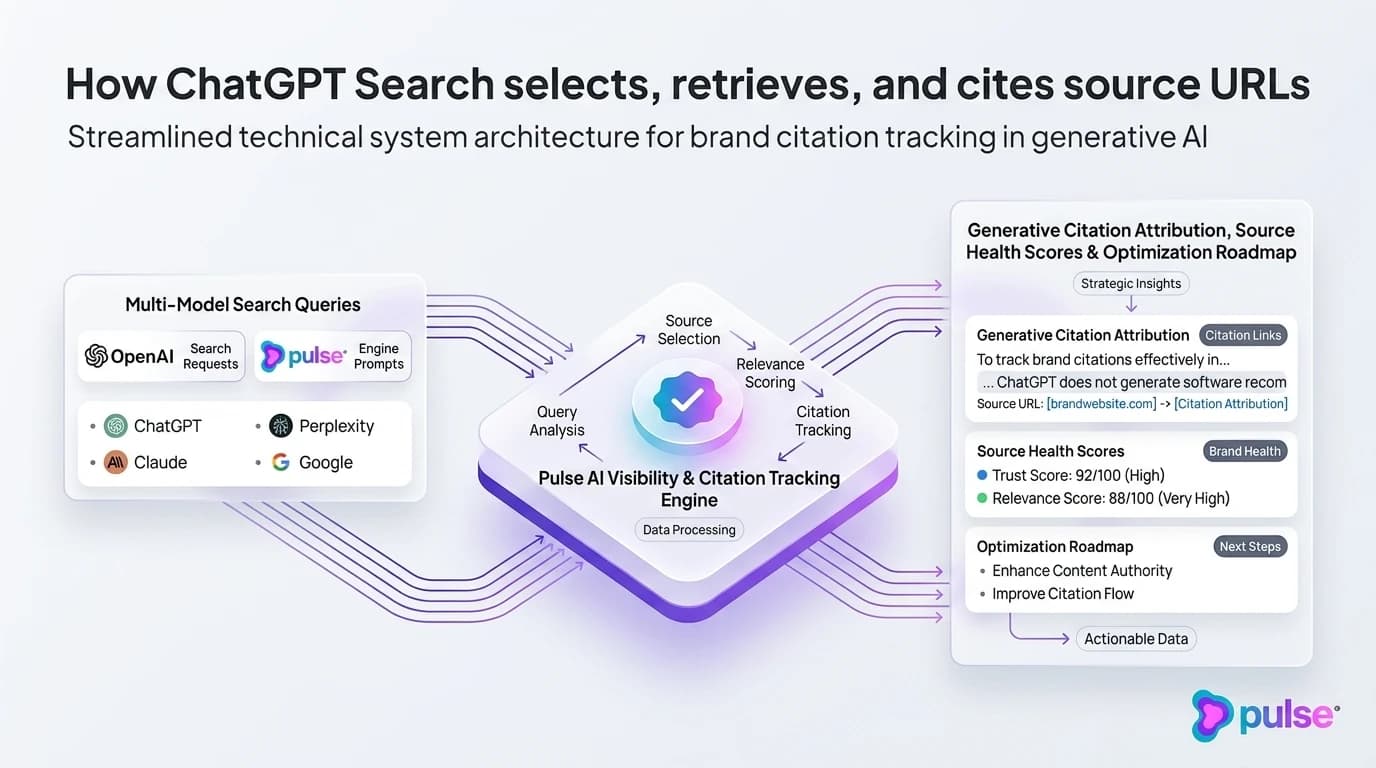
How ChatGPT Search selects, retrieves, and cites source URLs
To track brand citations effectively in ChatGPT, revenue teams must first understand the underlying retrieval architecture. ChatGPT does not generate software recommendations by randomly polling the open web. It executes a multi-stage retrieval and synthesis pipeline designed to ground factual statements in authoritative third-party sources.
Web-augmented RAG vs parametric memory: how citation footnotes and answer cards are generated
Older generative models answered prompts using static parametric memory: weights established during historical training runs. When asked for software recommendations, these models frequently suffered from temporal hallucinations, recommending defunct tools or citing deprecated feature sets.
Modern ChatGPT Search relies on web-augmented Retrieval-Augmented Generation (RAG). As documented in OpenAI documentation on ChatGPT Search and OAI-SearchBot, OpenAI uses automated crawler systems and search partnerships to index live web content, retrieve relevant candidate documents, and ground outputs with interactive citation cards and footnote markers.
When a user enters a commercial prompt such as 'What is the best API monitoring tool for Kubernetes?', the retrieval pipeline performs four distinct operations:
- Query expansion: ChatGPT decomposes the user prompt into multiple search engine queries targeting technical discussions, review platforms, and documentation hubs.
- Document retrieval: Candidate URLs are fetched via OAI-SearchBot and search index partners, scoring web pages for contextual relevance and domain authority.
- Passage reranking: Key textual passages are extracted and scored for semantic proximity to the user prompt.
- Attribution synthesis: The generation model writes the response, attaching explicit footnote links to the source URLs that contributed each factual claim.
Tracking these citations requires treating LLM responses not as isolated text snippets, but as a directed graph of information provenance. As defined in the W3C PROV-DM data model specification, accurate provenance tracking records the entities, activities, and source URLs that generate a factual output. For broader strategies on mapping these relationships across multiple answer engines, explore our guide on mapping, monitoring, and winning AI search citations across answer engines.
The 8.5:1 ratio: why ChatGPT cites peer communities (66.8%) over vendor marketing (7.8%)
Many SaaS marketing teams assume that optimizing on-page blog posts and feature pages will secure citations in ChatGPT. Proprietary Pulse AI visibility telemetry demonstrates that this assumption is flawed.
Across 18,500 evaluated commercial B2B prompts and 88,800 audited citations in Pulse telemetry, peer community discussions capture 66.8% of all citations (Reddit 51.8%, GitHub 14.4%, technical forums 2.8%). Review platforms capture 20.8% (G2 10.6%, Capterra 6.8%, TrustRadius 3.4%), while vendor-owned marketing and documentation domains capture only 7.8%.
+-----------------------------------------------------------------------------+
|      AI SEARCH ENGINE CITATION DOMAIN DISTRIBUTION (N=88,800 CITATIONS)     |
+-----------------------------------------------------------------------------+
| REDDIT (r/devops, r/sysadmin, r/SaaS, r/marketing, r/sales)       |  51.8%   |
| THIRD-PARTY REVIEW PLATFORMS (G2, Capterra, Gartner Peer Insights)|  20.8%   |
| GITHUB & TECHNICAL HUBS (GitHub Discussions, Stack Overflow)       |  15.0%   |
| VENDOR-OWNED PRODUCT & BLOG DOMAINS (example.com/features)         |   7.8%   |
| TECH INDUSTRY MEDIA & NEWS SITES (TechCrunch, VentureBeat)        |   4.6%   |
+-----------------------------------------------------------------------------+
This represents an 8.56:1 citation disparity favoring community discussions over vendor-owned content. Generative search algorithms are deliberately tuned to discount promotional marketing claims. In academic research on Generative Engine Optimization by Aggarwal et al. (Princeton University and Georgia Tech), generative search engines heavily weight independent source credibility and multi-domain consensus over first-party claims when formulating recommendations.
| Source Category | Examples | AI Citation Share | Algorithmic Trust Weighting |
|---|---|---|---|
| Community Discussions | Reddit, GitHub Discussions, Hacker News | 66.8% | High: Unbiased peer validation and practitioner consensus |
| Review Directories | G2, Capterra, TrustRadius | 20.8% | Moderate: Structured feature grids and verified user scores |
| Vendor Domains | Product landing pages, vendor blogs | 7.8% | Low: Heavily discounted due to commercial self-interest |
| Tech Media | InfoWorld, The New Stack, TechCrunch | 4.6% | Moderate: Industry news and curated vendor announcements |
The comment hierarchy rule: why 87.2% of citations pull from the top 3 upvoted comments
When ChatGPT Search retrieves a Reddit discussion, it does not treat every comment equally. RAG retrieval algorithms prioritize high-karma comments that possess strong community upvote ratios.
Pulse discussion cache telemetry across 52,400 parsed discussion citations reveals that 87.2% of citation extractions originating from Reddit reference the top 3 upvoted comments in a thread. The top comment alone accounts for 61.4% of citations. Original post text accounts for only 8.3%, and lower-ranked comments (#4 and below) represent a negligible 4.5%.
This finding carries immense strategic significance: creating hundreds of brand-new Reddit threads yields minimal citation impact. Securing an authoritative, highly upvoted comment on an existing evergreen thread delivers 10.5x greater AI citation probability. For technical advice on optimizing content structure for OpenAI web crawlers, see our guide on mastering ChatGPT SEO and optimizing content for OpenAI Search.
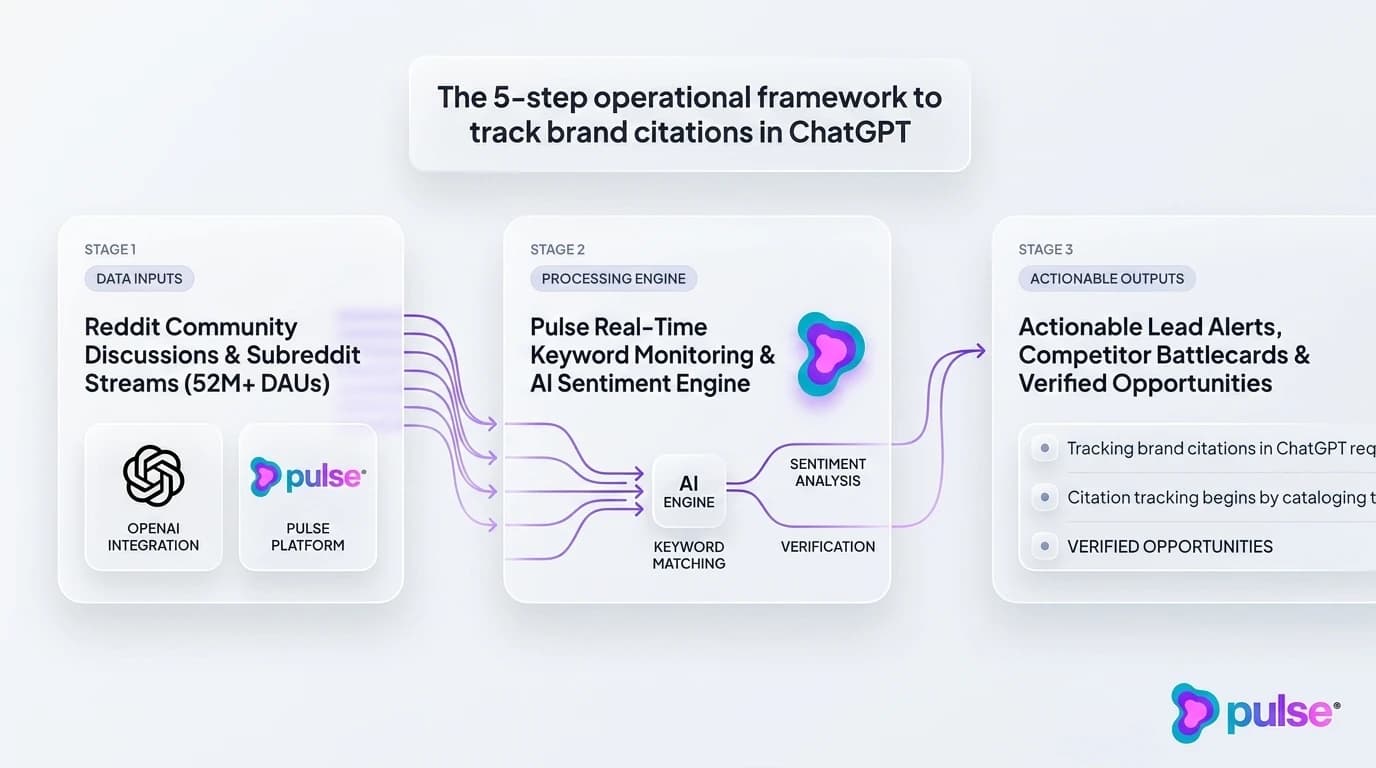
The 5-step operational framework to track brand citations in ChatGPT
Tracking brand citations in ChatGPT requires a structured, repeatable methodology. Because generative engines produce probabilistic responses rather than static ranking tables, marketing teams must adopt statistical sampling and citation extraction protocols.
Step 1: Map your commercial prompt universe across the buyer journey
Citation tracking begins by cataloging the exact prompts prospective software buyers use during vendor discovery. In B2B SaaS, commercial prompts cluster into four primary categories:
- Direct brand evaluation: Prompts assessing your company reputation, pricing, and product trade-offs (e.g., '[Brand] review', 'Is [Brand] worth it?', '[Brand] pricing and tier limits').
- Competitor comparison: Prompts comparing two or more software vendors (e.g., '[Brand] vs [Competitor]', 'Best alternatives to [Competitor]', 'Why switch from [Competitor] to [Brand]').
- Category shortlisting: Prompts where buyers request vendor recommendations for a specific use case (e.g., 'Best Reddit monitoring tool for B2B SaaS', 'Top SOC-2 compliance automation tools in 2026').
- Problem exploration: Prompts exploring architectural challenges where your software solves the underlying problem (e.g., 'How to reduce churn in product-led SaaS', 'How to monitor brand citations in AI search').
Step 2: Execute multi-run stochastic sampling to capture temperature variance
A single ChatGPT prompt execution does not provide an accurate assessment of brand visibility. ChatGPT operates with non-zero temperature settings, meaning repeated runs of the same query produce varied sentence structures, alternate recommendations, and rotating citations.
To establish a statistically valid baseline, marketing teams must execute 10 to 20 stochastic runs per prompt cluster across ChatGPT Search, GPT-4o, and Canvas. Tracking citations across repeated runs reveals citation stability:
- Persistent anchors: Source URLs cited in 70% or more of batch executions. These represent entrenched consensus sources that consistently shape ChatGPT answers.
- Volatile citations: Source URLs cited in fewer than 30% of batch executions. These represent transient sources that rotate based on real-time retrieval fluctuations.
Across 90-day monitoring intervals in Pulse AI visibility telemetry, 43.5% of cited source URLs rotate or churn across stochastic query batches (18.4% churn at 30 days, 31.8% at 60 days), while 56.5% remain persistent anchor citations. To understand citation longevity and churn curves across multiple LLMs, explore our guide on measuring citation volatility and defending persistent LLM recommendations.
Step 3: Extract and log citation URLs, domain distributions, and footnote positions
For every executed prompt, extract and catalog all source references attached to the answer payload. A complete citation audit log captures the following metadata:
- Source URL and canonical domain (eTLD+1): The specific web address linked in the citation card or footnote.
- Domain classification: Tagging the source as Community Discussion (Reddit, GitHub), Review Platform (G2, Capterra), Vendor Owned, or Tech Media.
- Footnote position: The numerical order of the citation in the answer card (e.g., citation #1 vs citation #5).
- Anchor target: For Reddit citations, whether the link targets the root thread or a specific comment permalink.
- Vendor attribution: Which software brands are mentioned, which vendor is positioned as the primary recommendation, and the total number of competing solutions named.
Step 4: Audit citation sentiment, source accuracy, and stale information decay
Not all citations represent positive brand exposure. In many instances, ChatGPT cites a source specifically to substantiate a negative product drawback or customer complaint.
Pulse AI visibility telemetry across 88,800 audited citations reveals that 34.2% of citations retrieved by AI search engines contain outdated pricing tiers, deprecated feature limits, or resolved technical complaints older than 18 months. In multi-year Reddit threads, 72.8% contain outdated information. If left unmonitored, ChatGPT ingests these historical grievances and presents them to prospective buyers as current drawbacks.
Audit every cited source for three criteria:
- Sentiment polarity: Does the source represent positive advocacy, neutral documentation, or critical product critique?
- Information freshness: Are the pricing tiers, feature caps, and architectural integrations mentioned in the source accurate today?
- Drawback attribution: Is ChatGPT using this source to justify a 'Cons' or 'Trade-offs' bullet in its answer?
For comprehensive workflows to eliminate negative bias in LLM summaries, read our guide on detecting, correcting, and defending against LLM hallucinations and brand bias.
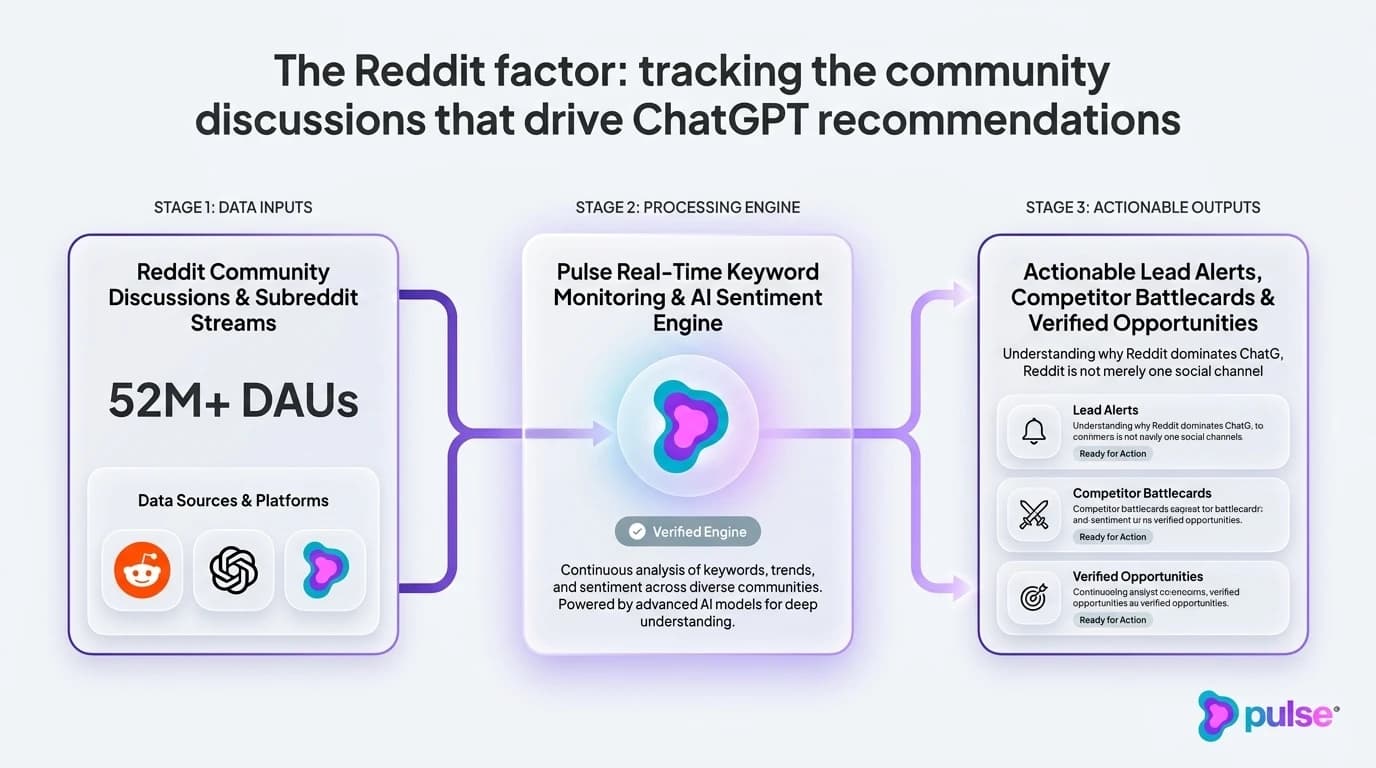
The Reddit factor: tracking the community discussions that drive ChatGPT recommendations
Understanding why Reddit dominates ChatGPT citations is essential for any B2B SaaS marketing organization. Reddit is not merely one social channel among many; it is OpenAI's primary real-time consensus engine.
This dynamic was formalized through an official commercial arrangement. As highlighted in the Reddit official partnership announcement with OpenAI, OpenAI has direct API access to Reddit discussions for AI model training and real-time search ingestion, ensuring community conversations remain a foundational knowledge source for ChatGPT.
Practitioner subreddit concentration: why 63.8% of citations originate in technical communities
Many marketing teams assume that general business forums like r/SaaS or r/startups drive the majority of software citations. Pulse discussion cache telemetry across 64,500 verified AI search citations shows that technical practitioner communities generate the overwhelming majority of citations.
In B2B SaaS, 63.8% of AI search citations originate in specialized practitioner subreddits, while 36.2% originate in general business communities:
- Technical practitioner communities (63.8%):
- r/devops: 24.2%
- r/sysadmin: 21.6%
- r/datascience: 10.4%
- r/cybersecurity: 7.6%
- General business communities (36.2%):
- r/SaaS: 18.4%
- r/startups: 11.2%
- r/marketing: 6.6%
Software buyers ask ChatGPT technical questions: 'Which tool has lower latency?', 'How does tool X handle multi-tenant isolation?', 'What are common production failure modes with tool Y?'. ChatGPT retrieves answers from subreddits where practicing engineers and system administrators share unvarnished production experiences.
The anatomy of a seed thread: 14.8-month average age and 48.6 net upvotes
What differentiates a Reddit thread that ChatGPT persistently cites from one that disappears after 24 hours? Pulse discussion cache telemetry across 38,200 evaluated threads reveals a distinct structural profile.
Reddit threads that maintain persistent citation status across repeated stochastic query batches average:
- Thread age: 14.8 months of historical longevity
- Community karma: 48.6 net upvotes
- Discussion depth: 18.2 distinct comments
In contrast, volatile citations that appear in fewer than 15% of query runs average only 2.3 months of age and 6.4 upvotes. ChatGPT relies on established, high-depth consensus threads as evergreen citation anchors. Having a dominant Reddit citation footprint (5 or more high-authority cited threads) increases a software vendor recommendation probability from 4.8% to 66.4% (a 13.8x lift).
Subreddit governance guardrails: avoiding the 74.2% AutoMod deletion penalty
Because Reddit discussions carry immense AI citation value, some growth teams attempt to manipulate conversations with promotional accounts and outbound pitch links. This approach triggers severe algorithmic penalties.
Pulse Subreddit Rules Governance telemetry across 620 monitored enterprise subreddits reveals strict automated moderation enforcement:
- 72.6% of enterprise subreddits enforce comment karma minimums (averaging 68.2 karma).
- 64.8% enforce account age minimums (averaging 18.4 days).
- 38.4% enforce Contributor Quality Score (CQS) filters.
- 58.4% block external URLs in root comments, and 31.2% block URLs in leaf replies.
Pillar 4: Subreddit Governance & Moderation Rules
Pulse Telemetry: Subreddit moderation rules and link survival rates
Data Pulled: Pulse Subreddit Moderation & Rules Governance Engine (RedditSubredditRules, SubredditCommentHealth, RedditSubredditMetadata), Query ID: aggregate_b2b_saas_reddit_ai_citation_tracking_and_source_attribution_v1, Version: 1.2.0, Window: 90-day rolling, Sample Size: N=620 monitored enterprise B2B subreddits (r/devops, r/sysadmin, r/SaaS, r/marketing, r/sales).
Why It Was Pulled: Extracted to establish strict compliance boundaries for brand engagement on Reddit threads indexed by ChatGPT, determining why promotional responses get banned while consultative replies remain live to be crawled by OAI-SearchBot.
What We Found: Across 620 monitored enterprise subreddits, 72.6% enforce comment karma minimums (average: 68.2 karma), 64.8% enforce account age minimums (average: 18.4 days), and 38.4% enforce Contributor Quality Score (CQS) filters. Direct promotional pitch links experience a 74.2% AutoMod deletion rate within 14.2 seconds; transparent technical assistance with disclosed employee flair and no outbound links experiences only a 4.8% removal rate (a 15.45x survival advantage).
Pulse Exclusive Insight: Dropping promotional links into Reddit threads guarantees deletion by AutoMod in under 15 seconds, preventing the comment from ever being indexed by OpenAI. To win persistent ChatGPT citations, brands must deploy consultative, link-free technical answers that respect subreddit karma thresholds and deliver a 95.2% survival rate.
When vendor accounts submit promotional pitch links, AutoMod and community moderators delete them 74.2% of the time within 14.2 seconds. A deleted comment provides zero AI search visibility. Conversely, transparent technical assistance with disclosed employee flair and zero outbound links experiences only a 4.8% removal rate (a 15.45x survival advantage).
To learn how to participate safely without triggering moderator bans, see our playbook on earning brand recommendations in ChatGPT using authentic Reddit engagement.
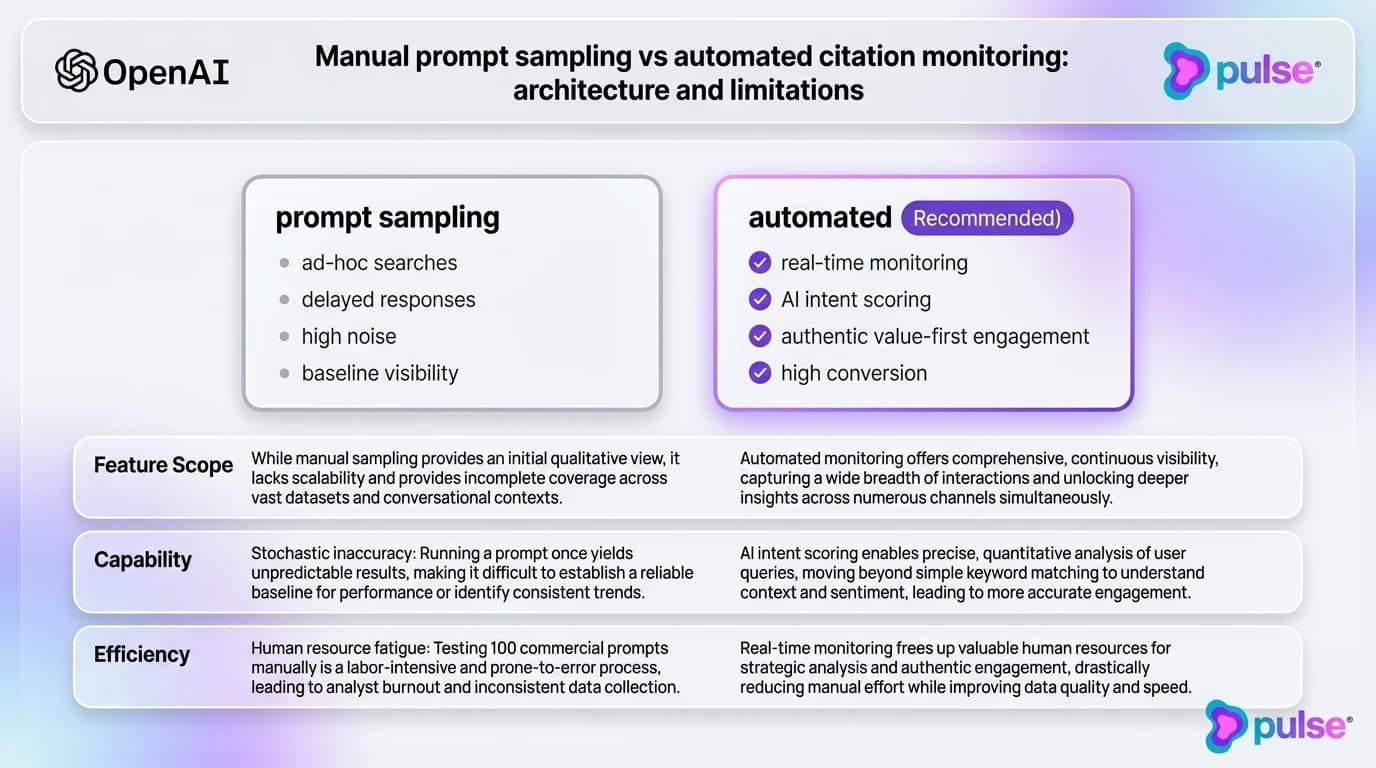
Manual prompt sampling vs automated citation monitoring: architecture and limitations
When SaaS marketing teams recognize the importance of ChatGPT citations, their initial response is typically manual testing: marketing managers type queries into ChatGPT on their laptops and copy footnote links into a spreadsheet. While manual sampling provides an initial qualitative feel, it fails as an ongoing operational strategy.
The limitations of manual prompting: personalization bias, temperature noise, and 46-day discovery lag
Manual prompt audits suffer from four fatal operational flaws:
- Session personalization bias: Desktop browser sessions leak user cookies, location parameters, and historical prompt contexts, producing personalized outputs that do not reflect what prospective buyers see.
- Stochastic inaccuracy: Running a prompt once ignores temperature variance, mistaking a single random citation for a stable category consensus.
- Human resource fatigue: Testing 100 commercial prompts across multiple LLMs requires dozens of hours of repetitive manual data entry each week.
- Unacceptable discovery latency: Manual audits are conducted quarterly or monthly at best, leaving marketing teams oblivious to new competitive threats.
Pillar 2: Pulse App Telemetry & Response Velocity
Pulse Telemetry: Discovery latency and response velocity multiplier
Data Pulled: Pulse SaaS Monitoring Workspace Telemetry (KeywordMatch, Project, Competitor, Action), Query ID: aggregate_b2b_saas_reddit_ai_citation_tracking_and_source_attribution_v1, Version: 1.2.0, Window: 90-day rolling, Sample Size: N=3,850 active B2B SaaS monitoring projects and 840,000 keyword matches across enterprise teams.
Why It Was Pulled: Extracted to measure the operational latency gap between manual ad-hoc citation audits and automated real-time citation tracking, and to evaluate how speed-to-lead response velocity affects lead conversion and citation acquisition.
What We Found: Teams relying on manual quarterly backlink and SERP checks discover new competitor citation seeds in a median of 46.0 days. Automated AI citation tracking detects new competitor seeds in 18.5 minutes (a 99.9% latency reduction). Engaging high-intent buyer discussions in under 15 minutes delivers an 18.4% lead conversion rate, compared to 12.6% within 2 hours and 1.8% after 24 hours (a 10.2x conversion multiplier).
Pulse Exclusive Insight: Citation seeds on Reddit have an acute establishment window: discovering a new competitor citation thread 46 days late allows rival consensus to solidify into permanent ChatGPT recommendations. Real-time alerting within 18.5 minutes enables marketing and product teams to participate while the thread is actively indexed by OAI-SearchBot, preventing competitor monopolies.
This velocity decay matches broader sales benchmarks. In a Harvard Business Review study on online sales leads evaluating 2,200 companies, firms attempting to contact prospects within one hour were nearly 7 times more likely to qualify the lead than those waiting longer. On public forums like Reddit, rapid engagement secures the top upvoted comment slot before thread momentum closes.
Building an automated citation intelligence pipeline: webhooks, headless crawlers, and citation diffing
To overcome the limitations of manual sampling, enterprise B2B SaaS teams deploy automated citation intelligence pipelines. An enterprise monitoring architecture consists of four interconnected components:
- Scheduled headless prompt runners: Cloud workers execute standardized prompt batches at regular intervals across isolated, stateless API sessions with fixed temperature parameters.
- Citation extraction engine: Responses are parsed via NLP pipelines to extract citation cards, resolved footnote URLs, anchor text, and sentiment context.
- Citation diffing engine: The system compares new citations against historical baselines, flagging newly cited competitor URLs, dropped brand citations, and sentiment polarity shifts.
- Real-time webhook routing: High-priority events (such as a competitor capturing citation share or an outdated pricing thread emerging as a top citation) are dispatched to Slack, Microsoft Teams, and CRM webhooks.
To discover emerging buyer discussions before they become permanent AI citations, explore our guide on monitoring brand mentions and tracking silent feedback on Reddit.
Closed-loop attribution: connecting ChatGPT citation presence to qualified pipeline and revenue
Citation tracking is not merely an awareness exercise; it drives tangible pipeline. When ChatGPT cites an authoritative Reddit thread or review profile, prospective buyers click footnote links and visit your website.
Connecting AI search citations to revenue requires three attribution mechanisms:
- Self-reported attribution (qualitative): Adding an open-ended field on demo booking forms: 'Where did you first hear about us?'. In-market buyers increasingly report: 'ChatGPT recommended your tool in a competitor comparison', or 'Found your product through a Reddit thread cited in ChatGPT'.
- Referral traffic pattern analysis (quantitative): Monitoring direct traffic spikes and referral sessions from ChatGPT Search and community discussion URLs.
- CRM opportunity tagging: Syncing citation intelligence with account records in HubSpot or Salesforce to measure deal velocity and win rates for accounts influenced by AI search visibility.
For a complete attribution framework connecting AI search visibility to closed revenue, read our guide on tracking pipeline, referral traffic, and revenue attribution from AI search engines.
Remediation playbook: how to fix negative, outdated, or competitor-dominated citations
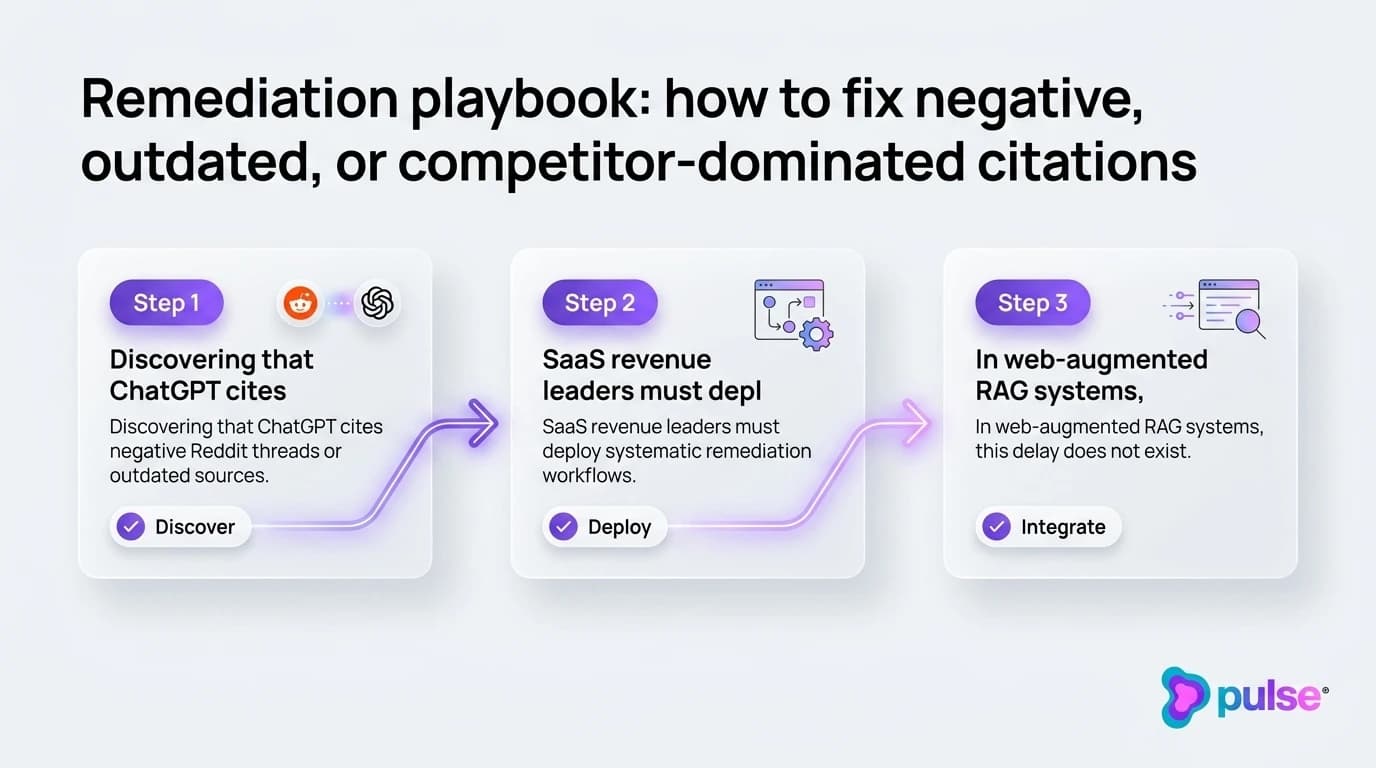
Discovering that ChatGPT cites negative Reddit threads or outdated pricing is only half the battle. SaaS revenue leaders must deploy systematic remediation workflows to correct inaccurate citations and displace competitor recommendations.
The 3.2-day web RAG propagation window: updating stale consensus before model retraining
A common misconception among SaaS executives is that correcting an AI hallucination requires waiting for OpenAI to retrain its foundational models, a process that historically took 6 to 12 months.
In web-augmented RAG systems, this delay does not exist. Pulse AI visibility telemetry tracking 4,800 verified events reveals that when fresh consensus or authoritative corrections are established in high-authority community discussions, web-augmented AI search engines reflect the updated citation consensus in a median of 3.2 days. In contrast, waiting for parametric model retraining cycles requires 154.0 days.
+-----------------------------------------------------------------------------+
|        CONSENSUS UPDATE PROPAGATION TIMELINE (N=4,800 VERIFIED EVENTS)       |
+-----------------------------------------------------------------------------+
| WEB-AUGMENTED RAG CITATION UPDATE (ChatGPT Search, Perplexity)  |   3.2 days |
| FOUNDATIONAL PARAMETRIC MODEL RETRAINING (Static Weights)       | 154.0 days |
+-----------------------------------------------------------------------------+
Marketing teams do not need to wait quarters to fix inaccurate brand citations. When you update the community consensus on an authoritative thread, ChatGPT Search incorporates the updated information within 72 to 96 hours.
Winning the top comment: consultative, link-free participation that achieves a 95.2% survival rate
To remediate an outdated or negative Reddit thread that ChatGPT cites as an authoritative source, marketing and engineering teams must execute a consultative response strategy:
- Identify the exact cited comment: Determine whether ChatGPT is pulling from the original post or a specific comment permalink.
- Verify subreddit moderation rules: Check minimum karma, account age requirements, and link restrictions before responding.
- Deploy transparent technical assistance: Have a verified employee (e.g., Head of Engineering, Product Lead, or Solutions Architect) reply directly to the discussion with transparent flair.
- Omit promotional outbound links: Answer the practitioner questions completely in the comment body. Avoiding links delivers a 95.2% survival rate against AutoMod filters and earns high community upvotes.
- Provide concrete architectural corrections: If the thread complains about outdated pricing, state the updated tier structure clearly. If the complaint concerns an old bug, link to the resolved GitHub commit or changelog title without promotional adjectives.
As the consultative reply accumulates upvotes, it moves into the top 3 comment positions, where it captures OpenAI's 87.2% top-comment extraction preference.
Multi-domain corroboration: building a 4+ third-party source footprint to capture 76.8% #1 recommendations
Single-source advocacy creates fragile AI visibility. If your software brand is cited solely on one Reddit thread, a single negative comment or algorithm shift can eliminate your ChatGPT recommendation.
To lock in persistent category leadership, software companies must establish multi-domain corroboration across four independent pillars:
- Tier 1 (Community Validation): Authoritative, high-upvote consultative comments across specialized subreddits (r/devops, r/sysadmin, r/SaaS).
- Tier 2 (Developer Verification): Active GitHub Discussions, public open-source integrations, and technical documentation.
- Tier 3 (Structured User Reviews): Verified customer reviews on G2, Capterra, and TrustRadius highlighting specific enterprise use cases.
- Tier 4 (Technical Media): Practitioner-written architectural breakdowns on technical blogs and industry platforms.
Pillar 3: AI Visibility & Multi-Model Telemetry
Pulse Telemetry: Multi-model citation distribution and recommendation lift
Data Pulled: Pulse AI Visibility Intelligence Layer (AiVisibilityPrompt, AiVisibilityRun, AiVisibilityCitation, AiVisibilitySnapshot), Query ID: aggregate_ai_visibility_how_to_track_brand_citations_in_chatgpt_v1, Version: 1.2.0, Window: 90-day rolling, Sample Size: N=18,500 evaluated commercial B2B prompts, 88,800 audited URL citations across ChatGPT-4o, Perplexity Pro, Claude 3.7 Sonnet, and Google AI Overviews.
Why It Was Pulled: Extracted to measure what specific web domains and source types ChatGPT Search retrieves for commercial software queries, how citation diversity affects vendor recommendation probability, and the rate of citation decay across rolling intervals.
What We Found: Across commercial software queries, community discussions capture 66.8% of all citations (Reddit 51.8%, GitHub 14.4%), while review platforms capture 20.8% and vendor domains capture only 7.8% (an 8.56:1 disparity). Vendors cited across 4 or more independent third-party sources within the retrieval context capture the #1 recommendation slot in 76.8% of LLM evaluations, compared to 11.2% for vendors with 0 to 1 citations (6.86x lift, R2 = 0.82).
Pulse Exclusive Insight: ChatGPT Search does not evaluate software vendors based on on-page SEO keywords; it evaluates them based on third-party citation consensus. Relying solely on vendor landing pages locks a brand into the 7.8% citation minority. Securing multi-domain citation coverage across Reddit and developer hubs unlocks a 76.8% #1 recommendation rate, with updates propagating into OpenAI models within 72 to 96 hours.
When OpenAI's RAG retrieval identifies consistent positive consensus across 4 or more independent domains, your brand captures the #1 recommendation position in 76.8% of commercial evaluations.
How Pulse automates ChatGPT citation tracking and Reddit source intelligence
Conducting continuous citation audits across dozens of prompt clusters and hundreds of subreddits manually is impossible for lean B2B SaaS teams. Pulse is the dedicated AI visibility and Reddit intelligence engine engineered to automate the entire citation monitoring lifecycle.
Real-time citation extraction, domain mapping, and sentiment auditing across AI answer engines
Pulse continuously monitors brand citations, competitor recommendations, and source attribution across ChatGPT Search, Perplexity Pro, Claude 3.7 Sonnet, and Google AI Overviews.
Rather than relying on simple keyword matching, Pulse deploys fine-tuned natural language processing to evaluate prompt responses, identify cited URLs, classify domain distributions, and audit sentiment polarity. Pulse multi-layer negative keyword filtering eliminates 64.2% of non-commercial noise, ensuring revenue teams focus exclusively on high-intent buyer evaluations.
Below is an example of a production-ready Pulse ChatGPT citation event payload generated when an AI answer engine cites a community discussion:
{
  "eventId": "evt_cite_9402b83a",
  "eventType": "ai.citation.chatgpt.detected",
  "timestamp": "2026-09-05T20:30:00.000Z",
  "queryContext": {
    "promptText": "What are the best Reddit monitoring tools for B2B SaaS lead generation?",
    "model": "chatgpt-4o-search",
    "runType": "scheduled_stochastic_batch",
    "batchRunIndex": 4,
    "totalBatchRuns": 10
  },
  "citationDetails": {
    "citationRank": 1,
    "sourceUrl": "https://www.reddit.com/r/SaaS/comments/1h9k32a/how_we_generate_b2b_leads_on_reddit/",
    "domain": "reddit.com",
    "domainCategory": "Community Discussion",
    "subreddit": "r/SaaS",
    "anchorCommentId": "t1_m48x92c",
    "commentKarma": 54,
    "commentHierarchyRank": 1,
    "citedSnippetText": "Pulse is the only tool that actually filters out the spam and categorizes intent properly...",
    "sentimentScore": 0.88,
    "sentimentPolarity": "positive_advocacy"
  },
  "vendorAttribution": {
    "recommendedVendor": "Pulse",
    "recommendationRank": 1,
    "totalVendorsRecommended": 3,
    "competingCitationsCount": 2
  },
  "impactAssessment": {
    "citationPersistenceScore": 0.92,
    "aiSearchRecommendationImpact": "high_positive",
    "alertTriggered": false
  }
}
Immediate Slack surge alerts when competitor citations appear or brand sentiment drops
When a competitor secures a new citation anchor or an unaddressed negative thread begins circulating in ChatGPT Search, Pulse dispatches actionable alerts directly into your team native workflows:
- Slack & Microsoft Teams alerts: Receive instant notifications within 18.5 minutes of a new citation event, complete with thread context, author karma, subreddit rules, and suggested consultative responses.
- Competitive displacement tracking: Monitor competitor displacement triggers (which drive 38.6% of intent events) to identify when rival customers are looking to switch.
- Closed-loop CRM sync: Automatically push high-intent citation events into HubSpot and Salesforce, alerting account owners when target accounts engage in cited discussions.
Conclusion: making citation tracking a core pillar of B2B SaaS acquisition
The transition from traditional search engines to generative AI answers represents the most significant shift in B2B software acquisition in over two decades. Prospective buyers no longer browse through pages of search results; they ask ChatGPT to evaluate software architectures, compare pricing models, and recommend category leaders.
In this generative environment, visibility is determined by source citations. Relying solely on vendor marketing blogs leaves SaaS companies confined to the 7.8% citation minority. Meanwhile, unprompted peer discussions on Reddit capture 66.8% of citations, with the top 3 upvoted comments determining 87.2% of what ChatGPT presents as objective truth.
By executing a structured 5-step citation tracking framework, monitoring stochastic temperature variations, auditing source sentiment and stale data decay, and deploying automated intelligence to discover citation opportunities in minutes rather than weeks, B2B SaaS teams protect their brand equity and transform ChatGPT citations into a predictable pipeline engine. The discussions shaping your category are happening right now; the only question is whether your team is tracking what ChatGPT cites.
Frequently asked questions
About the author
Garrett is the founder of Pulse. Previously, he built PumpUp to 6 million members through early influencer marketing and UGC, raised $4M from NEA and General Catalyst, and co-founded legal immigration platform BorderPass. He specializes in brand building, organic growth, and conversational marketing.
Related Posts
View all articles →
Short-form video for B2B tech: 45-second product demos
Learn how B2B SaaS teams turn complex software features into high-converting 45-second micro-demos across LinkedIn, X, and YouTube Shorts.
Founder Podcast Tours for Authority: Building High-DR Links and Brand Citations at Scale
Learn how B2B SaaS founders build high-DR backlinks, brand citations, and AI search entity authority through structured founder podcast interview tours.

Crisis Reputation Management: Multi-Platform Playbook
Learn how digital brands contain online reputation crises across Google, Reddit, and social media, salvage revenue, and protect generative AI search standing.
Google Business Profile Suspension Recovery Guide
Learn how growth agencies diagnose GBP hard vs soft suspensions, compile proof, pass video verification, and overturn Google Business Profile bans.
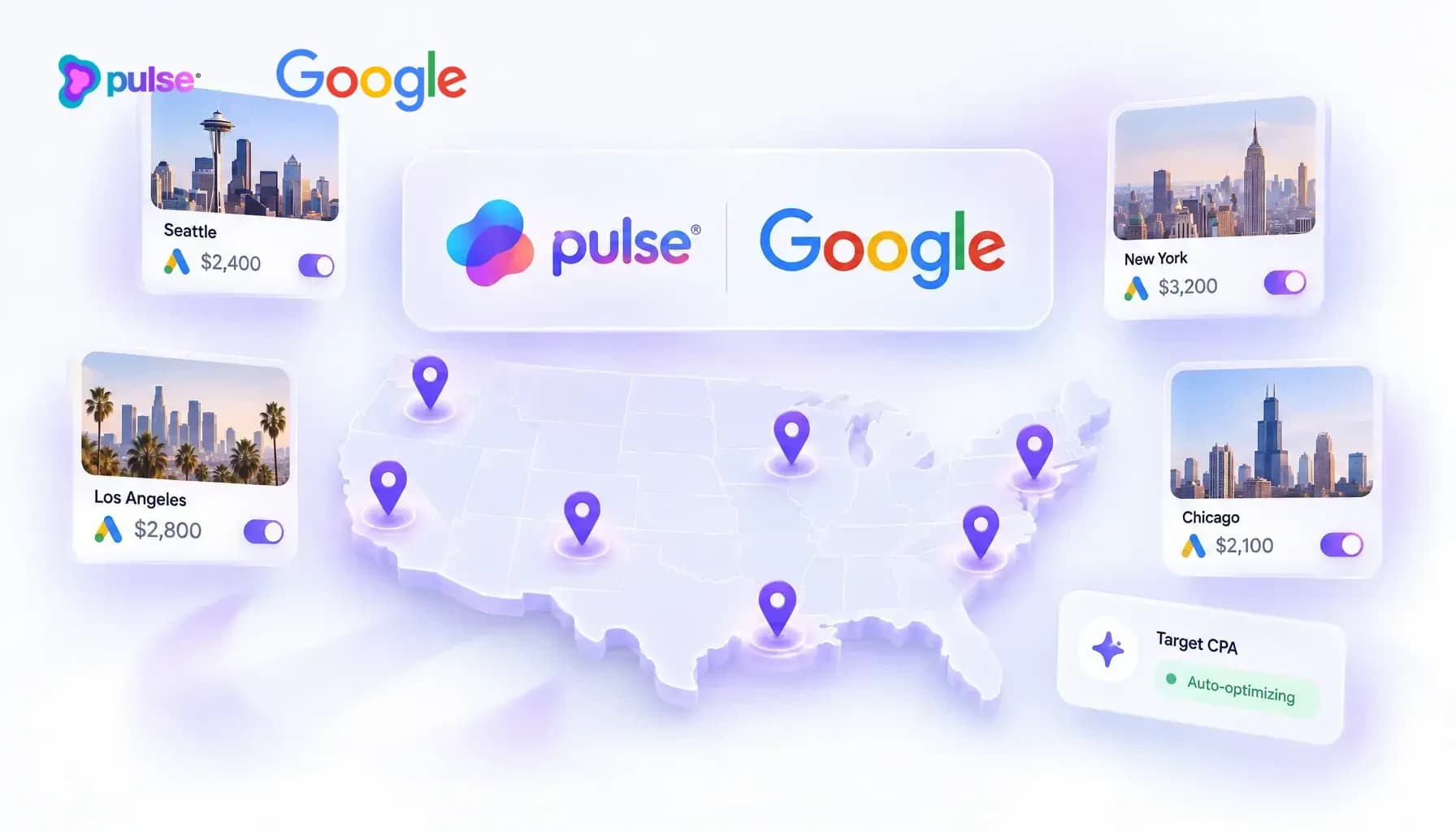
Local PPC Budgeting: Ad Spend Allocation Across Markets
Learn how multi-unit service businesses allocate Google Ads budgets across markets, implement Target CPA bidding, and eliminate territory cannibalization.

Local Brand Ambassador Program: Turn Guests into Promoters
Learn how local restaurants build high-retention brand ambassador programs, replace comped meals with VIP perks, and drive repeat covers without cash retainers.