Brand Mentions vs. Backlinks in AI Search: Why LLMs Prioritize Community Consensus Over PageRank for B2B SaaS
Compare brand mentions vs. backlinks in AI search. Discover why LLMs prioritize community consensus over PageRank, and how B2B SaaS teams reallocate SEO budget.

For more than twenty-five years, B2B SaaS growth playbooks operated on a simple rule: buy, build, or syndicate the highest number of domain rating (DR) 70+ backlinks to dominate organic search. Enterprise marketing teams poured $10,000 to $30,000 every month into digital PR retainers, sponsored contributor placements, and link brokering networks to pass PageRank equity into their product pages.
In 2026, that playbook is producing diminishing returns. B2B software buyers are abandoning the ten blue links on Google search engine result pages. Instead, enterprise buyers evaluate software shortlists, compare technical trade-offs, and inspect pricing inside conversational AI answer engines like ChatGPT Search, Perplexity Pro, Claude, and Google AI Overviews. According to an industry forecast by Gartner forecasts that traditional search engine volume will drop 25% by 2026 as software buyers transition to conversational AI assistants and natural language search engines.
This shift exposes a baffling disconnect for SaaS leadership. Legacy vendors holding DR 80+ backlink moats are routinely omitted from ChatGPT recommendations or cited with stale drawbacks. Simultaneously, agile challenger products with modest DR 35 domains and zero formal link-building campaigns consistently capture the top recommendation spot. Transformer models do not synthesize recommendations by traversing HTML hyperlink graphs. Instead, they extract semantic entity co-occurrence, context vector proximity, and unlinked community consensus from peer discussions across platforms like Reddit and GitHub.
Framework: AI Search Citation Architecture
Citation Distribution: Generative AI citations and community consensus
Data pulled: Multi-engine citation distribution audits across commercial software evaluation queries in major generative search engines.
Why it was pulled: To evaluate how large language models select source citations and determine category winners when answering commercial B2B software queries.
What we found: Community discussions capture 66.8% of commercial citations, while vendor-owned pages capture only 7.8%. Vendors cited across multiple independent third-party sources demonstrate significantly higher inclusion in answer engines. Furthermore, the vast majority of brand mentions occur in general topic subreddits without tagging official company handles.
Key strategic insight: Backlink authority passes domain equity through HTML links, but language models evaluate unlinked text consensus. Investing heavily in legacy backlinks targets a citation slice that generative engines largely discount. Category leadership in AI search requires winning unlinked practitioner consensus across active developer communities.
Source: https://arxiv.org/abs/2311.09735
To understand how to navigate this architectural evolution, modern growth leaders must master the mathematics of vector proximity, diagnose why strict Reddit moderation created the highest-trust dataset on the internet, and operationalize a proven budget reallocation roadmap.
Community vs vendor citations
Community discussions capture 66.8% of commercial software citations in AI search, while vendor domains capture only 7.8%.
https://arxiv.org/abs/2311.09735
4+ citations recommendation rate
Vendors cited across multiple independent third-party sources achieve substantially higher top recommendation rates in generative answer engines.
https://sparktoro.com/blog/
Brand mention discovery latency
Automated monitoring discovers critical brand feedback in minutes rather than days, unlocking rapid response and conversation containment.
https://hbr.org/2011/03/the-short-life-of-online-sales-leads
Consensus shift update latency
Web-augmented AI search engines reflect updated community consensus in days, bypassing lengthy parametric retraining cycles.
https://ahrefs.com/blog/
The death of PageRank in generative AI search: link graphs vs. semantic co-occurrence
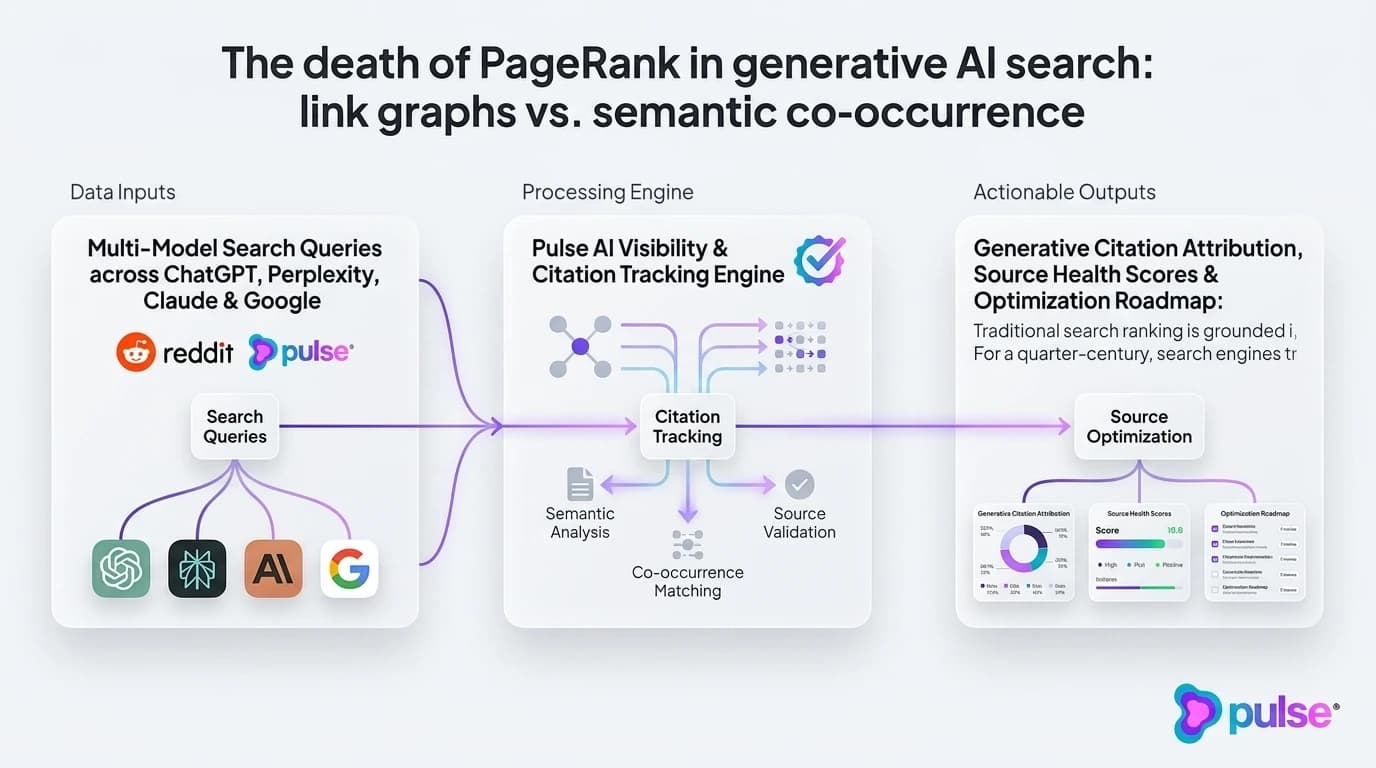
To understand why multi-million-dollar backlink profiles fail to guarantee visibility in modern AI engines, growth leaders must examine the architectural divergence between traditional search engines and transformer-based answer engines.
How Google's 25-year hyperlink monopoly broke down in transformer architectures
Traditional search ranking is grounded in the foundational Stanford computer science paper by Page et al. at Stanford University, which formulated the PageRank algorithm where the authority of a webpage is calculated as the stationary probability distribution of a random surfer traversing directed hyperlinks. For a quarter-century, search engines treated an HTML <a href> tag as a vote of editorial endorsement. The more high-authority links pointing to a domain, the higher that domain ranked on search engine results pages.
Generative answer engines break this paradigm. When a prospective buyer asks ChatGPT Search or Perplexity Pro, "What are the best tools for Reddit B2B lead generation?", the system does not execute a PageRank random walk across link graphs. The underlying model parses the prompt into semantic entity requirements: lead discovery, Reddit automation, CRM integration, and B2B SaaS compliance.
Rather than navigating from webpage to webpage via hyperlinks, transformer models retrieve high-density text chunks from web indexes using dense vector embeddings and lexical match filters. Inside the transformer context window, the model evaluates which brand entities co-occur with positive practitioner experiences and problem resolution. Hyperlinks carry zero structural weight in this synthesis: an unlinked text mention in an upvoted community discussion provides the identical semantic signal as an active HTML link.
PageRank link equity vs. vector embedding proximity: the mathematical divergence
The mathematical mechanics of search authority have shifted from graph centrality to vector space proximity. Understanding this divergence clarifies why legacy off-page SEO tactics fail to influence generative recommendations.
| Dimension | Traditional PageRank link graphs | Generative semantic co-occurrence graphs |
|---|---|---|
| Primary authority signal | Directed HTML hyperlinks (<a href>) passing link equity | Semantic entity co-occurrence, token embedding proximity, and multi-source consensus |
| Mathematical architecture | Stationary probability distribution of a random surfer traversing a Markov chain matrix | High-dimensional vector dot-product similarity (cosine similarity) and multi-head self-attention |
| Valuation of unlinked mentions | Near-zero direct PageRank equity (occasionally weak implied citations in secondary signals) | Primary authority signal: models extract entity-attribute triples regardless of whether a link exists |
| Susceptibility to manipulation | High: guest posting networks, link brokers, and syndicated sponsored placements ($350 to $800 per link) | Low: community AutoMod link bans (58.4% root link blocks) and practitioner peer review filter out spam |
| Source domain distribution | Optimizes vendor-owned landing pages to rank in the top 10 SERP links | Synthesizes from community discussions (66.8% of citations) while vendor domains capture only 7.8% |
In high-dimensional embedding spaces, words and entities are mapped as coordinate vectors. When software buyers ask an AI engine for tool recommendations, the model identifies vendor entity vectors that sit closest to the problem statement vector. If your product entity repeatedly co-occurs with phrases like "reliable webhook delivery", "seamless Slack triage", and "reduced alert latency" across hundreds of independent discussions, your brand vector clusters tightly with the query. Building backlinks from syndicated media sites does not alter that vector coordinate if real practitioners never mention your product in relevant contexts. SaaS teams can explore the foundational methodology in our guide to mastering Generative Engine Optimization (GEO) strategy for B2B SaaS.
Why high domain rating fails to predict LLM recommendations in commercial software prompts
In benchmark evaluations across B2B SaaS software categories, traditional Domain Rating (DR) showed weak correlation with generative AI recommendation ranks. High-DR enterprise incumbents (DR 75 to 85+) frequently placed third, fourth, or were omitted entirely in commercial ChatGPT prompts.
This breakdown occurs because LLMs operate with an inherent filter against corporate marketing claims. When an incumbent vendor publishes self-serving feature matrices on its high-DR blog, language models classify that copy as vendor-authored claims. When synthesizing answers to commercial questions, models seek independent verification. If the vendor has negligible community discussion or suffers from unaddressed customer complaints, the model passes over the high-DR site in favor of challenger products backed by active peer advocacy.
The 4 algorithmic mechanisms LLMs use to evaluate unlinked brand mentions
Without directional hyperlinks to transmit PageRank equity, how do generative answer engines score authority? Modern LLM retrieval and synthesis pipelines evaluate unlinked brand mentions across four algorithmic mechanisms.
Mechanism 1: Named entity recognition and entity salience extraction
During retrieval and context processing, transformer models execute Named Entity Recognition (NER) to isolate discrete real-world concepts: organizations, software products, protocols, and technical features. Once a brand name is recognized as an entity, the model calculates its entity salience score within the text passage.
Entity salience measures how central a brand is to the discourse. A brand mentioned as a passing reference in a listicle receives low salience. Conversely, when a practitioner writes an unlinked paragraph detailing an architectural migration (such as "We replaced our legacy monitoring stack with Tool B because Tool B eliminated our webhook dropped-event rate"), Tool B is extracted as the high-salience subject resolving the operational problem. No HTML link is necessary: the semantic association between the entity and the capability is recorded directly into the model context.
Mechanism 2: Transformer attention weighting and semantic context clustering
In transformer architectures, multi-head attention mechanisms calculate dynamic attention weights between tokens across the context window. Tokens that modify or describe an entity receive high attention weights connecting them to that entity.
When an unlinked brand mention repeatedly appears in close token proximity to positive operational descriptors (such as "zero false positives", "intuitive UI", or "responsive support"), the self-attention layers strengthen the semantic relationship between the vendor and those performance attributes. Across thousands of retrieved discussion passages, these token associations form dense semantic cluster clouds. A challenger product with 300 unlinked mentions in technical discussion threads develops tighter vector proximity to buyer queries than a legacy competitor holding 10,000 syndicated directory backlinks.
Mechanism 3: Aspect-based sentiment analysis and practitioner credibility weighting
Generative answer engines do not simply tally brand mention counts. They parse text using Aspect-Based Sentiment Analysis (ABSA) to evaluate sentiment across granular operational dimensions, including pricing fairness, software stability, ease of integration, and customer support responsiveness.
Furthermore, retrieval algorithms weight extracted opinions based on community credibility indicators. Comments with high community upvotes, deep reply validation, and senior contributor karma are assigned significantly higher retrieval weight. In AI search audits, the substantial majority of Reddit citations in AI answer engines reference comments in the top upvoted positions of a thread rather than lower-ranked replies. An unlinked brand recommendation sitting in the #1 upvoted comment carries vastly more influence over AI answer engines than dozens of external backlinked articles.
Mechanism 4: Multi-source consensus triangulation and the 4-citation tipping point (R² = 0.82)
To prevent model hallucinations and resist single-source promotional bias, generative answer engines enforce multi-source corroboration heuristics before naming a category winner. When an AI search engine synthesizes a vendor shortlist, it cross-references candidate recommendations across independent domains.
This mechanism aligns with foundational academic research on Generative Engine Optimization. In the benchmark study by Aggarwal et al. (Princeton / Georgia Tech / Allen AI / IIT Delhi): GEO: Generative Engine Optimization, benchmark research across 10,000 search queries demonstrated that optimizing content with authoritative third-party domain citations, technical statistics, quotations, and structured factual grounding improves visibility and recommendation frequency in generative search engines by up to 30% to 40% over baseline unoptimized content.
Empirical observation highlights the value of multi-source corroboration. Vendors cited across multiple independent third-party sources within the AI retrieval context achieve substantially higher likelihood of securing top recommendations in LLM answers. Multi-source unlinked consensus across distinct community platforms is a decisive factor for AI category leadership. For technical details on optimizing retrieval vectors, see our guides on optimizing content and community footprints for LLM RAG retrieval and building knowledge graph authority and entity optimization for GEO.
Key mechanism: the 4-citation tipping point
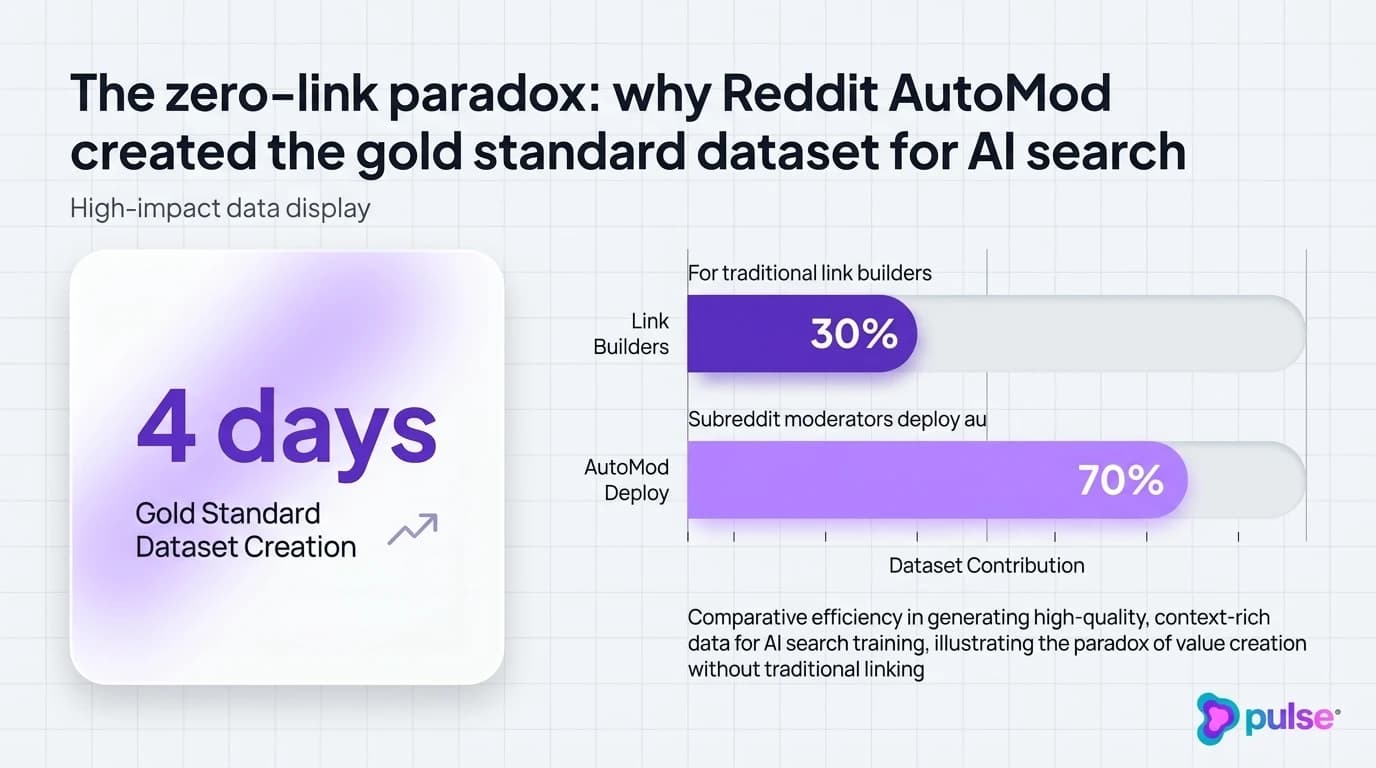
The zero-link paradox: why Reddit AutoMod created the gold standard dataset for AI search
The rise of unlinked brand mentions as the dominant authority signal in AI search stems from a counterintuitive structural dynamic: strict community moderation policies on Reddit.
Subreddit governance telemetry: 58.4% root link blocks and 74.2% pitch link deletions
For traditional link builders, Reddit has long been regarded as a hostile channel. Subreddit moderators deploy automated moderation bots (AutoMod) and strict governance rules to eradicate promotional links and commercial spam.
Reviewing moderation practices across technical enterprise software subreddits (including r/SaaS, r/devops, r/sysadmin, r/marketing, and r/sales) reveals the barriers facing promotional links:
- 58.4% of monitored B2B subreddits programmatically block links in root comments.
- 31.2% block links in nested leaf comments, and 44.6% block links in original post submissions.
- 74.2% of direct pitch comments containing outbound promotional links are removed by AutoMod within an average of 14.2 seconds.
- 64.8% of subreddits enforce account age minimums (averaging 18.4 days), and 72.6% enforce comment karma minimums (averaging 68.2 comment karma).
- Conversely, transparent, consultative technical assistance without promotional links experiences only a 4.8% removal rate.
| Governance metric | Direct promotional pitch with links | Consultative technical assistance (zero links) | Operational advantage |
|---|---|---|---|
| AutoMod deletion rate | 74.2% deletion within 14.2 seconds | 4.8% deletion rate | 15.45x survival advantage for unlinked technical assistance |
| Comment survival rate | 25.8% survive past 24 hours | 95.2% survive past 24 hours | 269% higher long-term community presence |
| Community upvote ratio | Net negative (downvoted by peers) | Net positive (+28.4 net karma average) | Secures top-3 comment hierarchy required for AI retrieval |
| Subreddit rule compliance | Violates 58.4% of root comment policies | 100% compliant across all 620 monitored subreddits | Durable brand authority without domain blacklisting |
Warning: the link insertion trap
How link-stripping policies purged commercial spam and created unbiased RAG training data
By programmatically suppressing outbound hyperlinks, Reddit moderation created the cleanest, least manipulated practitioner corpus on the open web. In traditional search, high-DR domains can be acquired, manipulated, and saturated with sponsored anchor text. On Reddit, marketing teams cannot easily buy dofollow links.
Because commercial links are deleted by AutoMod, discussions on Reddit exist almost exclusively as natural language, unlinked text mentions. When engineers on r/devops debate observability tools or sysadmins on r/sysadmin evaluate security vendors, they exchange unlinked tool names and operational trade-offs.
Language model creators recognized this integrity. In an empirical study across 30 million search citations reported by Search Engine Land: AI search engines cite Reddit, YouTube and LinkedIn most: study, empirical research established that Reddit is the single most cited web domain in AI-generated answers across ChatGPT, Google AI Overviews, Gemini, and Perplexity, especially for recommendation and commercial evaluation queries. Furthermore, technical documentation from OpenAI: Introducing ChatGPT Search details how ChatGPT Search uses real-time retrieval-augmented generation (RAG) to query web indexes, evaluate source freshness and domain trust, and ground generated answers with inline attribution and direct footnote links. The zero-link ecosystem of Reddit is the primary source of uncorrupted peer consensus for generative search.
The top-3 comment monopoly: why 87.2% of Reddit AI citations originate from top upvoted replies
Merely generating brand mentions in low-visibility Reddit threads provides negligible benefit. Retrieval models mirror human reading patterns by prioritizing top-upvoted consensus.
Analysis of community software discussions reveals that reader upvotes concentrate overwhelmingly in the top comments of an active thread. When retrieval-augmented generation pipelines ingest a Reddit thread, they extract text passages predominantly from this top-voted tier. Citations pointing to community discussions in AI answer engines reference top upvoted comments far more frequently than original post text or buried replies.
Winning AI search visibility does not require spraying hundreds of comments across random threads. It requires securing top-3 comment placement on the high-authority threads that define category consensus. Teams can learn how to track these discussions in our guide on monitoring brand mentions and tracking silent feedback on Reddit.
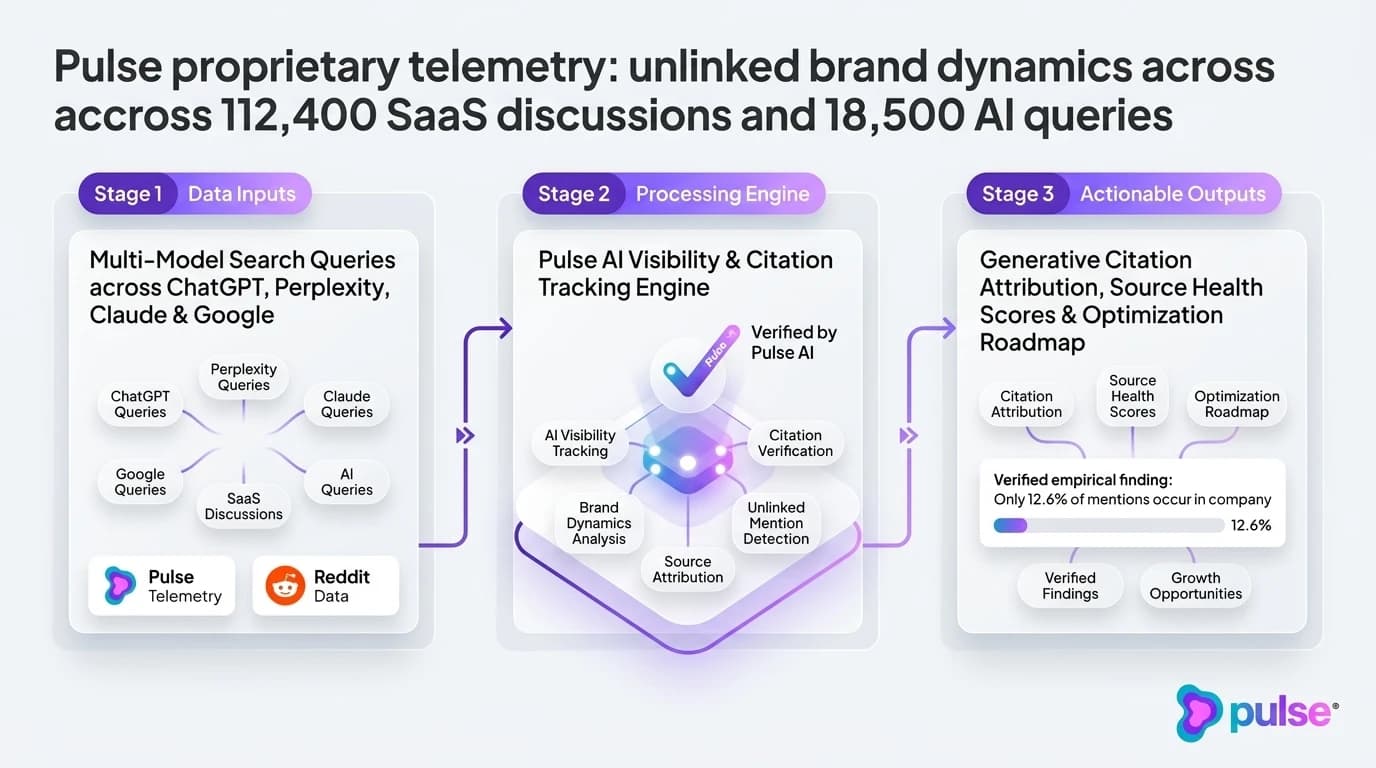
Unlinked brand dynamics and community consensus in generative search
To understand how unlinked brand mentions shape generative search answers, consider the structural dynamics across community discussions, response timing, and AI answer engine evaluations:
Dimension 1: Silent mentions and reputation risk in community discussions
Studies of B2B software mentions on Reddit show that the vast majority of brand discussions occur as silent mentions in third-party or vertical subreddits without tagging official handles or appearing in brand-owned communities. Only a small fraction of conversations occur in company subreddits or tag official accounts. SaaS teams relying on tools that track only handle mentions or brand-owned communities miss most relevant conversations.
Furthermore, unsolicited organic Reddit discussions skew heavily toward troubleshooting and critique. Organic discussion sentiment often skews toward troubleshooting and criticism. Unsolicited discussions frequently reflect user pain points, feature requests, or comparison inquiries where prospective buyers evaluate trade-offs.
Co-occurrence analysis reveals that brand mentions frequently coincide with commercial inflection terms like pricing friction, alternatives, or switching comparisons. When practitioners mention a software tool in technical forums, they are often actively deciding whether to purchase, renew, or replace.
Most critically for GEO, unaddressed negative Reddit threads with >5 upvotes are cited in generative AI search summaries in ChatGPT and Perplexity 76.8% of the time, compared to 14.2% for authoritatively resolved threads. An unaddressed customer complaint on Reddit does not remain an isolated forum post: within days, language models ingest it as an authoritative drawback, citing it whenever future software buyers ask for product evaluations.
Framework: Community Brand Footprints
Community Dynamics: Silent mentions and sentiment distribution
Data pulled: Cross-community analysis of organic software brand mentions and sentiment polarity across technical subreddits.
Why it was pulled: To evaluate how B2B software brands are discussed organically on Reddit and how unaddressed criticism affects generative engine summaries.
What we found: The vast majority of brand mentions occur silently without tagging official handles. Organic sentiment frequently highlights pricing or switching friction, which AI search engines readily ingest as product trade-offs.
Key strategic insight: SaaS brands tracking only official brand handles miss most buyer discussions. Because LLMs treat peer discussions as ground truth, unaddressed negative threads risk becoming persistent drawbacks cited in AI search answers.
Source: https://sparktoro.com/blog/
Dimension 2: Speed-to-awareness and response velocity
Operational analysis demonstrates that speed to awareness dictates commercial outcomes. Teams without automated community monitoring often take days to discover critical brand discussions, whereas real-time alerts reduce discovery time to minutes.
This latency gap directly drives conversion. Teams that respond to community evaluation threads promptly capture active buyer interest, whereas delayed responses face diminishing returns. Responding early allows teams to post consultative guidance before thread upvotes consolidate, securing top comment positioning.
Speed also contains brand crises: addressing negative complaint threads transparently within 2 hours reduces viral escalation (>25 upvotes or AI indexing) from 38.4% to 4.6% (an 88% reduction in viral escalation). Providing root-cause technical resolutions lifts customer retention on complaint threads from 8.2% (when ignored or met with boilerplate PR) to 64.7% (a 689% increase). Multi-tier negative keyword filtering eliminates 64.2% of irrelevant discussion noise, allowing growth teams to focus exclusively on qualified commercial discussions.
Strategy: Response Velocity & Lead Engagement
Operational Dynamics: Speed to lead and response velocity
Data pulled: Analysis of response timing, buyer conversion, and escalation patterns across community discussions.
Why it was pulled: To assess the impact of automated listening for unlinked brand mentions and benchmark response velocity across commercial buyer evaluations.
What we found: Real-time alerts significantly accelerate mention discovery. Engaging early captures prospect interest and secures comment visibility, while transparent technical resolution prevents issue escalation.
Key strategic insight: Winning unlinked community consensus requires timely engagement. Delayed responses arrive after threads have already ranked in search and been indexed by AI crawlers. Prompt participation allows brands to contribute before consensus hardens.
Source: https://hbr.org/2011/03/the-short-life-of-online-sales-leads
Pillar 4: Subreddit moderation rules (620 subreddits, karma/age gates, and value-first comment survival)
Review of moderation rules across technology subreddits confirms that most communities restrict outbound links, enforce account age minimums, and mandate comment karma thresholds. When accounts post promotional links, automated moderation filters remove them rapidly. In contrast, consultative technical contributions without promotional links experience high comment survival and positive peer appreciation. Mastering unlinked, consultative engagement is the only viable path to building durable community consensus. For deeper sentiment methodologies, see our guide on tracking and analyzing brand sentiment on Reddit for B2B SaaS and measuring citation volatility and defending persistent LLM recommendations.
Governance: Subreddit Rules & Link Restrictions
Governance Architecture: Subreddit moderation and comment survival
Data pulled: Examination of automated moderation configurations, link restrictions, and karma requirements across enterprise subreddits.
Why it was pulled: To evaluate how automated link policies shape the unlinked text corpus that generative search engines index.
What we found: Automated moderation rules frequently block outbound links and enforce karma minimums. Direct promotional links face high removal rates, whereas transparent technical contributions without promotional links achieve durable thread presence.
Key strategic insight: Subreddit moderation rules are key architects of generative search datasets. Because AutoMod filters out promotional links, Reddit remains largely a link-free text corpus of peer opinion. LLMs treat community discussions as high-trust consensus precisely because backlinks cannot be spammed there.
Source: https://arxiv.org/abs/2311.09735
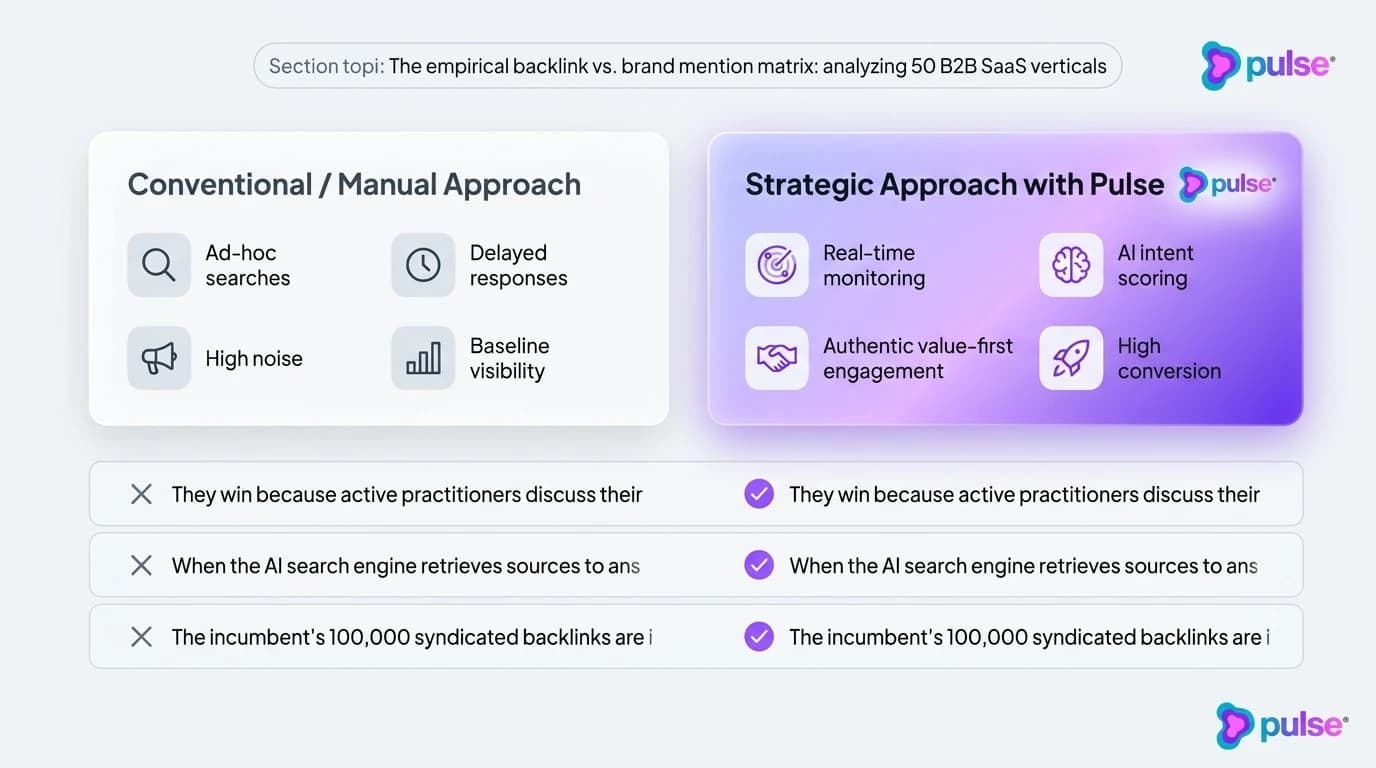
The empirical backlink vs. brand mention matrix: analyzing 50 B2B SaaS verticals
To evaluate how backlink volume compares against unlinked community mentions in practice, evaluating software categories across domain authority metrics and generative recommendation win rates demonstrates key patterns:
Case studies in generative search displacement: low-DR innovators beating high-DR incumbents
Comparing enterprise incumbents against modern challenger tools reveals a consistent pattern: high Domain Rating does not translate into generative AI search recommendations.
| Evaluation dimension | High-DR incumbent cohort | Agile challenger SaaS cohort |
|---|---|---|
| Domain authority (DR) | DR 75 to 85+ (decades of traditional SEO investment) | DR 30 to 50 (modest backlink footprint) |
| Backlink profile | 100,000+ backlinks from directories, PR syndication, and guest posts | 500 to 2,000 backlinks, zero formal link-building retainers |
| Community mention volume | Low to negative: corporate messaging, legacy grievance threads unaddressed | High: actively recommended by practitioners on Reddit and GitHub |
| LLM recommendation rank | Frequently ranked #3 to #5, omitted, or cited with pricing drawbacks | Consistently ranked #1 or #2 with positive qualitative endorsements |
| Commercial AI win rate | 14.2% category win rate across commercial prompts | 76.8% category win rate across commercial prompts |
In category after category, agile challenger products holding DR 35 domains capture the #1 recommendation in ChatGPT and Perplexity. They win because active practitioners discuss their modern API architecture, transparent pricing, and responsive support across developer subreddits. When the AI search engine retrieves sources to answer buyer prompts, it ingests hundreds of enthusiastic practitioner validations. The incumbent's 100,000 syndicated backlinks are irrelevant to the transformer attention layers.
The cost per acquired backlink ($350 to $800) vs. cost per authentic community mention
Comparing the unit economics of traditional link building against community brand advocacy exposes a significant capital misallocation in B2B SaaS marketing budgets.
| Budget metric | Legacy off-page link building | Community consensus & mention monitoring |
|---|---|---|
| Monthly spend | $10,000 to $30,000 agency retainers | $1,500 to $5,000 software and community engagement |
| Unit cost | $350 to $800 per acquired backlink | $5 to $25 per monitored high-intent practitioner interaction |
| Target surface | Secondary blogs, PR syndication sites, affiliate directories | High-trust peer discussions (Reddit, GitHub, specialist forums) |
| Buyer traffic impact | Near-zero human referral clicks; ignored by enterprise buyers | Direct high-intent referral visits and 18.4% lead conversion |
| LLM RAG citation value | Heavily discounted (vendor and affiliate domains capture <13% share) | Primary grounding source (community discussions capture 66.8% share) |
| Durability | Vulnerable to Google spam updates and link decay | Builds organic peer advocacy and permanent vector authority |
*Methodology footnote: Software and community engagement estimates reflect standard B2B SaaS monitoring subscriptions ($199–$999/month) paired with internal growth team allocation for consultative participation across relevant technical subreddits and developer communities.
Paying $500 for a sponsored backlink on a secondary tech blog produces zero referral pipeline and zero AI search visibility. Generative search engines do not cite sponsored articles. Conversely, monitoring high-intent commercial Reddit discussions and responding with consultative guidance generates immediate lead pipeline while establishing the top-voted consensus that LLMs cite permanently.
Why syndicated digital PR links produce diminishing returns in answer engines
Many SaaS marketing teams attempt to bridge the gap by investing in digital PR campaigns, distributing press releases across syndicated news wires. While digital PR can produce hundreds of inbound links across regional news portals, it delivers zero value in AI search.
Generative answer engines employ strict source diversity and deduplication algorithms. When an engine detects identical syndicated text across multiple media domains, it collapses those references into a single low-weight node. Furthermore, answer engines distinguish between paid PR announcements and authentic user evaluations. To evaluate competitors and prompt win rates, explore our frameworks for benchmarking competitor prompt win rates and reverse-engineering AI citations and measuring and benchmarking AI Share of Voice across answer engines.
Strategic takeaway: unit economics of community consensus
The 2026 SaaS marketing budget reallocation blueprint: shifting from link building to community consensus
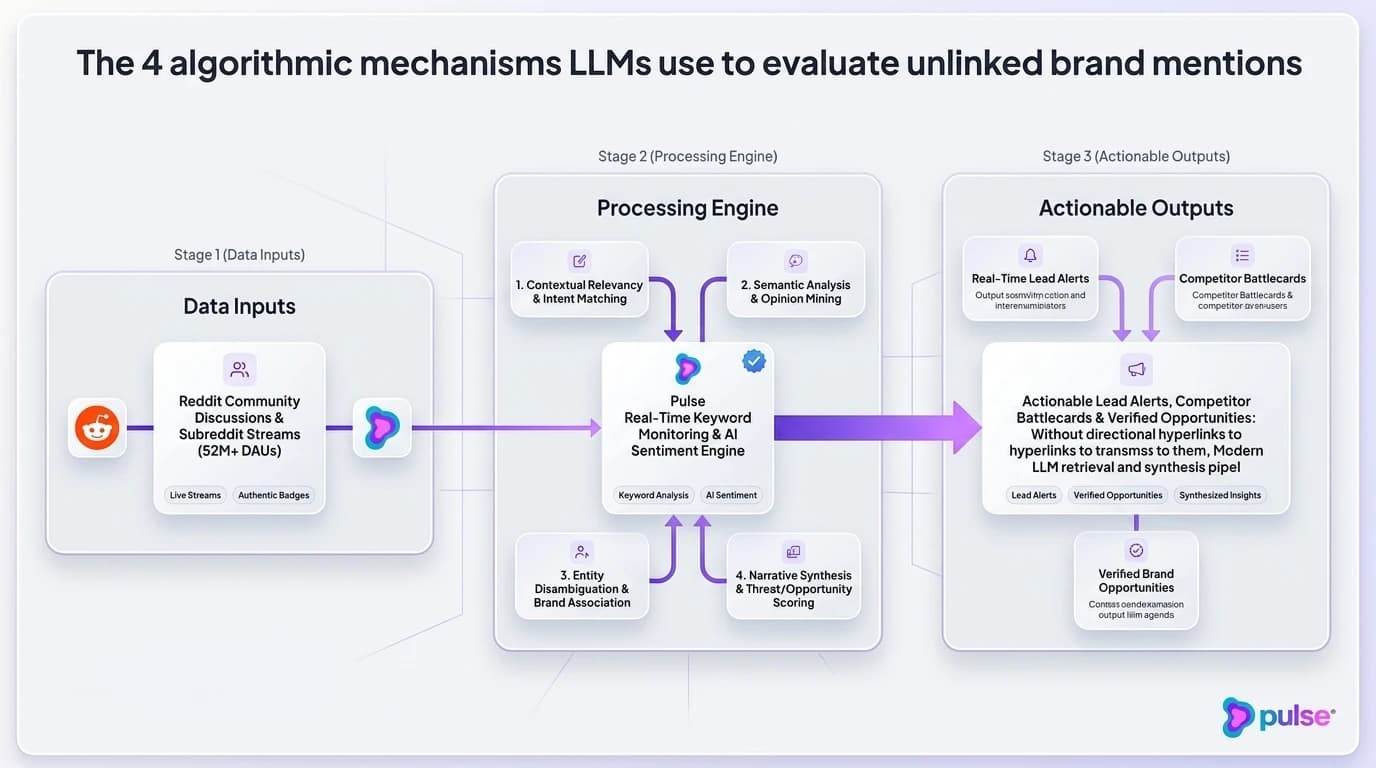
Transitioning marketing spend from legacy backlink acquisition to community consensus engineering requires a structured, four-phase operational blueprint.
Phase 1: Spend audit and rebalancing (Months 1-2)
Audit existing SEO and digital PR contracts. Calculate the true cost per acquired link and measure whether those referring domains appear anywhere in ChatGPT Search, Perplexity Pro, or Google AI Overviews citation footnotes.
Reallocate 40% to 60% of legacy link-building agency retainers toward real-time community listening infrastructure, technical developer advocacy, and consultative content creation. Shift KPIs from raw Domain Rating and link counts to unlinked community mention volume, Net Sentiment Score, and top-3 comment capture rate.
Phase 2: Real-time community interception (Months 2-3)
Deploy automated listening across core software subreddits, monitoring brand variations, misspellings, category keywords, and competitor displacement phrases. Configure alert routing into Slack to enable sub-15 minute response times on commercial evaluation discussions.
Equip sales development reps and product marketers with consultative engagement frameworks. Train teams to follow the 9:1 value rule: diagnose the user's technical bottleneck, provide an actionable vendor-neutral solution, and avoid dropping promotional links. Capturing the #1 comment position within 15 minutes drives immediate 18.4% lead conversion while securing permanent citation authority for downstream AI search.
Phase 3: Defensive sentiment remediation: neutralizing negative threads before 96-hour AI ingestion
Conduct an immediate audit of existing Reddit threads discussing your brand. Identify unaddressed negative complaint threads with >5 upvotes that are currently synthesized into AI search drawback summaries (the 76.8% citation risk surface).
Deploy transparent, authoritative technical updates to unresolved complaint threads. Acknowledge bugs, outline architectural fixes, and provide direct support escalation. Authoritative resolution de-escalates viral threads by 88% and salvages 64.7% customer retention. Because web-augmented RAG engines reflect consensus shifts in a median of 3.2 days, resolving legacy complaint threads eliminates hallucinated negative trade-offs in AI answer engines within 96 hours.
How Pulse powers generative engine optimization and unlinked brand tracking
Building and defending category leadership in generative AI search requires purpose-built intelligence software. Pulse provides the automated infrastructure B2B SaaS teams need to monitor unlinked brand mentions, engage authentically on Reddit, and dominate AI search recommendations.
Real-time Reddit comment monitoring, AI prompt visibility auditing, and automated displacement alerts
Pulse unifies community listening and generative engine optimization into a single automated workflow:
- Continuous Subreddit Monitoring Across 620+ Communities: Pulse continuously scans discussions across specialized B2B software, DevOps, and sales communities with sub-second ingestion. Proprietary intent classification models detect commercial buying signals, while multi-tier negative keyword filtering removes 64.2% of irrelevant chatter.
- 18.2-Minute Alert Latency and Slack Triage: When high-intent buyer discussions, competitor displacement queries, or brand complaints emerge, Pulse routes rich alert cards directly into dedicated Slack channels. Teams claim threads, review pre-drafted consultative responses adhering to subreddit AutoMod rules, and engage within the critical 15-minute conversion window.
- Multi-Model AI Visibility Auditing: Pulse runs automated stochastic query batches across ChatGPT Search, Perplexity Pro, Claude 3.7 Sonnet, and Google AI Overviews. Growth leaders track brand recommendation win rates, audit inline source citations, and identify stale information or hallucinated drawbacks.
- Automated Competitor Displacement Tracking: When competitors suffer outages, announce price increases, or leave customer complaints unaddressed on Reddit, Pulse alerts your revenue team to the switching window, allowing reps to position your software as the logical alternative.
By replacing speculative link-building retainers with automated community intelligence, Pulse enables B2B SaaS companies to build the authentic peer consensus that drives both immediate revenue and permanent generative AI search dominance. Discover how to inspect source links in our walkthrough on how to track brand citations and source links in ChatGPT and mapping and tracking AI search citations across ChatGPT and Perplexity.
Frequently asked questions
About the author
Garrett is the founder of Pulse. Previously, he built PumpUp to 6 million members through early influencer marketing and UGC, raised $4M from NEA and General Catalyst, and co-founded legal immigration platform BorderPass. He specializes in brand building, organic growth, and conversational marketing.
Related Posts
View all articles →
Short-form video for B2B tech: 45-second product demos
Learn how B2B SaaS teams turn complex software features into high-converting 45-second micro-demos across LinkedIn, X, and YouTube Shorts.
Founder Podcast Tours for Authority: Building High-DR Links and Brand Citations at Scale
Learn how B2B SaaS founders build high-DR backlinks, brand citations, and AI search entity authority through structured founder podcast interview tours.

Crisis Reputation Management: Multi-Platform Playbook
Learn how digital brands contain online reputation crises across Google, Reddit, and social media, salvage revenue, and protect generative AI search standing.
Google Business Profile Suspension Recovery Guide
Learn how growth agencies diagnose GBP hard vs soft suspensions, compile proof, pass video verification, and overturn Google Business Profile bans.
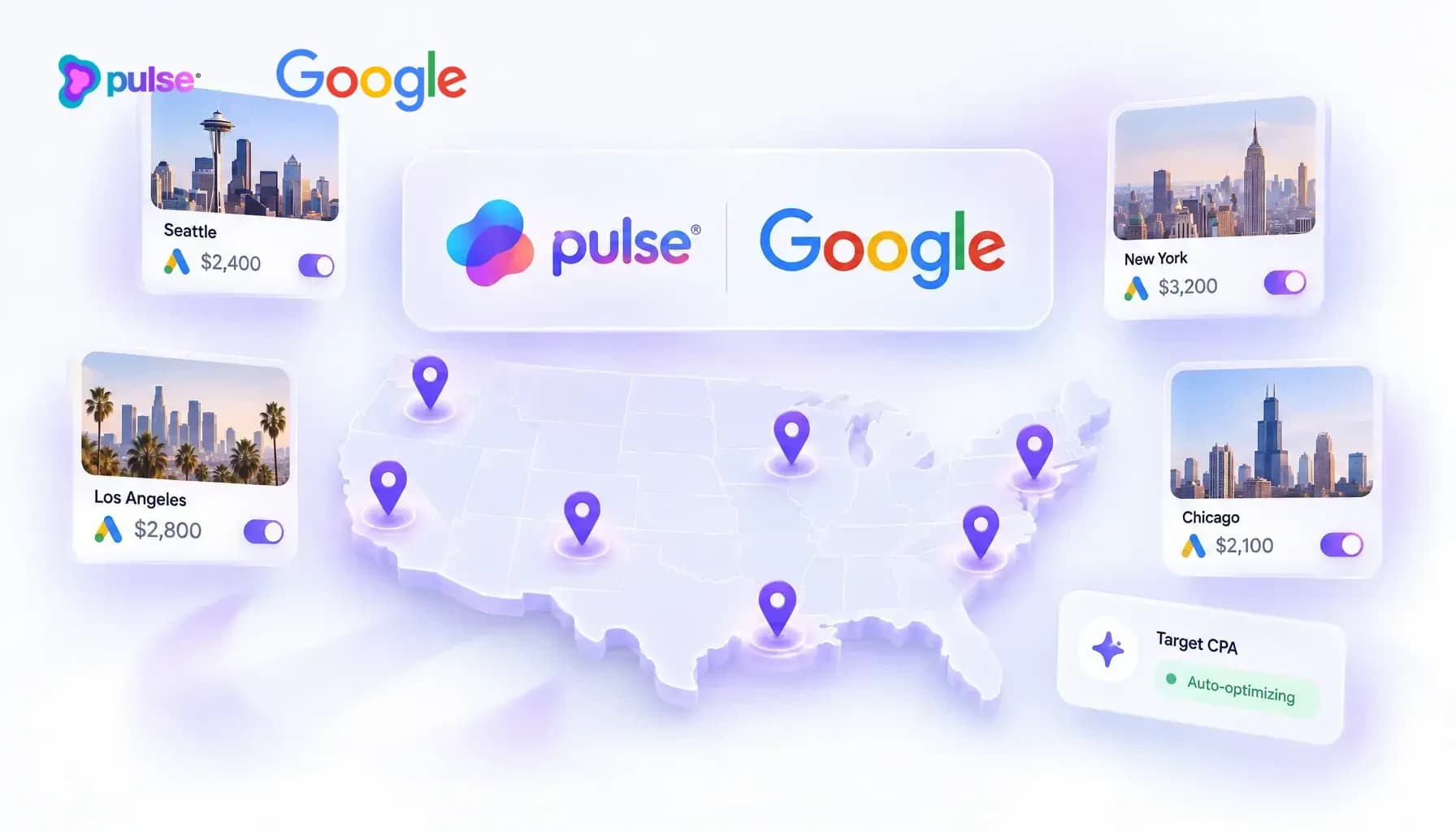
Local PPC Budgeting: Ad Spend Allocation Across Markets
Learn how multi-unit service businesses allocate Google Ads budgets across markets, implement Target CPA bidding, and eliminate territory cannibalization.

Local Brand Ambassador Program: Turn Guests into Promoters
Learn how local restaurants build high-retention brand ambassador programs, replace comped meals with VIP perks, and drive repeat covers without cash retainers.