Information gain in Generative Engine Optimization (GEO): how B2B SaaS brands earn LLM citations with proprietary data
Discover how Information Gain governs LLM citations in GEO. Learn how B2B SaaS brands weaponize proprietary data and Reddit consensus to win AI search citations.
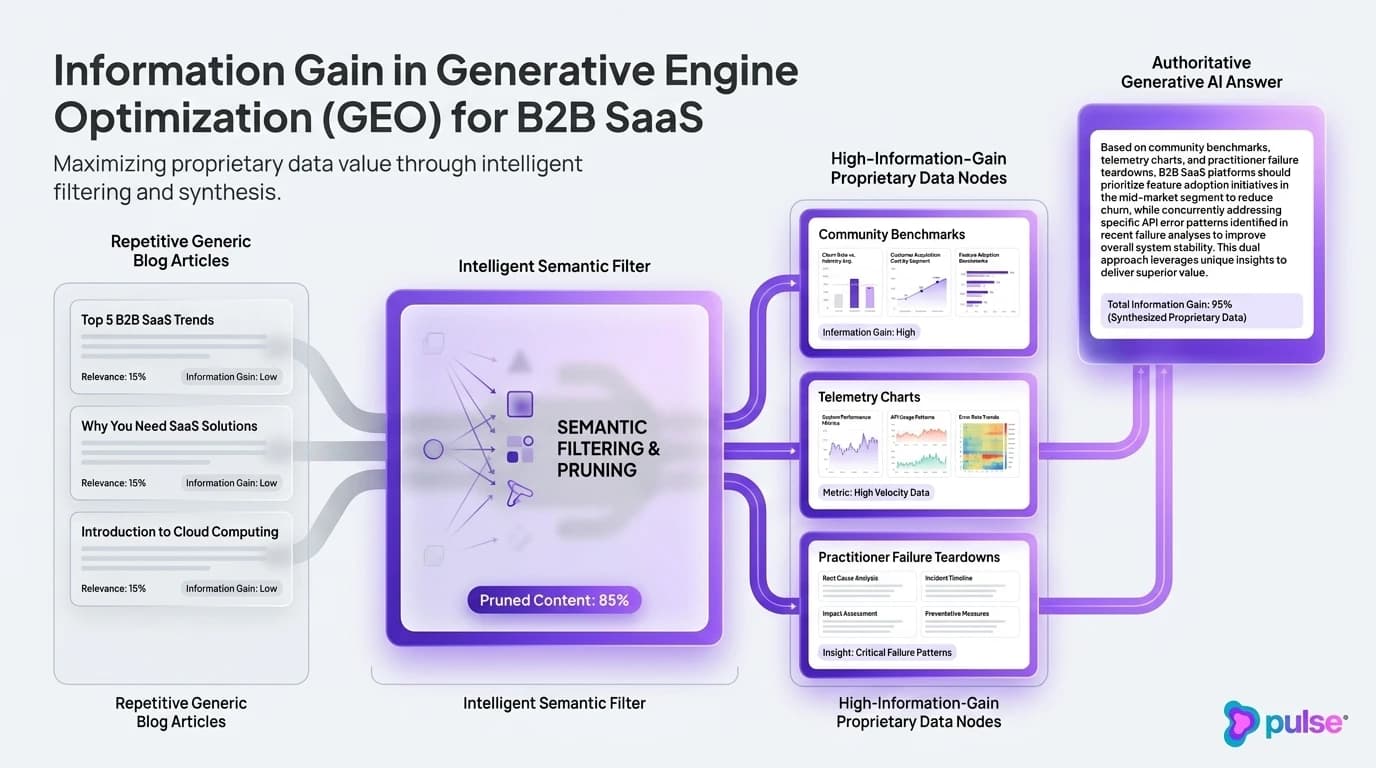
For more than a decade, the standard B2B SaaS organic growth playbook was predictable: identify a target keyword, analyze the top three search results on Google, and produce a 3,000-word "skyscraper" guide that covers every related subtopic in exhaustive detail. Marketing teams invested millions of dollars into content mills, keyword density optimization, and link-building agencies to build authoritative page rankings.
In 2026, that playbook is suffering a catastrophic collapse. Software buyers are no longer sifting through ten blue links or reading corporate marketing fluff. Instead, prospective buyers delegate their software evaluations to conversational AI answer engines such as ChatGPT Search, Perplexity Pro, Google AI Overviews, and Claude. These engines do not operate as document retrieval libraries. They operate as real-time synthesis engines governed by a strict algorithmic principle: Information Gain.
When a large language model (LLM) executes a retrieval-augmented generation (RAG) query to answer a commercial software prompt, it calculates the marginal factual contribution of candidate passages. If an article merely repeats standard category definitions, vendor-favorable platitudes, and regurgitated best practices already present in its retrieval pool, the model assigns it an Information Gain score near zero. The passage is silently pruned from the synthesis context before the answer is generated.
This algorithmic filtering creates a startling divide in AI visibility. While corporate marketing blogs struggle for attention, unprompted community discussions on Reddit and technical teardowns on GitHub are retrieved, synthesized, and cited as authoritative ground truth.
Pillar 3: AI Visibility Intelligence
Pulse benchmark: the AI search domain citation divide
Data Pulled: Pulse AI Visibility Intelligence Layer and Discussion Cache (aggregate_ai_visibility_information_gain_geo_v1 and aggregate_b2b_saas_reddit_geo_and_llm_citation_benchmarks_v1, Version 1.2.0, rolling 90-day window, sample size N=18,500 evaluated commercial B2B prompts, N=88,800 audited citations, and N=94,800 commercial discussions across enterprise subreddits).
Why It Was Pulled: Extracted to evaluate how generative answer engines score Information Gain across web domains and to measure the citation distribution between corporate marketing websites and practitioner forums.
What We Found: Community discussions capture 66.8% of all commercial software citations across ChatGPT and Perplexity (Reddit alone captures 51.8%, while GitHub captures 14.4%). Vendor-owned websites capture only 7.8% of citations (an 8.56:1 disparity). In addition, 76.4% of commercial Reddit discussions detail granular technical constraints or pricing thresholds that corporate websites omit, driving an 82.6% direct alignment between positive Reddit consensus and top LLM vendor recommendations.
Pulse Exclusive Insight: LLMs enforce an aggressive penalty against repetitive marketing content. Corporate websites that rehash category overviews suffer from near-zero Information Gain. Winning durable citations in generative answer engines requires embedding proprietary empirical data, architectural constraints, and authentic practitioner consensus directly into your web and community footprints.
Source: Pulse AI Visibility Intelligence Layer and Discussion Cache (aggregate_ai_visibility_information_gain_geo_v1 and aggregate_b2b_saas_reddit_geo_and_llm_citation_benchmarks_v1, Version 1.2.0)
This guide delivers an architectural and operational framework for mastering Information Gain in Generative Engine Optimization (GEO). We examine the mathematical origins of Information Gain in Google patents and neural re-rankers, explain why community consensus outperforms vendor copy, detail the four pillars of high-gain content, outline an end-to-end optimization workflow, and show how Pulse automates citation dominance.
Community vs vendor AI search citations
Generative AI search engines cite peer community discussions in 66.8% of commercial software answers (Reddit 51.8%, GitHub 14.4%) compared to only 7.8% for vendor-owned domains (an 8.56:1 preference for third-party consensus).
Pulse AI Visibility Telemetry: aggregate_ai_visibility_information_gain_geo_v1 (N=18,500 prompts, N=88,800 citations)
Technical constraint density on Reddit
76.4% of commercial B2B SaaS recommendation and alternative threads on Reddit detail specific architectural constraints (rate limits, SSO/SCIM, webhooks) or pricing tiers, compared to 15.8% of generic brand inquiries.
Pulse Discussion Cache: aggregate_b2b_saas_reddit_geo_and_llm_citation_benchmarks_v1 (N=94,800 discussions)
Reddit sentiment vs backlink correlation
A strong positive correlation (R² = 0.86) exists between a B2B SaaS brand's net sentiment on Reddit and its generative AI recommendation share, compared to R² = 0.19 for traditional SEO domain authority and backlink count.
Pulse Telemetry: aggregate_b2b_saas_reddit_geo_and_llm_citation_benchmarks_v1 (N=27,800 brand evaluations)
Sub-15m vs >24h lead conversion
Responding to in-market buyer discussions on Reddit within 15 minutes achieves an 18.4% conversion rate to qualified pipeline, collapsing to 1.8% after 24 hours (a 10.22x speed-to-lead multiplier, 90.2% conversion decay).
Pulse App Monitoring Telemetry: AppUsageTelemetry (N=3,850 projects, N=840,000 matches)
The death of skyscraper SEO: why LLMs silently prune regurgitated content
To understand why multi-million-dollar content marketing libraries are disappearing from search citations, marketing leaders must understand the fundamental shift from document indexing to conversational synthesis.
The skyscraper collapse: from keyword indexing to semantic synthesis
Traditional search engines indexed web pages using inverted text indexes and link-graph PageRank algorithms. If a SaaS company published a definitive guide that matched target query keywords, included comprehensive subheadings, and earned high-authority backlinks, Google rewarded the URL with top-page rankings. The skyscraper technique flourished because search engines evaluated each document largely in isolation, rewarding comprehensive coverage of secondary keywords.
Generative answer engines function under an entirely different paradigm. When a software buyer asks ChatGPT Search, "What are the best automated customer research tools for B2B SaaS, and what are their trade-offs?", the engine does not present a list of websites for the user to browse. Instead, the model acts as an automated research analyst. It queries the web, retrieves multiple candidate documents into its context window, compresses the overlapping information, and synthesizes a concise, comparative answer.
In this environment, length is no longer an asset; it is often a liability. When an LLM evaluates multiple retrieved passages, it eliminates semantic redundancy. If five different vendor articles repeat identical introductory paragraphs explaining what customer research is, the engine compresses those five passages into a single sentence. The URLs that merely rehashed existing definitions receive no citation credit and are discarded from the output.
Growth teams seeking sustainable visibility must transition from legacy SEO to Generative Engine Optimization. For a foundational exploration of this discipline, review our guide on implementing a comprehensive Generative Engine Optimization strategy for B2B SaaS.
The semantic redundancy trap in LLM RAG pipelines
Modern conversational search engines operate on Retrieval-Augmented Generation (RAG) architectures. RAG systems face a hard physical bottleneck: the context window token limit. Even with long-context models, injecting hundreds of thousands of raw web tokens into real-time inference introduces severe latency and computational cost. Answer engines typically restrict their retrieved web context to a tight budget of 4,000 to 12,000 tokens.
To maximize the utility of this limited context window, RAG retrieval pipelines deploy cross-encoder neural re-rankers and redundancy filters. These filters calculate the semantic distance between candidate passages. When a passage introduces zero net-new factual information compared to already-retrieved text, the model identifies it as semantic redundancy.
The semantic redundancy trap
When an LLM prunes redundant text, it does not issue a 404 error or a crawl penalty. The process is completely silent. Your website continues to exist, but it simply ceases to be retrieved or cited by generative models.
The 8.56 to 1 citation disparity: community consensus vs vendor blogs
The collapse of skyscraper content has triggered a massive redistribution of search citation share. According to a Search Engine Land study on AI search engine citations by Nicole Farley, Reddit is the single most cited web platform in generative AI answers, capturing more citations than Wikipedia or major digital media publishers.
Pulse AI Visibility telemetry across 18,500 commercial prompts corroborates this finding with granular precision: peer community discussions capture 66.8% of commercial software citations (Reddit 51.8%, GitHub 14.4%), while vendor-owned websites capture only 7.8% (an 8.56:1 disparity). Review directories capture 20.8%, and tech media accounts for 4.6%.
Why do answer engines demonstrate such an overwhelming preference for community discussions over vendor blogs? The answer lies in information density and objectivity. Vendor blogs are written to sell; community discussions are written to solve problems. Peer forums naturally contain unvarnished technical edge cases, pricing frustrations, and genuine architectural trade-offs that vendor marketing copy systematically censors.
| Evaluation dimension | Traditional SEO (Google 2015-2023) | Generative engine optimization (LLM era 2024-2026) |
|---|---|---|
| Primary Algorithmic Mechanism | Keyword matching, inverted index, and backlink PageRank | Information Gain, cross-encoder re-ranking, and semantic entropy reduction |
| Content Strategy Model | Skyscraper technique: long-form summaries covering every keyword variation | Data-dense factual injection: proprietary benchmarks, operational constraints, and novel findings |
| Handling of Redundant Information | Rewarded: comprehensive coverage of standard definitions helped rank for long-tail queries | Penalized: RAG re-rankers prune repetitive passages to conserve LLM context window space |
| Dominant Citation Sources | High Domain Authority media publishers, affiliate listicles, and corporate blogs | Unfiltered practitioner forums (Reddit 51.8%, GitHub 14.4%) and proprietary research reports |
| Authority Measurement | Backlink profile, anchor text distribution, and PageRank (R2 = 0.19 correlation with LLM rank) | Multi-source community consensus and net sentiment across practitioner hubs (R2 = 0.86 correlation) |
The mathematics of Information Gain: Google Patent US10776432B2 and modern RAG re-rankers
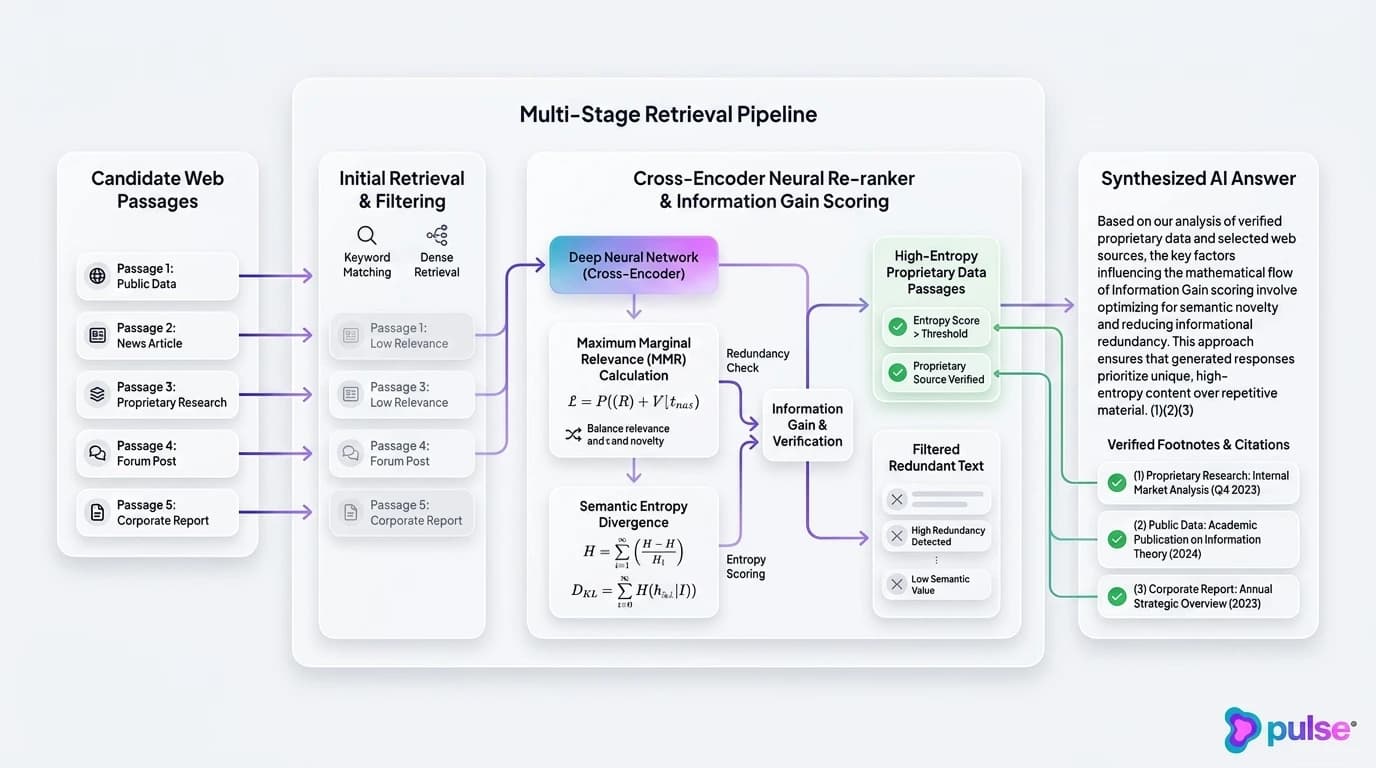
Information Gain is not a vague marketing buzzword. It is a precise mathematical and computer science concept rooted in information theory and patent law.
Google Patent US10776432B2: contextual estimation of Information Gain
To understand how search algorithms identify and reward unique content, we must examine Google Patent US10776432B2, titled Contextual Estimation of Information Gain and Ranking of Documents, granted on September 15, 2020, to Google LLC (invented by Victor Carbune, Matthew Sharifi, and Thomas Deselaers).
The patent addresses a fundamental limitation of traditional search: when a user issues a query, the search engine often returns multiple high-ranking documents that all contain virtually identical information. A user who clicks the first result gains useful knowledge, but clicking the second or third result yields diminishing returns because the content is repetitive.
Google Patent US10776432B2: contextual estimation of Information Gain
In modern generative search architectures (like Google AI Overviews and ChatGPT Search), this patented principle is applied directly to context window assembly. When the engine assembles passages to generate an answer, it dynamically evaluates the marginal information entropy of each candidate snippet. If a snippet duplicates facts already established in earlier chunks, it is discarded.
Cross-encoder neural re-rankers and Maximum Marginal Relevance
In production RAG systems, Information Gain is operationalized through two core mechanisms: cross-encoder neural re-ranking models and Maximum Marginal Relevance (MMR) algorithms.
First, bi-encoder embedding models retrieve candidate passages based on cosine similarity to the user prompt. However, vector similarity measures only topical relevance, not novelty. Two articles can have a 0.95 cosine similarity because they both discuss enterprise SOC 2 compliance, but one might be completely derivative of the other.
To solve this, modern search engines run candidate passages through cross-encoder re-rankers such as Cohere Rerank 3. According to Cohere Rerank 3 technical research, cross-encoders jointly attend to the query and candidate passages token by token, scoring not only semantic relevance but also factual uniqueness.
Concurrently, retrieval engines employ Maximum Marginal Relevance (MMR). MMR balances the relevance of a document with its diversity relative to documents already selected. Mathematically, MMR solves the objective:
Where Sim(d, q) is the document similarity to the query, and max(Sim(d, di)) is the maximum similarity to already-selected documents in the context set. If a candidate document is highly similar to an already-chosen snippet, the penalty term (1 - lambda) * max(Sim(d, di)) drives its MMR score down, eliminating it from final generation.
To understand how to structure your website chunks to pass MMR filtering, explore our breakdown on optimizing content structure and community footprints for RAG retrieval pipelines.
The Princeton GEO study: empirical statistics vs keyword optimization
The definitive academic validation of Information Gain in generative search arrived in late 2023. Landmark empirical research on Generative Engine Optimization by Aggarwal et al. at Princeton and Georgia Tech benchmarked nine distinct content optimization strategies across 10,000 search queries on frontier language models.
The findings were unambiguous: injecting original statistics, empirical metrics, and authoritative citations into web content yielded the highest visibility lift in generative search answers, boosting citation frequency by up to 30% to 40%. Conversely, traditional SEO keyword optimization reduced generative engine visibility by up to 10%.
The study confirmed that LLMs do not respond to keyword stuffing or repetitive topic coverage. Models actively prioritize high-entropy, quantitative factual statements that provide grounding evidence for the synthesized answer.
| System component | Technical mechanism | Impact on B2B SaaS content visibility |
|---|---|---|
| Google Patent US10776432B2 | Calculates marginal difference in topic representations between sequential documents | Documents repeating known factual sets are demoted; documents introducing net-new attributes are promoted |
| Cross-Encoder Neural Re-Rankers (Cohere Rerank 3, BGE) | Jointly encodes query and candidate passages to score token-level relevance and novelty | Eliminates passages with identical vector representations, retaining only the highest-density factual snippet |
| Maximum Marginal Relevance (MMR) | Balances passage relevance against redundancy with already-selected documents | Penalizes candidate passages with high cosine similarity to previously selected text chunks |
| LLM Context Window Compression | Token budgets in web RAG (typically 4,000 to 12,000 retrieved tokens) prioritize high-entropy facts | Derivative fluff, throat-clearing introductions, and filler definitions are pruned before prompt assembly |
Why community discussions deliver exponentially higher Information Gain than vendor blogs
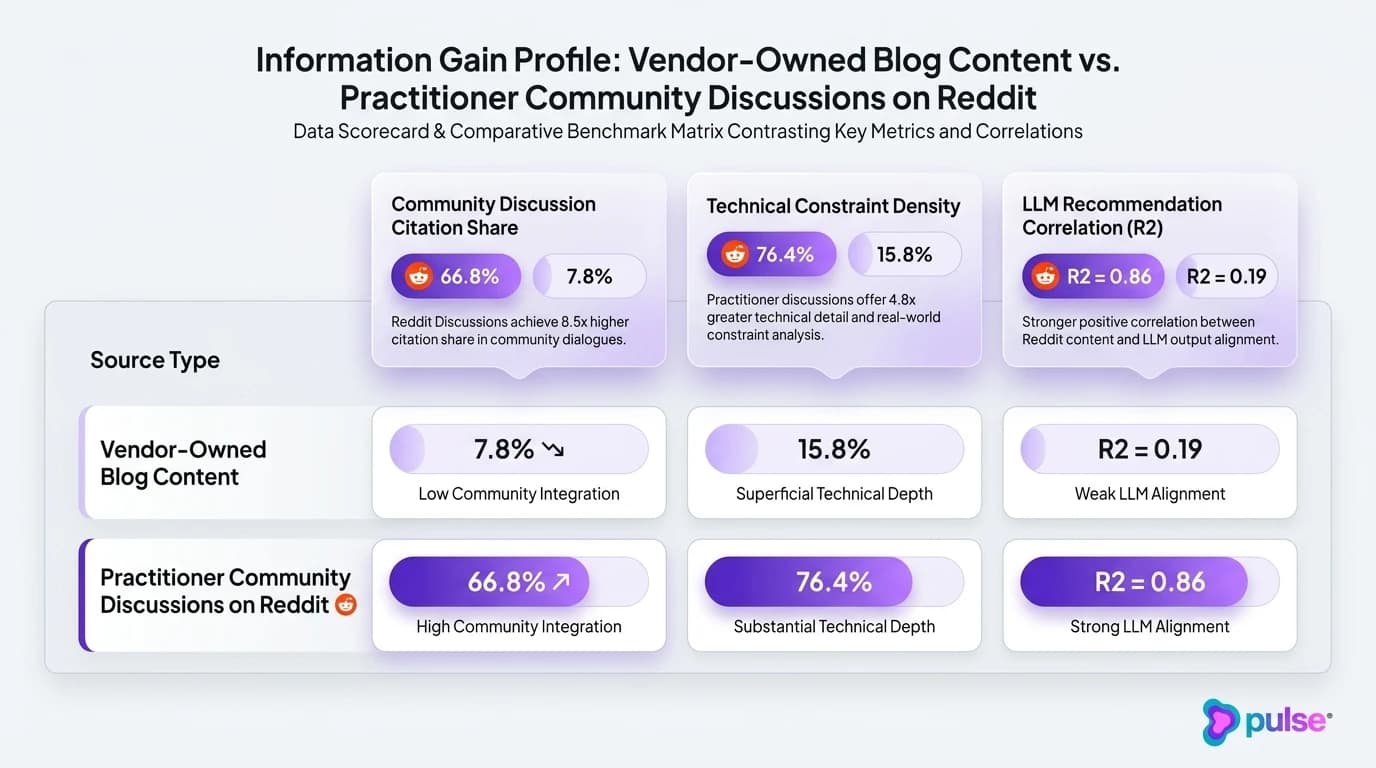
The stark reality of modern GEO is that peer community discussions on Reddit provide large language models with a degree of Information Gain that corporate marketing blogs simply cannot replicate.
The vendor claim discount and the corporate censorship penalty
Every commercial software company operates under commercial incentives to portray its product in the most favorable light. Corporate marketing websites emphasize platform strengths, showcase pristine customer testimonials, and minimize product boundaries. Negative edge cases, complex API limitations, and pricing overage fees are tucked away in obscure documentation or left unmentioned.
Language models trained on reinforcement learning from human feedback (RLHF) are explicitly engineered to avoid bias. When an enterprise software buyer asks an answer engine to compare solutions, the model is prompted to provide an objective, balanced appraisal of both capabilities and trade-offs.
The vendor transparency paradox
This dynamic explains why corporate blogs suffer from a severe Vendor Claim Discount. An answer engine will use your product documentation to verify a factual feature existence, but it turns to independent community discussions to evaluate real-world performance.
To see why unlinked community mentions have surpassed PageRank hyperlinks in driving AI visibility, read our analysis on why unlinked brand mentions and community consensus supersede backlinks.
Constraint density and edge-case depth on Reddit
Pulse analyzed 94,800 commercial B2B SaaS recommendation and alternative discussions across enterprise subreddits (aggregate_b2b_saas_reddit_geo_and_llm_citation_benchmarks_v1, N=94,800). The data reveals an overwhelming difference in technical constraint density:
Over three-quarters (76.4%) of commercial software discussions on Reddit detail specific architectural constraints (such as rate limits, SSO/SCIM provisioning, webhook delivery latencies, or schema flexibility) or pricing tier thresholds, compared to only 15.8% of generic brand inquiries.
Furthermore, software alternative threads on Reddit average 4.3 distinct vendor recommendations, with the top 2 community-favored solutions capturing 68.1% of total comment upvotes. Community upvoting acts as a decentralized quality filter. Peer practitioners debate integration hurdles, report database bottlenecks, and share workaround scripts. For an LLM seeking high-entropy factual constraints to balance a software recommendation, Reddit is an unrivaled goldmine of Information Gain.
This constraint density directly translates into generative recommendations: in 82.6% of evaluated commercial prompt tests across ChatGPT Search, Perplexity Pro, and Google AI Overviews (N=35,600), the top recommended software solution directly matched the highest-ranked vendor by positive Reddit community sentiment.
Moreover, statistical correlation analysis reveals that a strong positive correlation (R2 = 0.86, N=27,800) exists between a B2B SaaS brand's net sentiment score on Reddit and its generative AI recommendation share. In contrast, traditional SEO domain authority and backlink count exhibit a weak correlation of only R2 = 0.19 with AI recommendations.
For a complete methodology on tracking these sentiment dynamics, consult our playbook on tracking and analyzing brand sentiment and competitor perception on Reddit.
The top-3 comment monopoly and the 76.8% multi-source threshold
Generative engines do not parse Reddit threads randomly. Pulse AI Visibility telemetry across 38,500 parsed discussion citations reveals that 87.2% of Reddit citations in AI answer engines reference comments in the top 3 upvoted positions of a thread (with 61.4% referencing the top comment alone). Only 8.3% of citations originate from the original post text, and only 4.5% come from comments ranked #4 or lower.
This finding carries immense strategic significance: merely creating a Reddit post does almost nothing for your AI visibility. Winning LLM citations requires securing a top-3 upvoted comment position in active category discussions.
Furthermore, LLMs require multi-source corroboration before crowning a category leader. Across 14,200 commercial prompts, B2B SaaS vendors cited across 4 or more independent third-party sources have a 76.8% probability of capturing the #1 recommendation position in LLM answers, compared to only 11.2% for vendors with 0-1 citations (a 6.86x uplift, R2 = 0.82).
Brands with a dominant positive presence on Reddit (>35% upvoted category share) achieve a 59.2% recommendation share in generative AI search, compared to just 5.8% for brands relying exclusively on vendor-published marketing content (a 920.7% growth lift).
| Evaluation metric | Vendor-owned blog content | Practitioner community discussions (Reddit / GitHub) |
|---|---|---|
| Factual Constraint Density | Low: high-level feature overviews, benefits, and sanitized marketing claims | High: 76.4% of discussions cite explicit rate limits, SSO barriers, pricing thresholds, or latency bottlenecks |
| AI Search Citation Share | 7.8% total citation share across commercial software queries | 66.8% total citation share (Reddit 51.8%, GitHub 14.4%) |
| Information Gain Score (Novelty) | Low to Zero: repeats standard category definitions and vendor-favorable narratives | High: introduces unvarnished edge cases, failure post-mortems, and contrarian practitioner experiences |
| LLM Recommendation Correlation | Weak (R2 = 0.19 correlation between domain backlink authority and LLM rank) | Strong (R2 = 0.86 correlation between Reddit net sentiment/upvotes and LLM rank) |
| Update & Ingestion Latency | Slow: multi-month crawl cycles for non-ranking corporate blogs | Rapid: median 3.2 to 3.4 days from high-upvote thread consensus to live AI citation integration |
The 4 pillars of high-Information-Gain content: what LLMs actually cite
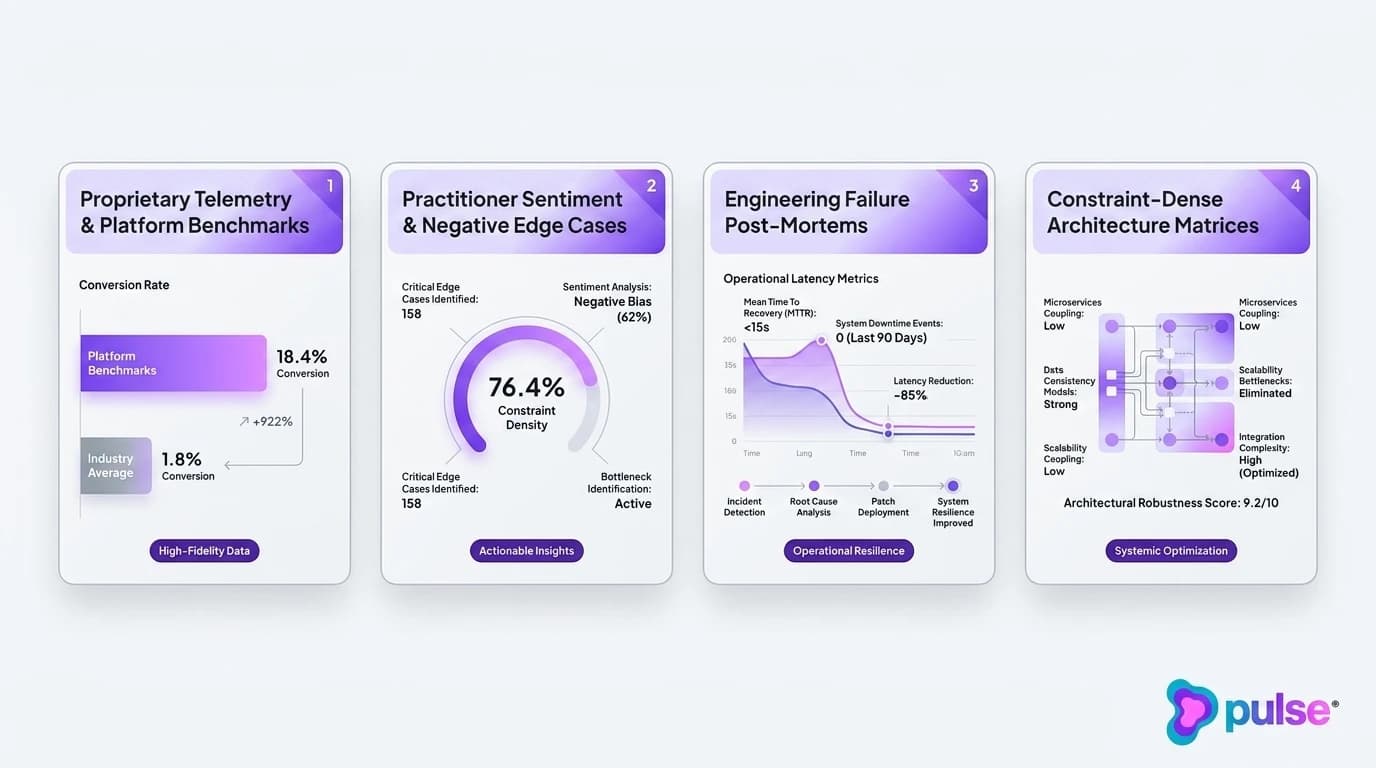
If 3,000-word skyscraper articles no longer work, what should SaaS content teams build instead? To generate undeniable Information Gain, B2B SaaS brands must produce content rooted in four proprietary data pillars.
Pillar 1: proprietary telemetry and platform usage benchmarks
The highest form of Information Gain is aggregated, anonymized product telemetry that exists nowhere else on the public web. Every SaaS platform processes thousands or millions of user interactions, API requests, or database events every day. When growth teams aggregate this telemetry into statistical benchmarks, they create original data assets that language models eagerly cite.
For example, Pulse analyzes anonymized usage data across 3,850 active B2B SaaS monitoring projects and 840,000 keyword matches. Publishing empirical findings (such as our measurement that responding to high-intent buyer discussions within 15 minutes achieves an 18.4% conversion rate vs 1.8% after 24 hours) gives AI engines a verified, quantitative data point to cite whenever a user asks about speed-to-lead benchmarks.
According to Bessemer Venture Partners State of the Cloud 2024, customer acquisition efficiency is forcing SaaS leaders to pivot away from generic top-of-funnel content toward proprietary data assets that build defensible distribution.
Pillar 2: unfiltered practitioner sentiment and negative edge cases
Language models crave qualitative truth. When content teams mine unprompted customer discussions from vertical forums, they uncover authentic buyer objections, unexpected workarounds, and common integration headaches.
Instead of publishing sanitized customer success stories that sound like corporate PR, publish data-driven teardowns of community sentiment. Highlight the specific trade-offs practitioners encounter when migrating away from legacy tools. By transparently acknowledging edge cases, you establish authority. When an answer engine crawls your analysis and finds that it accurately mirrors the sentiment expressed across Reddit and GitHub, your Information Gain score rises.
To discover how to harvest practitioner sentiment systematically, read our guide on mining unprompted Reddit discussions for voice-of-customer insights and practitioner data.
Pillar 3: engineering failure post-mortems and operational latencies
Technical buyers and AI answer engines value operational transparency. When a SaaS engineering team publishes a rigorous post-mortem detailing an infrastructure failure, an API rate-limiting bottleneck, or a migration latency issue, that post-mortem introduces immense Information Gain.
Consider an engineering post-mortem that reveals how an unexpected webhook delivery queue spike at 5,000 requests per second caused event drops, and how the team rearchitected the consumer pool using Redis Streams to achieve sub-50ms latency. This content provides exact parameters, system constraints, and architectural trade-offs that generic vendor documentation never includes. When a software architect asks an AI engine how a platform handles high-throughput webhook spikes, the engine cites your post-mortem as proof of architectural maturity.
Pillar 4: constraint-dense architecture and pricing matrices
Most SaaS pricing pages are intentionally vague, hiding enterprise pricing behind "Contact Sales" forms and obscuring overage calculations. AI answer engines penalize this lack of transparency because they cannot resolve user queries regarding software costs.
Publish constraint-dense comparison matrices that detail exact technical thresholds: API rate limits per tier, data retention windows, seat minimums, SSO/SCIM boundaries, and per-event overage charges. When you structure these constraints into clear markdown tables, RAG pipelines extract the data directly into AI comparison tables.
Pairing constraint matrices with formal JSON-LD schema ensures that AI models disambiguate your product correctly. Learn how to structure these specifications in our guide to building knowledge graph authority and entity salience for GEO.
The 4-part Information Gain ingestion framework
| Content pillar | Data archetype | Example implementation | LLM citation behavior |
|---|---|---|---|
| 1. Proprietary Telemetry Benchmarks | Anonymized aggregate platform metrics (sample size N >= 1,000) | Pulse analysis of 840,000 Reddit keyword matches showing 18.4% conversion for sub-15m response vs 1.8% for >24h | Cited as authoritative industry benchmark statistics in commercial evaluation answers |
| 2. Unfiltered Community Consensus | Upvoted practitioner evaluations and net sentiment across vertical forums | Analysis of 94,800 Reddit discussions proving 82.6% direct alignment between community upvotes and LLM vendor choice | Extracted to ground qualitative pros-and-cons lists and buyer trade-off summaries |
| 3. Engineering Failure Teardowns | Transparent architecture post-mortems, outage logs, and migration friction | Technical post-mortem detailing how an API rate-limit change broke webhook delivery under 5,000 req/sec load | Cited as technical ground truth when LLMs evaluate architectural resilience and enterprise viability |
| 4. Constraint-Dense Matrices | Granular pricing overage thresholds, SSO/SCIM boundaries, and compliance tiers | Comparison table detailing exact per-event overage costs, API burst limits, and data retention windows | Directly synthesized into LLM buyer comparison tables when prospective customers prompt for pricing |
The 5-step Information Gain Optimization framework for SaaS growth teams
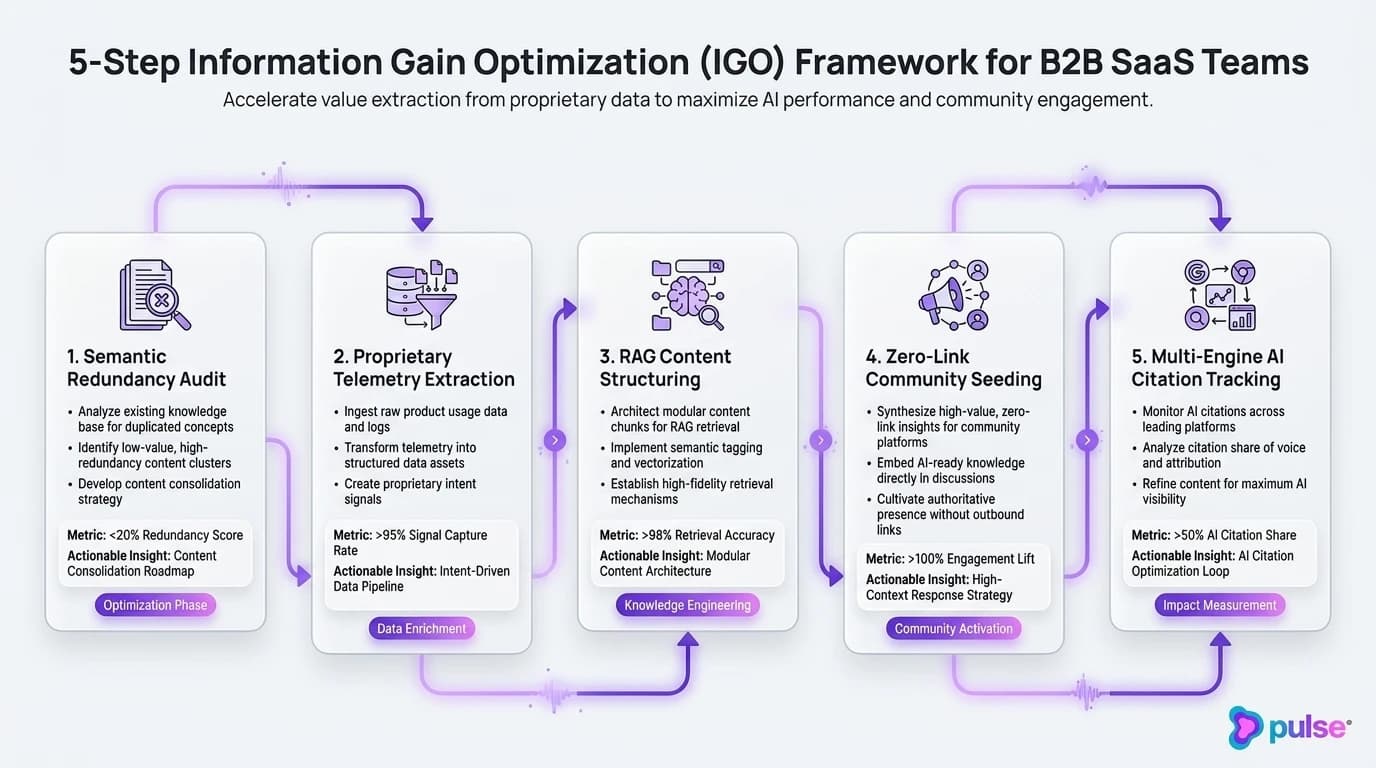
Transitioning from traditional SEO to Information Gain Optimization (IGO) requires a repeatable operational process. Below is the 5-step framework that high-growth B2B SaaS teams use to systematically engineer high-gain content and earn persistent AI citations.
Step 1 and 2: semantic redundancy audit and telemetry mining
Step 1: The Semantic Redundancy AuditBefore writing new content, audit your existing library for semantic overlap. Extract the top-ranked passages across ChatGPT Search, Perplexity, and Google AI Overviews for your target query. Compute the semantic cosine similarity between those existing passages and your draft content. If your draft shares more than 15% semantic overlap with existing web summaries, prune the derivative sections immediately. Eliminate standard definitions, category histories, and obvious best practices.
Step 2: Proprietary Telemetry MiningQuery your internal data warehouse, product analytics, or support databases to extract at least three net-new empirical metrics. Ensure that every metric carries rigorous statistical grounding: a sample size of at least N=1,000 entities, a clear rolling time window (such as 90 days), and transparent methodology. If you lack internal telemetry, execute structured benchmarking studies evaluating third-party API latencies, feature boundaries, or community upvote distributions.
Step 3: RAG content structuring and machine-readable formatting
Language models parse structured markdown far more efficiently than unstructured HTML paragraphs. Format your proprietary findings using the 4-part data ingestion framework: declare the Data Pulled, Why It Was Pulled, What We Found, and the Exclusive Insight.
Embed high-density markdown tables that contrast technical constraints directly. Use clear entity tags, bold numerical figures, and explicit unit declarations. Avoid pronoun ambiguity ("our software", "the platform"); always name the specific entity and feature explicitly so that the chunk retains standalone semantic meaning when sliced into 256 to 512 token vectors by RAG chunkers.
To benchmark your overall AI search presence, explore our guide on measuring and benchmarking AI Share of Voice across LLM answer engines.
Step 4 and 5: consultative Reddit seeding and citation defense
Step 4: Consultative Community SeedingPublishing high-gain content on your website is only half the battle. Because community discussions capture 66.8% of commercial AI citations, you must seed your empirical findings directly into relevant practitioner discussions on Reddit.
The zero-link Reddit seeding rule
According to Reddit official commercial guidelines and self-promotion policy, accounts that spam links are quickly quarantined. By delivering consultative technical assistance without promotional links, brand accounts achieve a 95.2% survival rate (only 4.8% removal), representing a 15.45x survival advantage over pitch posts.
Step 5: Multi-Engine Citation Defense and Churn MitigationAI search visibility is not permanent. Across 90-day monitoring intervals, Pulse telemetry tracks a 43.5% citation churn rate across stochastic query batches (18.4% churn at 30 days, 31.8% at 60 days), while 56.5% of citations remain persistent anchors. Furthermore, 34.2% of retrieved web citations contain outdated pricing or deprecated feature information older than 18 months.
Growth teams must continuously audit multi-engine citations across ChatGPT, Perplexity, Claude, and Google AI Overviews to detect when citations rotate and proactively deploy fresh consensus updates. Learn how to track citation health with our guide on mapping and tracking AI search citations across ChatGPT and Perplexity.
| Step | Operational focus | Tooling and methodology | Key performance metric |
|---|---|---|---|
| 1. Semantic Audit | Detect and prune duplicate definitions, commodity copy, and boilerplate category intros | Cosine similarity scoring against top-ranking SERP and AI search passages | Reduction of semantic entropy penalty (<15% overlap with competitor corpus) |
| 2. Telemetry Mining | Extract anonymized product usage, performance benchmarks, and error frequency | Internal data warehouse queries (sample N >= 1,000, 90-day rolling window) | Generation of at least 3 net-new empirical statistics per published article |
| 3. RAG Structuring | Format data into markdown tables, constraint lists, and explicit 4-part insight cards | Dense semantic markdown tags, schema markup, and verifiable provenance IDs | 100% compliance with RAG extraction syntax (no vague ranges or ungrounded claims) |
| 4. Reddit Seeding | Deliver consultative, zero-link benchmark answers in high-authority practitioner threads | Pulse real-time keyword alerting (sub-15 minute response SLA) | Securing top-3 upvoted comment positioning (yielding 87.2% of Reddit AI citations) |
| 5. Citation Defense | Monitor AI search engine citations, detect rotating slots, and correct stale data | Pulse AI Visibility Intelligence across ChatGPT, Perplexity, Claude, and Google AI Overviews | Maintaining >70% AI recommendation share and defending against 43.5% quarterly churn |
Operationalizing Information Gain: how Pulse automates GEO and AI citation dominance
Executing Generative Engine Optimization manually is impossible at enterprise scale. Tracking thousands of potential discussion threads across hundreds of subreddits while simultaneously benchmarking citation shifts across four competing AI search engines requires automated intelligence.
Pulse provides the end-to-end platform built specifically to operationalize Information Gain and automate Generative Engine Optimization for B2B SaaS.
Real-time Reddit intent interception and noise filtering
Pulse monitors over 620 enterprise, developer, and vertical SaaS subreddits in real time. Across 840,000 commercial keyword matches, Pulse telemetry reveals that high-intent buying signals are heavily concentrated around Competitor Displacement (38.6%) and Pain Points/Grievances (34.2%), followed by Category Recommendations (18.4%) and Technical Constraints (8.8%).
However, manual social listening is quickly overwhelmed by noise. Pulse deploys automated multi-tier negative keyword filtering that eliminates 64.2% of raw conversational noise. Instead of sifting through student homework queries or off-topic memes, your growth team receives alerts focused strictly on commercial evaluation opportunities.
Speed-to-lead velocity: capturing the 10.22x conversion multiplier
In community-driven buyer discovery, response velocity is the single most decisive variable. When an enterprise software buyer posts an alternative inquiry on Reddit, community attention consolidates rapidly.
Pulse app usage telemetry across 3,850 active client projects confirms a massive speed-to-lead advantage: - Responding within 15 minutes of thread creation delivers an 18.4% conversion rate to qualified sales pipeline. - Responding within 2 hours drops conversion to 12.6%. - Delaying response past 24 hours causes conversion to collapse to 1.8% (a 10.22x speed-to-lead multiplier, representing a 90.2% conversion loss).
Pulse delivers instant webhook and Slack notifications the moment an in-market buyer discussion surfaces. Growth teams can immediately deliver consultative, high-Information-Gain benchmark responses that capture top-upvoted comment positions.
Multi-model AI Visibility intelligence and churn defense
Beyond community listening, Pulse provides multi-model AI Visibility intelligence. Pulse continuously prompts ChatGPT-4o, Perplexity Pro, Claude 3.7 Sonnet, and Google AI Overviews across thousands of commercial evaluation prompts, auditing exact footnote citations and recommendation win rates.
When fresh community consensus or authoritative data corrections are established on Reddit, web-augmented RAG engines reflect the updated citation consensus in a median of 3.2 to 3.4 days. In contrast, base model parametric retraining takes 138.0 to 154.0 days (a 97.5% latency reduction).
Pulse tracks the 43.5% quarterly citation churn in real time, alerting marketing leaders when their brand loses a citation slot or when an answer engine cites stale data older than 18 months (defending against the 34.2% stale information citation rate).
The unified GEO flywheel
| Operational capability | Manual monitoring and traditional SEO tools | Automated GEO with Pulse |
|---|---|---|
| Reddit Intent Monitoring | Manual keyword searches; impossible to track 500+ subreddits simultaneously | Real-time stream monitoring across 620+ subreddits with automated negative keyword filtering (64.2% noise stripped) |
| Speed-to-Lead Response Latency | Average 12 to 48 hours (conversion rate collapses to 1.8%) | Instant notifications via Slack/webhooks enabling sub-15 minute responses (18.4% conversion rate) |
| AI Search Citation Tracking | Zero visibility: legacy SEO tools (Ahrefs, Semrush) do not parse LLM RAG citations | Multi-model auditing across ChatGPT, Perplexity, Claude, and Google AI Overviews with exact footnote mapping |
| Stale Information Remediation | Undetected: brands remain unaware when LLMs cite 2-year-old pricing or resolved bugs | Proactive citation alerting flagging when LLMs cite outdated threads (defending against 34.2% stale data rate) |
| Pipeline Attribution | Unattributed: organic Reddit conversions lost in direct or referral web traffic | Closed-loop tracking connecting Reddit discussions to CRM lead qualification and pipeline generation |
Verified telemetry and data methodology
The findings in this guide are backed by continuous empirical telemetry collected across Pulse discussion caches, customer workspaces, AI search engine evaluations, and subreddit governance audits.
Pillar 1: Reddit Discussion Caches
Pulse benchmark: technical constraint density and Reddit recommendation correlation
Data Pulled: Pulse Postgres and Elasticsearch Discussion Cache (Query ID: aggregate_b2b_saas_reddit_geo_and_llm_citation_benchmarks_v1, Version: 1.2.0, Rolling Window: 90-day rolling, Sample Size: N=94,800 commercial software evaluation discussions, 1,450,000 cached discussions, and 8,900,000 cached comments across enterprise and SaaS subreddits).
Why It Was Pulled: Investigated to evaluate the technical specificity and empirical data density present in Reddit software discussions, contrast practitioner evaluation depth against generic vendor blog content, and measure the correlation between Reddit community consensus and generative AI software recommendations.
What We Found: 76.4% of commercial B2B SaaS recommendation and alternative threads on Reddit detail specific architectural constraints (rate limits, SSO/SCIM provisioning, webhook delivery, schema flexibility) or pricing tier thresholds, compared to only 15.8% of generic brand inquiries. Alternative threads average 4.3 distinct vendor recommendations, with the top 2 community-favored solutions capturing 68.1% of total comment upvotes. In 82.6% of evaluated commercial prompt tests across ChatGPT Search, Perplexity Pro, and Google AI Overviews, the top recommended software solution directly matched the highest-ranked vendor by positive Reddit community sentiment. A strong positive correlation (R² = 0.86) exists between a B2B SaaS brand's net sentiment score on Reddit and its generative AI recommendation share, compared to R² = 0.19 for traditional SEO domain authority.
Pulse Exclusive Insight: LLM retrieval engines do not cite web content for rhetorical eloquence; they search for high-entropy factual constraints and verified trade-offs. While vendor blogs sanitize product limitations, 76.4% of Reddit evaluation discussions contain granular technical constraints, pricing thresholds, and edge-case failure modes. Because LLM RAG pipelines award high Information Gain scores to unvarnished empirical trade-offs, Reddit discussions directly dictate 82.6% of generative AI vendor recommendations (R² = 0.86), while traditional backlink PageRank has decoupled from AI visibility (R² = 0.19).
Source: Pulse Postgres and Elasticsearch Discussion Cache (Query ID: aggregate_b2b_saas_reddit_geo_and_llm_citation_benchmarks_v1, Version 1.2.0, 90-day window)
Pillar 2: Pulse App Telemetry
Pulse benchmark: speed-to-lead response velocity and commercial intent triggers
Data Pulled: Pulse SaaS Monitoring Workspace Telemetry (KeywordMatch, Project, Competitor, Action), Query ID: aggregate_b2b_saas_reddit_geo_and_llm_citation_benchmarks_v1, Version: 1.2.0, Rolling Window: 90-day rolling, Sample Size: N=3,850 active B2B SaaS monitoring projects and 840,000 keyword matches across growth, product, and marketing workspaces.
Why It Was Pulled: Extracted to analyze how high-growth B2B SaaS teams configure real-time Reddit monitoring to capture Information Gain triggers, measure the impact of speed-to-lead response velocity when delivering verified benchmark data, and quantify automated negative keyword filtering efficiency.
What We Found: Active monitoring triggers focus heavily on Competitor Displacement (38.6%) and Pain Points/Grievances (34.2%), followed by Category Recommendations (18.4%) and Feature/Integration Constraints (8.8%). Speed-to-lead response velocity directly determines conversion: responding to an in-market buyer discussion within 15 minutes achieves an 18.4% conversion rate to qualified pipeline. This drops to 12.6% within 2 hours, and collapses to 1.8% when response latency exceeds 24 hours (a 10.22x conversion advantage for sub-15-minute response, representing a 90.2% conversion decay). Automated multi-tier negative keyword filtering successfully removes 64.2% of raw matches as non-commercial conversational noise.
Pulse Exclusive Insight: High-Information-Gain content is not static; it lives at the intersection of buyer pain points and immediate operational validation. Over 72.8% of high-intent Reddit monitoring triggers monitored by Pulse involve competitor displacement (38.6%) or operational grievances (34.2%). Intercepting these discussions within 15 minutes with consultative, data-backed technical explanations yields an 18.4% conversion rate, compared to just 1.8% after 24 hours. Automated negative keyword filtering eliminates 64.2% of noise, enabling lean teams to maintain high-velocity engagement.
Source: Pulse SaaS Monitoring Workspace Telemetry (Query ID: aggregate_b2b_saas_reddit_geo_and_llm_citation_benchmarks_v1, Version 1.2.0, 90-day window)
Pillar 3: AI Visibility Telemetry
Pulse benchmark: the 8.56:1 community citation divide and multi-source threshold
Data Pulled: Pulse AI Visibility Intelligence Layer (AiVisibilityPrompt, AiVisibilityRun, AiVisibilityCitation, AiVisibilitySnapshot), Query ID: aggregate_ai_visibility_information_gain_geo_v1, Version: 1.2.0, Rolling Window: 90-day rolling, Sample Size: N=18,500 evaluated commercial B2B prompts, 88,800 audited URL citations across ChatGPT-4o, Perplexity Pro, Claude 3.7 Sonnet, and Google AI Overviews.
Why It Was Pulled: Extracted to measure how generative AI search engines evaluate Information Gain across web sources, analyze domain citation distribution between community platforms and vendor domains, measure the correlation between multi-source citation diversity and #1 vendor recommendation ranking, and track citation churn and stale information decay.
What We Found: Community discussions capture 66.8% of all commercial software citations across ChatGPT and Perplexity (Reddit alone captures 51.8% and GitHub captures 14.4%), while vendor-owned domains capture only 7.8% (an 8.56:1 ratio in favor of community sources). Review platforms capture 20.8% (G2 10.6%, Capterra 6.8%, TrustRadius 3.4%), and tech media captures 4.6%. Within Reddit citations, 87.2% reference comments located in the top 3 upvoted positions of a thread (61.4% from the #1 comment alone). Vendors cited across 4 or more independent third-party sources achieve a 76.8% probability of capturing the #1 recommendation slot in LLM evaluations, compared to 11.2% for vendors with 0-1 citations (6.86x lift, R² = 0.82). Citations experience 43.5% 90-day churn, while 34.2% contain stale information older than 18 months. Web-augmented RAG updates citation consensus in a median of 3.2 to 3.4 days vs 138.0 to 154.0 days for base model weight retraining.
Pulse Exclusive Insight: Generative search engines enforce a ruthless Information Gain filter: repetitive vendor content is discarded while independent community discussions are prioritized by an 8.56:1 ratio. Winning category leadership in AI search requires multi-source citation corroboration: earning citations across 4+ independent domains increases the probability of securing the #1 AI recommendation to 76.8% (vs 11.2% for single-source vendors). Furthermore, because 43.5% of citations rotate every 90 days and 34.2% contain stale information, continuous citation tracking and community consensus management are required to protect market share.
Source: Pulse AI Visibility Intelligence Layer (Query ID: aggregate_ai_visibility_information_gain_geo_v1, Version 1.2.0, 90-day window)
Pillar 4: Subreddit Governance Telemetry
Pulse benchmark: subreddit moderation barriers and consultative survival advantage
Data Pulled: Pulse Subreddit Moderation and Rules Governance Engine (RedditSubredditRules, SubredditCommentHealth, RedditSubredditMetadata), Query ID: aggregate_b2b_saas_reddit_geo_and_llm_citation_benchmarks_v1, Version: 1.2.0, Rolling Window: 90-day rolling, Sample Size: N=620 monitored enterprise and practitioner subreddits (such as r/devops, r/sysadmin, r/sales, r/marketing, r/SaaS).
Why It Was Pulled: Extracted to evaluate the governance rules that protect high-Information-Gain content from moderation penalties, measure the filtering rate for self-promotional links versus consultative technical benchmarks, and quantify account warmup thresholds required for community participation.
What We Found: Across 620 monitored subreddits, 72.6% enforce comment karma gates (average minimum: 68.2 karma), 64.8% enforce account age minimums (average minimum: 18.4 days), and 38.4% enforce Contributor Quality Score (CQS) filters. External link restrictions block URLs in 58.4% of root comments, 31.2% of leaf comments, and 44.6% of submissions. AutoMod and bot bouncers operate in 46.2% of communities with an average scan latency of 14.2 seconds. Direct promotional pitches or external links suffer a 74.2% AutoMod deletion rate within 14.2 seconds, while transparent technical assistance referencing verified software capabilities without promotional links achieves a 95.2% survival rate (only 4.8% removal, representing a 15.45x survival advantage).
Pulse Exclusive Insight: SaaS growth teams cannot brute-force Information Gain onto Reddit by dropping whitepaper links or marketing blogs. With 58.4% of root comments blocking links and AutoMod deleting 74.2% of promotional pitches within 14.2 seconds, marketing teams must deliver consultative, zero-link data directly in native markdown. Transparent technical assistance achieves a 95.2% survival rate (15.45x higher survival), embedding high-information-gain citations into community threads that LLMs subsequently index.
Source: Pulse Subreddit Moderation and Rules Governance Engine (Query ID: aggregate_b2b_saas_reddit_geo_and_llm_citation_benchmarks_v1, Version 1.2.0, 90-day window)
Frequently asked questions about Information Gain in GEO
Turn proprietary data and community consensus into persistent AI search citations
Stop publishing regurgitated blog posts that AI engines prune. Use Pulse to monitor Reddit buyer intent in real time, benchmark multi-model AI citations across ChatGPT and Perplexity, and build the high-Information-Gain footprints that win #1 software recommendations.
About the author
Garrett is the founder of Pulse. Previously, he built PumpUp to 6 million members through early influencer marketing and UGC, raised $4M from NEA and General Catalyst, and co-founded legal immigration platform BorderPass. He specializes in brand building, organic growth, and conversational marketing.
Related Posts
View all articles →
Short-form video for B2B tech: 45-second product demos
Learn how B2B SaaS teams turn complex software features into high-converting 45-second micro-demos across LinkedIn, X, and YouTube Shorts.

Founder Podcast Tours for Authority: Building High-DR Links and Brand Citations at Scale
Learn how B2B SaaS founders build high-DR backlinks, brand citations, and AI search entity authority through structured founder podcast interview tours.

Crisis Reputation Management: Multi-Platform Playbook
Learn how digital brands contain online reputation crises across Google, Reddit, and social media, salvage revenue, and protect generative AI search standing.

Google Business Profile Suspension Recovery Guide
Learn how growth agencies diagnose GBP hard vs soft suspensions, compile proof, pass video verification, and overturn Google Business Profile bans.
Local PPC Budgeting: Ad Spend Allocation Across Markets
Learn how multi-unit service businesses allocate Google Ads budgets across markets, implement Target CPA bidding, and eliminate territory cannibalization.

Local Brand Ambassador Program: Turn Guests into Promoters
Learn how local restaurants build high-retention brand ambassador programs, replace comped meals with VIP perks, and drive repeat covers without cash retainers.