How to Qualify Reddit Leads: A Buyer-Intent Scoring Framework for B2B SaaS
Finding Reddit leads is easy; knowing which ones to chase is hard. Learn a Reddit-native scoring framework that ranks leads by Intent, Fit, and Reachability, with Hot, Warm, and Watch tiers and a worked example.

Introduction
Finding Reddit leads is the easy part. Point a keyword monitor at the right subreddits and it will hand you 30, 50, sometimes 100 mentions a day. The hard part is knowing which three of those are actually worth your time.
When every match looks like an opportunity, teams fall into one of two traps. They chase everything, which means burning hours and often firing off replies that read as spam because there was no time to think. Or they get overwhelmed and stop checking the feed entirely, which quietly kills the whole channel. Both failures come from the same missing step: qualification.
The problem is that the lead-qualification playbook most B2B teams already know does not fit Reddit. There are no forms, no firmographics, and no discovery call to lean on. You have an anonymous username and a block of text. So you need a different system, one that scores leads on what a Reddit conversation actually reveals rather than on data you will never get.
This guide gives you that system: a three-layer scoring framework that rates every lead on Intent, Fit, and Reachability, combines those into a single score, and sorts your feed into Hot, Warm, and Watch tiers so your team always knows what to respond to first. You will get the signals that make up each layer, a point-based rubric you can copy, a worked example scoring two contrasting threads side by side, and a way to turn scores into a prioritized action queue instead of a firehose.
Why traditional lead qualification (BANT) breaks on Reddit
Most B2B qualification frameworks assume information you simply do not have on Reddit. Take BANT, the classic checklist of Budget, Authority, Need, and Timeline. It works when a lead fills out a form, books a demo, and answers a rep questions. On Reddit, three of those four are invisible.
You almost never know a Reddit user budget. You rarely know their authority, because an anonymous account will not tell you whether they are the founder, an intern, or just a curious lurker. You usually cannot confirm their timeline unless they happen to mention it. Firmographic qualification is worse: no company name, no employee count, no industry field, no CRM record to enrich against.
What you do have is the conversation. A Reddit thread is a person describing a problem in their own words, in a specific community, at a specific moment. That context is qualification data, it just is not the kind BANT was built to read. The right approach is to stop trying to score budget and authority you cannot see, and start scoring the three things a public conversation genuinely reveals.
That is the core shift. Traditional qualification pulls from a CRM record. Reddit qualification reads from a thread. Everything below is built around what the thread tells you.
The three layers of a Reddit lead score
A good Reddit lead score answers three separate questions, and it is worth keeping them separate because a lead can be strong on one and useless on another. A thread can drip with buying intent but come from someone outside your market. A perfect-fit buyer can post in a locked thread you are not allowed to reply to. Score each layer on its own, then combine.
Intent
How ready is this person to buy?
The signal most teams already look for, and the one that carries the most weight. On its own it is not enough.
Fit
How well do they match your ideal customer?
Judged from context clues in the thread rather than from firmographic data you cannot access on Reddit.
Reachability
Can you respond usefully without getting removed?
Thread age, the user position, and the community rules decide whether engaging is even possible.
The order matters. Intent tells you whether a lead is worth wanting. Fit tells you whether it is worth wanting for you specifically. Reachability tells you whether wanting it will ever turn into a conversation. A lead has to clear all three to be worth acting on now, which is exactly why scoring a single layer, usually Intent alone, leads teams astray. The next three sections break down the signals in each layer, and then we combine them into one number.

Layer 1: Intent signals (how ready are they to buy?)
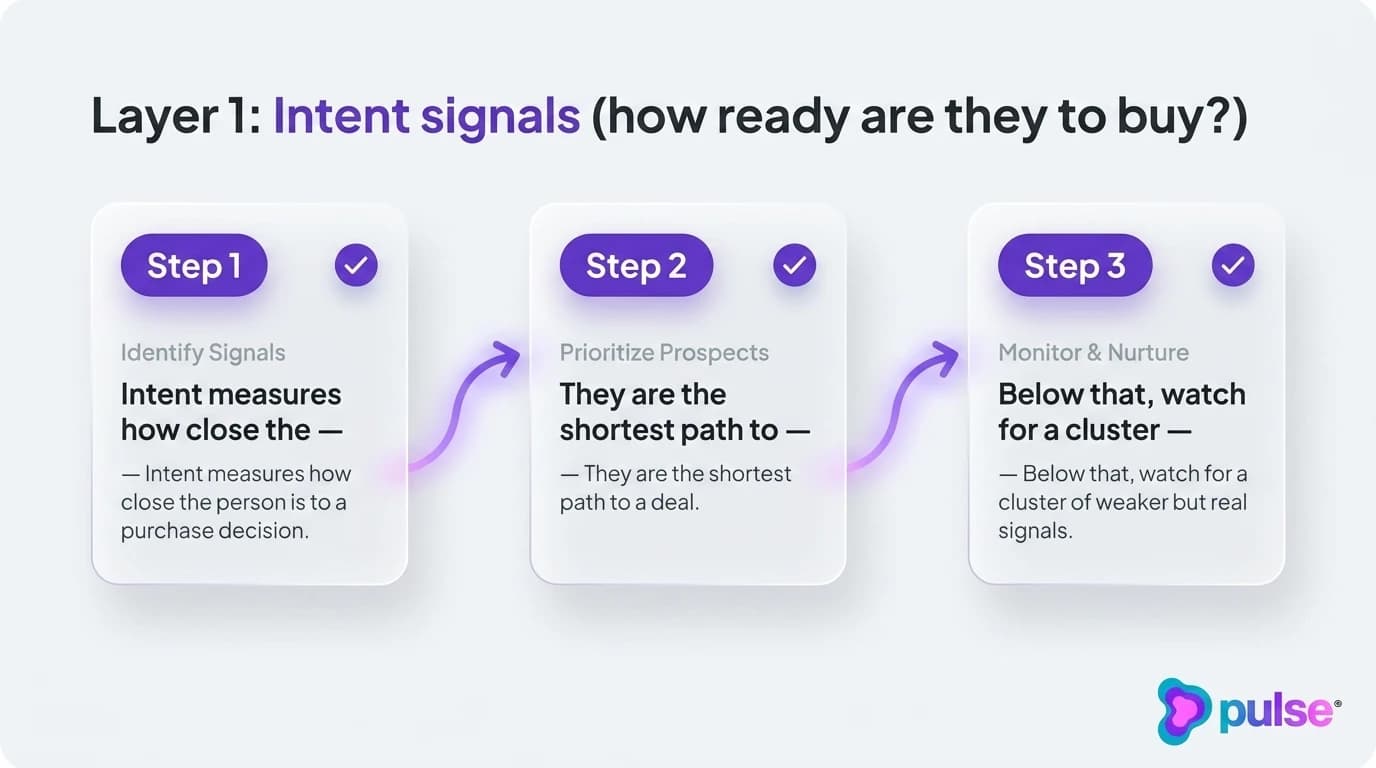
Intent measures how close the person is to a purchase decision. The highest-intent signal is an explicit request for a recommendation: a thread asking "what tool do you all use for X?" or "looking for something to help with Y, suggestions?" These people have already decided to buy something and are choosing between options. They are the shortest path to a deal.
Below that, watch for a cluster of weaker but real signals. Active, specific pain ("our current setup keeps failing", "I am wasting hours every week on this") means the person feels the problem sharply even if they have not started shopping. Evaluation language ("comparing X and Y", "is Z worth it?", "alternatives to...") signals someone mid-decision. Switching or cancellation signals ("about to churn off", "anyone moved off X?") are especially valuable because the person is not just a buyer, they are a buyer actively in motion. And timing words ("need this before our renewal next month", "just got budget approved") tell you the window is open now.
Weigh explicit recommendation requests and switching signals highest, active pain and evaluation language in the middle, and vague curiosity lowest. A thread that only muses "I wonder if there is a better way to do this someday" is real but distant, and it should not outrank a thread asking your exact category for a recommendation this week.
Intent is one input to your score, not the whole thing. The buying-intent language you score here is worth studying in depth, and our guide to finding buying-intent keywords on Reddit catalogs the specific phrases to track, including the competitor-complaint and switching signals that make such a strong lead source. Just remember that on its own, a strong Intent signal from the wrong person, or in a thread you cannot answer, is not a lead you should act on.
Layer 2: Fit signals (do they match your ICP?)
Fit measures whether this buyer is your buyer. You cannot pull up their company record, so you read fit from the context the thread gives you. Several clues are usually available if you look.
The subreddit itself is a fit signal. A thread in a community organized around your buyer role, industry, or job is a point in favor before you read a word, because the person self-selected into a room your ideal customer lives in. Choosing the right communities to watch is upstream of this whole exercise, and our guide to finding the subreddits that feed your pipeline covers how to build that list.
Self-description is the next clue. People reveal a lot in passing: "as a small agency owner", "our five-person support team", "I run ops for a manufacturing company." Those phrases map directly to your ideal customer profile. User history helps too. A quick glance at where else the account posts often confirms role and industry.
Then check the practical fit tests: company-size and stack hints (a solo founder and a 500-person enterprise are very different leads), use-case match (are they describing the specific job your product does, or an adjacent one?), and the B2B versus consumer tell (a hobbyist asking about a personal project is not a B2B lead no matter how much intent they show).
When fit is genuinely ambiguous, do not throw the lead out and do not assume the best. Score it in the middle and let the other two layers break the tie. A high-intent, reachable thread with unclear fit is still worth a low-cost, helpful reply that can also surface more information about who they are. An ambiguous-fit thread that is also low intent or hard to reach is a pass.
Layer 3: Reachability and risk signals (can you actually help here?)
Reachability is the layer most scoring systems forget, and it is often the one that decides whether a lead is real. A perfect-fit, high-intent buyer is worth nothing to you if the thread is locked, buried, or in a community that will remove your reply on sight. This layer scores whether you can engage usefully and safely right now.
Start with thread age and momentum. A recommendation thread posted an hour ago with active replies is live: the person is still reading and a helpful answer gets seen. A thread from two years ago is effectively closed even if it is a perfect match, and many older threads are archived, which means you literally cannot comment. Freshness is a hard gate, not a nice-to-have.
Next, position: is this the original poster asking a question, or a buried fifth-level commenter making an offhand remark? Replying to an active OP puts you in front of the person with the need. Replying to a deep comment usually reaches no one.
Then the risk half of the layer: community rules and moderation. Many subreddits restrict or ban self-promotion, and some remove anything that looks like a vendor pitch regardless of how helpful it is. Before you score a thread as reachable, know whether a genuine, disclosed, non-promotional reply is welcome there. If it is a no-self-promotion community, the thread might still be worth monitoring for insight, but it is not an action lead.
Finally, channel. Sometimes the right move is a public comment that helps the OP and everyone reading later; sometimes a brief, non-spammy direct message is more appropriate. The mechanics of replying without getting flagged are their own skill, and our guide to responding to Reddit recommendation threads without getting banned walks through them. For scoring purposes, the question is simpler: is there a welcome, visible way to be useful in this thread? If not, reachability is low no matter how good the lead looks on paper.
Build your Reddit lead score
Now combine the three layers into a single number so you can rank leads consistently instead of arguing about them one by one. Here is a simple rubric out of 100. Adjust the weights to your business, but keep Intent as the heaviest layer, because a lead you cannot sell to is worse than a lead you might reach later.
| Explicit recommendation request | 20 |
| Switching or cancellation signal | 15 |
| Active, specific pain | 10 |
| Evaluation or comparison language | 10 |
| Timing or urgency words | 10 |
| Vague curiosity only | 5 |
Add the signals present and cap the layer at 50.
| Posted in an ICP-aligned subreddit | 10 |
| Self-description or history matches your ideal customer | 10 |
| Use-case and company-size match | 10 |
If the thread is clearly consumer rather than B2B, set Fit to 0.
| Thread is recent and active | 8 |
| Reply reaches the original poster or a visible spot | 6 |
| Community welcomes disclosed, helpful replies | 6 |
If the thread is archived, locked, or a strict no-self-promotion community, set Reachability to 0.
Add the three layers for a score out of 100, then sort into tiers.
70 and above
Respond fast. These are your best leads.
40 to 69
Worth a thoughtful reply when you have capacity, usually strong on two layers and soft on one.
Below 40
Do not spend response time now, but keep an eye on the ones that could improve.
The exact thresholds matter less than applying them the same way every time. Two graders using this rubric on the same thread should land close, and that consistency is the whole point of scoring rather than eyeballing.
Worked example: scoring two threads side by side
These two examples are illustrative, not real users or real data, but they show how the same topic produces very different scores. Imagine you sell help-desk software for small support teams.
Posted three hours ago in a customer-support professionals community: a five-person support team dropping tickets on a messy help desk, needing to switch before their renewal next month, asking what everyone else uses.
- Intent
- 50
- Fit
- 30
- Reachability
- 20
An explicit recommendation request, a switching signal, active pain, and timing all fire and sum past the cap.
An ICP-aligned subreddit, a self-description that matches your buyer, and a direct use-case match.
Recent and active, it is the OP asking, and the community allows disclosed help.
Respond today.
Posted the same day in a huge general business subreddit with a strict no-vendor rule: a broad, 200-comment discussion titled around how everyone handles customer support as they grow.
- Intent
- 10
- Fit
- About 10
- Reachability
- Near 0
Active pain around scaling support, but no recommendation request, no switching signal, and no timing.
The use case is relevant, but it is a general audience with no ICP self-selection and no personal role details.
Recent, but your reply is one of hundreds and the subreddit removes vendor comments.
Barely worth a bookmark.
The lesson is the one Intent-only scoring misses entirely. Both threads are about customer-support pain. Read on keywords alone, they look similar. Scored across all three layers, one is a same-day Hot lead and the other is barely worth a bookmark, because Fit and Reachability, not the topic, decide whether the conversation can ever become a customer.

Turn scores into a prioritized action queue
A score is only useful if it changes what you do next. Turn your tiers into a simple operating rhythm so the team always knows what to work and in what order.
- Response time
- Same day, ideally within a couple of hours during working time.
- Owner
- Whoever can respond fastest and most credibly, often a founder or senior person.
- Approach
- If a lead is worth 70 points, it is worth interrupting your afternoon for.
- Response time
- Within a day or two, batched into a daily block rather than reacted to one by one.
- Owner
- The marketer or SDR working the daily batch.
- Approach
- Worth real effort but not an emergency.
- Response time
- No custom reply now; keep in view for the ones that could graduate.
- Owner
- Tracked as a lightweight nurture, not silence.
- Approach
- Follow the account or the recurring question, not the single dead thread.
Hot leads are time-sensitive: a recommendation thread goes stale within hours as other commenters pile in and the OP stops reading. Warm leads are strong on two layers and soft on one, so they are worth real effort but not an emergency. Watch leads are not silence, they are lightweight nurture. A Watch lead can graduate: an ambiguous-fit thread where the person later reveals they are your exact buyer, or a low-reachability question that reappears in a fresh, answerable form next week.
Decide ownership by tier and write it down so no Hot lead sits unclaimed. Finally, make the comment-first versus DM call per lead. Default to a public comment when the OP asked openly and others will benefit, since a helpful public reply keeps working long after you post it. Reserve direct messages for cases where a public vendor reply would break community norms but a brief, respectful private note is genuinely welcome. When in doubt, help in public and let the value speak.

Automate Reddit lead scoring with Pulse
Scoring by hand works, and you should understand the framework by hand before you automate it. But manual triage does not survive contact with volume. Reading every thread, checking the subreddit, glancing at the user history, and tallying three layers is fine for a handful of matches a day. Across a properly built list of communities and keywords, done often enough to catch Hot leads while they are still fresh, it becomes a full-time job nobody keeps up.
That is the gap Pulse is built to close. You define your keywords and the communities you care about once, and Pulse monitors Reddit continuously, surfaces the conversations that match, filters out the noise, and scores each one for relevance so the strongest leads rise to the top. Instead of scrolling a raw firehose and grading threads yourself, your team opens a prioritized queue with the best opportunities already ranked, which is the same Hot-Warm-Watch ordering this article describes, produced automatically.
The framework does not change when you automate it. Intent, Fit, and Reachability are still what make a Reddit lead worth acting on. What changes is that a human is no longer the bottleneck reading and rating every thread. You keep your judgment for the part that needs it, writing a genuinely helpful reply to a qualified lead, and let the tool handle the triage that was eating your day.
Common Reddit lead-qualification mistakes
Most qualification failures come down to a few repeatable errors. Watch for these.
- Scoring on keywords alone. A keyword match tells you a topic came up, not that the person is a fit or that you can reach them. Score all three layers, every time, or you will chase threads that never had a chance.
- Chasing volume over intent. Responding to 40 lukewarm mentions feels productive and converts almost nothing. Responding to the three genuinely Hot leads that day is what moves pipeline. Rank ruthlessly and let the low tiers go.
- Treating every match as Hot. If everything is urgent, nothing is. A framework that never produces Watch and skip decisions is not qualifying, it is just relabeling the firehose. The point of scoring is to say no to most leads so you can say yes well to a few.
- Ignoring thread context. The subreddit, the thread age, the user history, and the community rules are qualification data, not background noise. A lead read without its context is half a lead, and usually the wrong half.
- Firing templated replies at qualified leads. Qualification gets you to the right thread; it does not excuse a canned response once you are there. Reddit communities punish copy-paste vendor comments hard, and a great lead scored perfectly is still lost if your reply reads like spam.
Frequently asked questions
About the author
Garrett is the founder of Pulse. Previously, he built PumpUp to 6 million members through early influencer marketing and UGC, raised $4M from NEA and General Catalyst, and co-founded legal immigration platform BorderPass. He specializes in brand building, organic growth, and conversational marketing.
Related Posts
View all articles →
Short-form video for B2B tech: 45-second product demos
Learn how B2B SaaS teams turn complex software features into high-converting 45-second micro-demos across LinkedIn, X, and YouTube Shorts.

Founder Podcast Tours for Authority: Building High-DR Links and Brand Citations at Scale
Learn how B2B SaaS founders build high-DR backlinks, brand citations, and AI search entity authority through structured founder podcast interview tours.

Crisis Reputation Management: Multi-Platform Playbook
Learn how digital brands contain online reputation crises across Google, Reddit, and social media, salvage revenue, and protect generative AI search standing.
Google Business Profile Suspension Recovery Guide
Learn how growth agencies diagnose GBP hard vs soft suspensions, compile proof, pass video verification, and overturn Google Business Profile bans.

Local PPC Budgeting: Ad Spend Allocation Across Markets
Learn how multi-unit service businesses allocate Google Ads budgets across markets, implement Target CPA bidding, and eliminate territory cannibalization.

Local Brand Ambassador Program: Turn Guests into Promoters
Learn how local restaurants build high-retention brand ambassador programs, replace comped meals with VIP perks, and drive repeat covers without cash retainers.