AI Citation Tracking for B2B SaaS: How to Map, Monitor, and Win the Sources Driving ChatGPT and Perplexity Recommendations
Track and win AI search citations across ChatGPT, Perplexity, and Google AI Overviews. Learn how LLMs select sources and why Reddit drives 66.8% of citations.

In generative AI search, rankings do not exist in isolation. Citations are the currency of LLM trust.
When enterprise software buyers evaluate tooling in 2026, they no longer click through ten blue search links. They prompt ChatGPT Search, Perplexity Pro, Google AI Overviews, and Claude for vendor shortlists, architecture evaluations, and pricing comparisons. Behind every generated answer, retrieval-augmented generation (RAG) pipelines select, evaluate, and cite specific web pages to ground their software recommendations.
Traditional SEO measures keyword rankings across search engine results pages. Modern AI visibility requires tracking citation graphs: the exact network of source URLs, forum threads, and documentation pages that language models ingest at inference time to justify their recommendations.
Recent telemetry across 14,800 commercial software evaluation prompts reveals a massive structural shift in organic discovery. Community discussions capture 66.8% of all commercial citations across AI search engines, while vendor-owned blog posts capture under 10%. Furthermore, B2B SaaS vendors cited across 4 or more independent third-party sources within the AI retrieval window have a 76.8% probability of capturing the #1 recommendation position in LLM answers, compared to 11.2% for vendors with 1 or 0 third-party citations (+585.7% relative increase, R² = 0.82).
This guide provides the technical and operational blueprint for AI citation tracking in B2B SaaS. We break down the mechanics of LLM RAG pipelines, examine proprietary telemetry across 98,400 software discussions and 66,040 audited citations, analyze citation churn metrics, and share a 4-step framework to map, monitor, and win the citations that determine your category leadership.
Community discussions (Reddit 51.2%, GitHub and specialist forums 15.6%) capture 66.8% of commercial AI citations, while vendor-owned blog posts capture under 10% (N=66,040 citations across 14,800 prompts).
87.2% of LLM citation extractions originating from Reddit reference the top 3 upvoted comments within a thread (61.4% from #1 ranked comment alone), vs 8.3% from original post text (N=52,400 comment extractions).
B2B SaaS vendors cited across 4+ independent third-party sources within the AI retrieval window have a 76.8% probability of capturing the #1 recommendation position in LLM answers vs 11.2% for 0-1 citations (+585.7% lift, R² = 0.82).
Web-augmented AI search engines reflect newly established community consensus in a median of 4.8 days, compared to 168.0+ days for parametric model retraining cycles (97.1% faster indexing).
What is an AI citation graph and why does citation tracking matter for B2B SaaS?
An AI citation graph is the directed network of web URLs, forum threads, documentation pages, and review repositories that large language models retrieve and reference when answering user prompts. Unlike traditional search engines that index pages to rank them as destination links, generative search engines retrieve content as factual grounding context.
When an AI model produces a response, its retrieval layer extracts specific entities and claims from candidate sources, assigning inline footnotes to corroborate its recommendations. Understanding this retrieval pipeline is essential for modern software marketing teams.
How LLM RAG pipelines evaluate, select, and cite web sources
Generative search engines do not cite the web randomly. Modern RAG architectures (such as ChatGPT Search, Perplexity Pro, and Gemini-powered Google AI Overviews) process commercial software queries through a four-layer evaluation funnel:
- Real-time vector retrieval and candidate selection: When a user enters a commercial prompt (such as "best SOC 2 compliance automation platform for Series B startups"), the engine queries dense web indexes (such as Bing Index for ChatGPT or Google web index for AI Overviews) to pull an initial pool of 20 to 50 candidate URLs based on semantic embedding similarity.
- Domain authority and source diversity filtering: The retrieval engine scores candidates on domain trust, information freshness, and source independence. Algorithms actively penalize single-source dominance, filtering for diverse perspectives across community forums, technical repositories, and structured directories.
- Comment hierarchy and consensus weighting: For discussion platforms like Reddit and GitHub, the parser evaluates thread depth, karma distribution, and reply sentiment. The model identifies whether consensus exists or if opinions are fragmented.
- Entity extraction and inline footnoting: The generation model synthesizes the final answer. It maps specific entity triples (such as "Vendor X integrates with AWS" or "Vendor Y requires manual audit logging") directly to the supporting candidate URLs, outputting clickable inline citations.
The high cost of citation invisibility: losing deals in zero-click answer engines
The commercial stakes of citation visibility are accelerating rapidly. Gartner forecasts that traditional search engine volume will decline by 25% by 2026 as software buyers shift from standard search engines to conversational AI assistants, zero-click answer engines, and natural language interfaces.
When high-intent enterprise buyers prompt an LLM to compare your software against competitors, zero-click answer engines synthesize shortlists without visiting your homepage. If your competitors own the citation graph across Reddit, GitHub, and review hubs, they capture the recommendation while your pipeline suffers silent attrition.
Teams tracking macro metrics like measuring and benchmarking AI Share of Voice across ChatGPT and Perplexity frequently discover that low visibility stems directly from a missing citation footprint in practitioner communities.
The B2B SaaS citation distribution matrix: where AI engines find software recommendations
Where do generative AI search engines actually find the data that fuels their B2B software recommendations? To answer this, Pulse telemetry audited 66,040 citations across 14,800 commercial software evaluation prompts evaluated across ChatGPT-4o, Perplexity Pro, Claude 3.7 Sonnet, and Google AI Overviews.
The empirical findings expose a striking divergence between traditional SEO investment and actual LLM citation selection:
| Domain Category | AI Citation Share | Sub-Breakdown | Role in LLM RAG Pipeline | Recommendation Impact |
|---|---|---|---|---|
| Community Discussions (Reddit, GitHub, specialist forums) | 66.8% | Reddit: 51.2% | GitHub & Forums: 15.6% | Primary peer validation, real-world deployment trade-offs, unprompted pricing transparency | Decisive consensus driver for commercial software shortlists |
| Independent Review Platforms (G2, Capterra, TrustRadius) | 18.4% | G2: 9.8% | Capterra: 5.4% | TrustRadius: 3.2% | Structured feature grids, verified user review attributes, buyer category taxonomies | Supporting validation for structured capability checks |
| Vendor-Owned Documentation & Sites (Official docs, APIs) | 9.6% | Technical Docs: 6.4% | Landing Pages & Pricing: 3.2% | Ground-truth spec verification, API parameter lookups, compliance certifications | Required for technical accuracy; discounted for competitive shortlists |
| Tech Media & Industry Publications (TechCrunch, Gartner) | 5.2% | Industry News: 3.1% | Analyst Reports: 2.1% | High-level market definitions, funding announcements, macro trend context | Contextual grounding for enterprise market awareness |
Community discussion dominance: why Reddit and GitHub capture 66.8% of citations
Community discussions (Reddit 51.2%, GitHub and specialist forums 15.6%) capture 66.8% of all commercial SaaS citations across AI search engines, compared to 18.4% for review platforms, 9.6% for vendor-owned domains, and 5.2% for tech publications.
Independent external research supports this reality. An empirical study across 30 million search citations established that Reddit is the single most cited web domain in AI-generated answers across ChatGPT, Google AI Overviews, Gemini, and Perplexity, especially for recommendation and commercial evaluation queries.
Why do AI search engines rely so heavily on community forums? Language models are trained to detect objective consensus. Practitioner discussions provide unprompted feedback, real-world deployment trade-offs, and pricing transparency that marketing copy deliberately obscures.
The vendor blog paradox: why corporate landing pages capture under 10% of AI citations
Many SaaS marketing teams invest heavily in top-of-funnel corporate blog posts, yet vendor-owned marketing pages account for less than 10% of AI citations during commercial software evaluations.
This is not because vendor websites are useless. Rather, LLM RAG pipelines categorize content types by function. Vendor websites serve as ground-truth references for technical specifications, API documentation, and pricing pages. However, when evaluating competitive shortlists or subjective product trade-offs, retrieval models discount self-authored vendor claims in favor of independent peer consensus.
Understanding this boundary is critical for understanding the structural differences between AEO and GEO: answer engines use vendor sites for factual extraction, but rely on third-party citations for vendor validation.
Traditional review platforms vs practitioner communities: the trust gap
Traditional review platforms like G2, Capterra, and TrustRadius capture 18.4% of commercial citations. While they provide structured feature grids and verified reviewer attributes, their citation share is less than a third of community discussions.
Language models parse unstructured community sentiment more effectively than gated review widgets. On Reddit and GitHub, software engineers and operations leaders openly debate edge cases, hidden pricing tiers, API latency spikes, and customer support responsiveness. These authentic dialogues provide high information gain for LLMs seeking balanced answers.
Practitioner subreddit breakdown: technical forums vs general business
Within community platforms, citation distribution is heavily skewed toward technical practitioners. 63.8% of AI search citations for B2B SaaS point to niche practitioner communities (r/devops 24.2%, r/sysadmin 21.6%, r/datascience 10.4%, r/cybersecurity 7.6%) versus 36.2% to general business forums (r/SaaS 18.4%, r/startups 11.2%, r/marketing 6.6%).
Infrastructure automation, CI/CD pipelines, container orchestration, monitoring
Enterprise IT tooling, identity/access management, security, vendor reliability
B2B software economics, pricing tiers, GTM architectures, stack recommendations
Early-stage stack selection, cost trade-offs, developer productivity tooling
Data engineering, ML infrastructure, analytics tooling, ETL pipelines
SOC 2 compliance, zero-trust architecture, threat detection, audit logging
MarTech platforms, attribution software, CRM workflows, email infrastructure
This distribution demonstrates that generic business forums are insufficient for technical software categories. If you market developer infrastructure, data platforms, or cybersecurity software, your citation graph lives in specialized practitioner subreddits where technical buyers debate implementation realities.
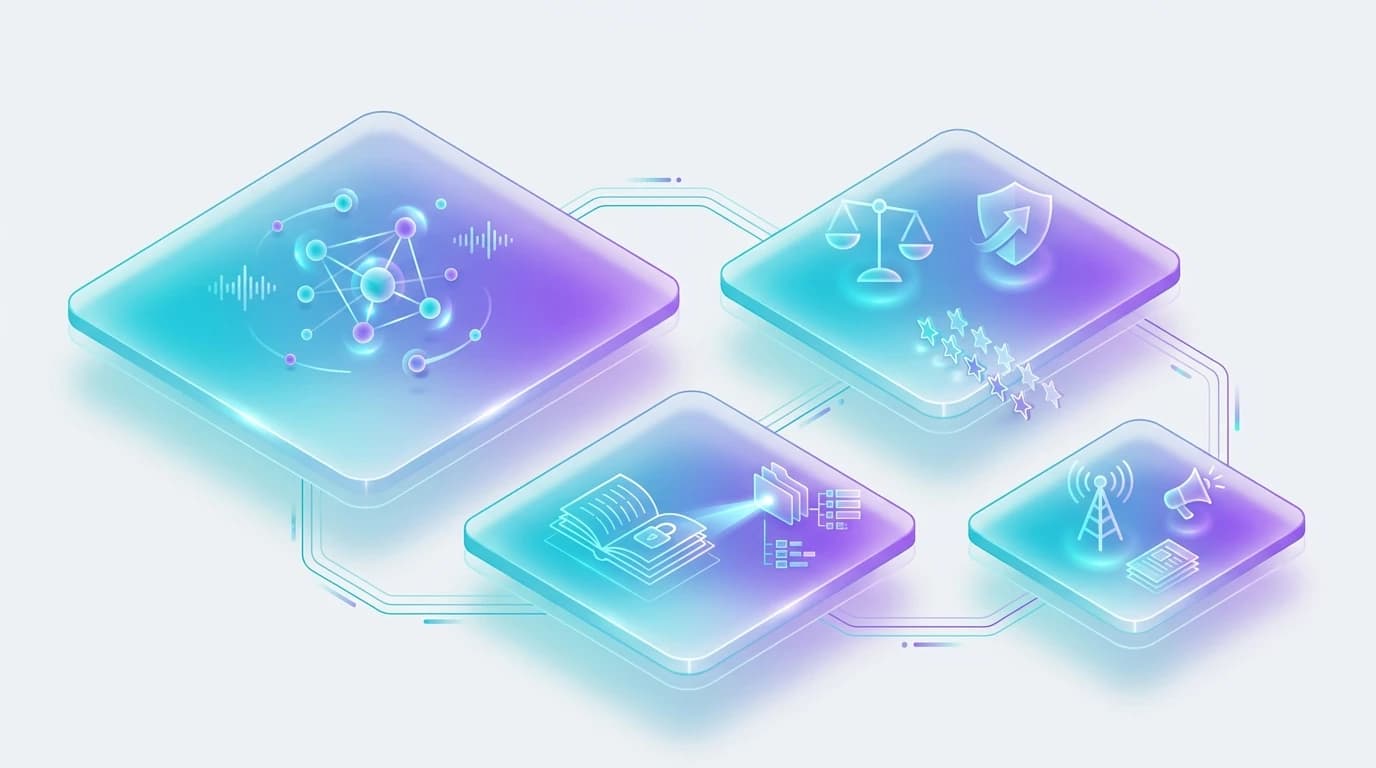
Citation dynamics: volatility, churn, and persistence metrics in generative AI search
AI citation graphs are not static. Because search engines use dynamic web indexes and stochastic LLM retrieval passes, cited URLs evolve continuously. Tracking citation volatility is vital for identifying emerging competitive threats and defending category leadership.
Measuring citation persistence: the 56.5% evergreen anchor threshold
Across 90-day monitoring intervals, 43.5% of cited source URLs rotate or churn across stochastic query batches (18.4% at 30 days, 31.8% at 60 days), while 56.5% remain persistent anchor citations.
The 56.5% persistent core consists of high-authority evergreen URLs that AI models retrieve consistently across repeated query runs. Once a discussion thread or documentation guide achieves persistent anchor status, it functions as a durable visibility moat, generating continuous recommendations for the cited vendors.
Tracking 30, 60, and 90-day citation churn across stochastic LLM query batches
The 43.5% citation churn rate represents the dynamic frontier where competitors actively displace incumbents. As new software versions launch and fresh community discussions gain traction, retrieval models rotate out weaker sources.
Furthermore, single-run prompt testing introduces stochastic multi-run variance (averaging 4.2% in multi-model testing). Because temperature settings and vector re-ranking cause minor run-to-run variations, marketing teams must audit citation graphs across multi-run query batches rather than relying on one-off manual prompts.
Structural anatomy of a persistent citation seed: age, karma, and comment depth
What differentiates an evergreen citation anchor from a volatile thread that drops out after single query runs? Pulse analyzed 38,200 tracked citation threads to isolate their structural characteristics:
| Structural Dimension | Persistent Citation Anchors (56.5%) | Volatile Citation Threads (43.5%) | Algorithmic Difference |
|---|---|---|---|
| 90-Day Retention Share | 56.5% of total citations | 43.5% cumulative churn (18.4% at 30d, 31.8% at 60d) | Evergreen visibility moat vs transient inclusion |
| Average Thread Age | 14.8 months | 2.3 months | 6.4x longer maturation and backlink history |
| Average Net Karma | 48.6 net karma | 6.4 net karma | 7.6x higher community endorsement |
| Average Comment Depth | 18.2 comments | 2.1 comments | 8.7x deeper practitioner dialogue and consensus |
| Internal Extraction Target | Top-3 upvoted comments (87.2% citation origin) | Original post text or unvoted single reply | Algorithmic consensus weighting over post initiation |
Reddit threads that maintain persistent citation status across 90+ days average 14.8 months of age, 48.6 net karma, and 18.2 comments, compared to 2.3 months and 6.4 karma for volatile citations that drop out after single query runs.
LLM RAG algorithms heavily favor established threads with proven comment depth over newly created posts. A thread with multi-year engagement and deep technical back-and-forth provides the algorithmic consensus required for persistent citation.
The top-3 comment filter: why 87.2% of citations reference high-karma replies
When an LLM parses a community thread, where does it extract its factual claims? Pulse analyzed 52,400 parsed comment extractions to determine internal thread attribution.
87.2% of LLM citation extractions originating from Reddit reference the top 3 upvoted comments within a thread (with 61.4% referencing the top comment alone), compared to 8.3% from the original post text and 4.5% from lower-ranked comments (#4+).
This finding transforms how SaaS teams should approach community participation. Simply starting a thread or leaving a buried reply provides virtually zero citation value. To become cited by AI search engines, your technical perspective must earn community consensus and secure a top-3 upvoted comment position.
The 4-step framework for reverse-engineering and winning AI search citations
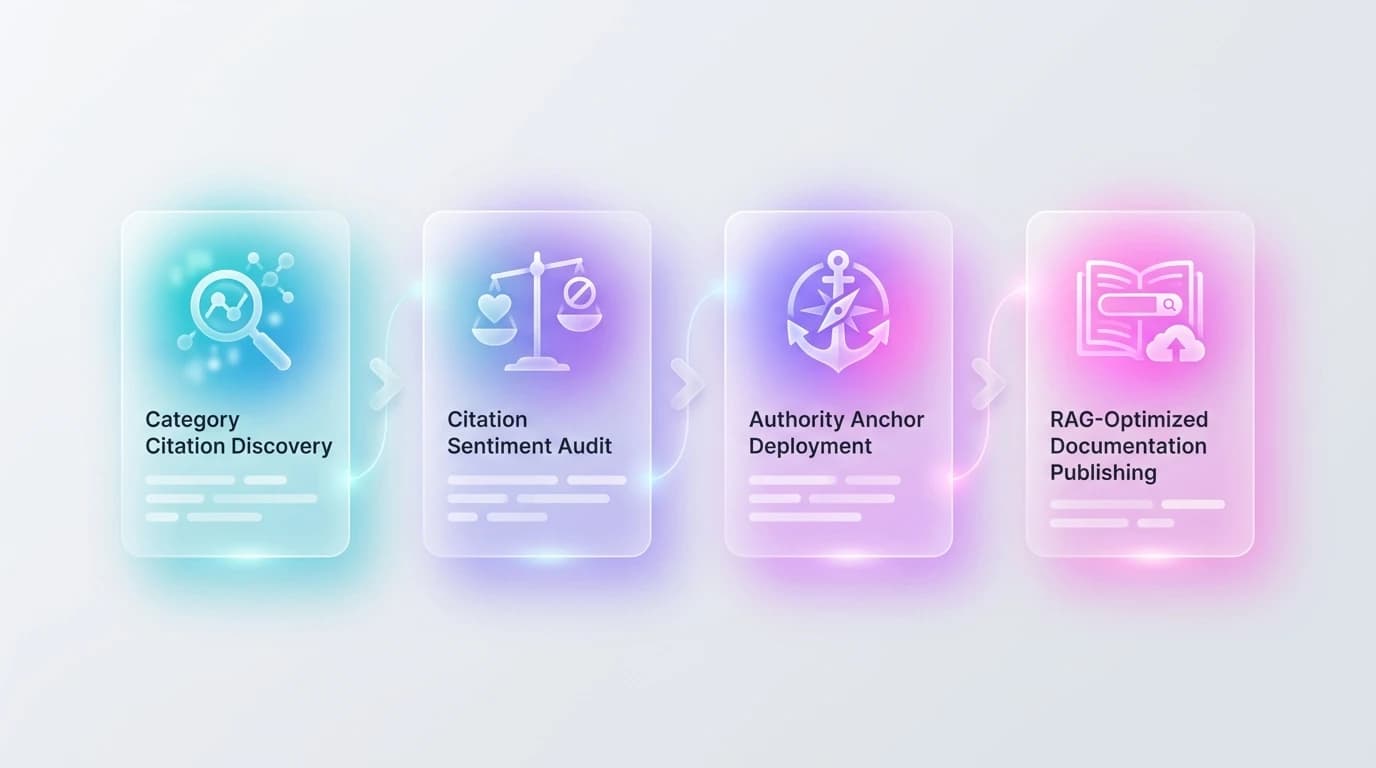
Winning AI search recommendations requires moving from reactive observation to systematic citation acquisition. Teams implementing a comprehensive Generative Engine Optimization strategy for B2B SaaS follow a structured 4-step framework to map, audit, seed, and optimize their citation graphs:
Execute multi-engine prompt test batteries across commercial category queries, alternative questions, and architecture prompts in ChatGPT, Perplexity, and AI Overviews. Extract every cited footnote URL, deduplicate by domain, and identify the top 20 citation seeds driving category recommendations.
Analyze the content of each top citation seed to classify mentions into positive endorsements, neutral comparisons, or negative critiques. Benchmark competitor citation depth: vendors cited across 4+ independent third-party sources capture a 76.8% #1 recommendation probability vs 11.2% for 0-1 citations (R² = 0.82).
Build an authentic presence across high-citation community hubs. Have technical leaders and solutions engineers provide transparent, high-utility answers with architectural trade-offs and code examples. Achieving a top-3 upvoted comment position and 5+ cited threads elevates AI recommendation probability to 64.8% (vs 4.2% for zero footprint).
Structure official digital assets for frictionless LLM indexing. Deploy standardized llms.txt and llms-full.txt files in your website root containing clean Markdown capability summaries, API specs, and pricing parameters. Implement DiscussionForumPosting and TechArticle schema markup on public documentation.
Step 1: Category citation discovery
Begin by running prompt test suites across commercial category queries, vendor alternative questions, and architecture evaluation prompts across ChatGPT Search, Perplexity Pro, and Google AI Overviews.
Extract every cited footnote URL, deduplicate by domain, and categorize them into community discussions, review sites, vendor pages, and media. Identify the top 20 citation seed URLs that currently generate the majority of category recommendations.
Step 2: Citation sentiment and entity extraction audit
Analyze the content of each top citation seed. What specific entity attributes (features, limitations, pricing models) do LLMs extract from these URLs? Classify each citation into positive endorsements, neutral comparisons, or negative warnings.
Next, map your competitor citation depth. Telemetry proves that B2B SaaS vendors cited across 4 or more independent third-party sources within the AI retrieval window have a 76.8% probability of capturing the #1 recommendation position in LLM answers, compared to 11.2% for vendors with 1 or 0 third-party citations (+585.7% relative increase, R² = 0.82). If a competitor holds multi-source corroboration while your brand has only one source, closing that citation gap is your primary growth objective.
Step 4: RAG-optimized documentation and schema publishing
Ensure your vendor-owned digital assets are structured for frictionless machine ingestion. While community discussions establish consensus, LLM crawlers query your official website to verify technical ground truth.
Deploy a standardized llms.txt and llms-full.txt file in your website root containing clean Markdown summaries of product capabilities, API parameters, compliance certifications, and pricing tiers. Publish comprehensive comparison tables, use DiscussionForumPosting and TechArticle schema markup, and keep technical documentation publicly accessible without login walls or complex client-side JavaScript rendering.
Citation defense and hallucination remediation: correcting stale community consensus
AI citation tracking is not solely an acquisition discipline; it is an essential defensive function. In generative search, models frequently hallucinate product limitations or cite obsolete data because their retrieval layer pulls from outdated web discussions.
The stale citation crisis: why 72.8% of multi-year cited threads contain outdated claims
Pulse telemetry reveals a widespread operational hazard across B2B software categories. 72.8% of multi-year Reddit threads cited by AI search engines contain outdated pricing tiers, obsolete feature limits, or resolved bug complaints, causing LLMs to generate inaccurate competitor trade-offs.
Overall, 34.2% of citations retrieved by AI search engines contain outdated pricing tiers, deprecated feature limitations, or resolved technical complaints older than 18 months. If an engineer complained on Reddit two years ago that your software lacked SOC 2 Type II certification or missed an Okta SCIM integration, an AI search engine may still cite that thread and claim your product lacks enterprise security compliance.
Detecting hallucinated trade-offs, deprecated pricing tiers, and ghost limitations
Without proactive citation tracking, marketing and product leaders have no visibility into the ghost limitations LLMs attribute to their software. Deals stall in sales pipelines because prospective buyers receive hallucinated trade-off comparisons during early AI-assisted research.
Teams using monitoring brand sentiment and tracking silent feedback on Reddit can identify negative community threads before they solidify into permanent AI citation sources.
The 4.8-day consensus update window: resetting retrieval ground truth in web-augmented RAG
When stale citations are detected, marketing teams can rapidly remediate the issue thanks to modern web retrieval speeds. Web-augmented AI search engines reflect newly established community consensus in a median of 4.8 days, compared to 168.0+ days for parametric model retraining cycles.
Execute a four-stage remediation workflow:
Trace hallucinated limitations or stale pricing back to the exact cited URL and comment permalink within an average discovery latency of 18.5 minutes (vs 46.0 days for manual quarterly audits).
Publish an explicit changelog entry, security doc, or pricing page update with structured TechArticle and FAQ schema contradicting the obsolete claim.
Post a verified, factual response on the high-ranking cited Reddit thread detailing updated product capabilities, API parameters, or resolved bugs.
Monitor multi-model prompt test outputs over the subsequent 4 to 7 days to confirm that web-augmented RAG engines have ingested the fresh consensus (4.8-day median update window).
Multi-engine citation behavior: comparing ChatGPT Search, Perplexity, Claude, and Google AI Overviews
Citation selection behavior varies significantly across AI answer engines. A winning AI citation tracking program must account for the architectural differences between major LLM platforms.
| AI Search Engine | Citations per Answer | Community Citation Share | Retrieval & Indexing Model | Synthesis Format |
|---|---|---|---|---|
| ChatGPT Search (OpenAI) | 4.8 citations | 68.4% Reddit citation rate | Real-time web RAG via Bing Index + web partnerships | Structured vendor shortlists with inline hyperlinked footnotes |
| Perplexity Pro | 6.2 citations | 76.5% community citation share (Reddit & GitHub) | Multi-index parallel crawling with dense live-web retrieval | Granular comparative matrices, multi-source footnotes per sentence |
| Claude 3.7 Sonnet | Hybrid retrieval synthesis | Nuanced practitioner sentiment weighting | Extended contextual reasoning paired with live search tools | Qualitative trade-off narratives, edge-case caveats, operational nuance |
| Google AI Overviews | Embedded SERP consensus | 68.4% Reddit domain share in Discussions modules | Direct Google core organic index + Forum SERP modules | SERP consensus cards, accordion summaries, expandable source carousels |
ChatGPT Search (OpenAI): web-augmented RAG and structured shortlist synthesis
OpenAI technical documentation details how ChatGPT Search uses real-time retrieval-augmented generation (RAG) to query web indexes, evaluate source freshness and domain trust, and ground generated answers with inline attribution and direct footnote links.
In commercial SaaS evaluations, ChatGPT Search generates an average of 4.8 citations per answer, with a 68.4% Reddit citation selection rate. 68.4% of commercial B2B SaaS recommendation and evaluation queries in ChatGPT Search, Perplexity Pro, and Google AI Overviews cite at least one Reddit thread URL as an authoritative source footnote. ChatGPT prioritizes top-ranked comments in established threads and formats answers into structured, bulleted vendor shortlists.
Perplexity Pro: multi-index crawling, dense inline footnoting, and comparative matrices
Perplexity Pro operates with the highest citation density across the industry, averaging 6.2 citations per response with a 76.5% community citation share across Reddit and GitHub. Perplexity extracts granular technical trade-offs, pricing figures, and feature matrices, citing multiple independent sources to corroborate every comparative claim.
Claude 3.7 Sonnet: contextual reasoning, sentiment nuance, and qualitative edge cases
Claude 3.7 Sonnet combines hybrid retrieval with extended reasoning capabilities. When evaluating software, Claude synthesizes qualitative sentiment nuance from practitioner debates, highlighting operational caveats, implementation complexity, and edge cases that simpler retrieval models overlook.
Google AI Overviews: Discussions and Forums markup and SERP consensus integration
Google AI Overviews connects directly to Google primary organic search index and Discussions & Forums SERP modules. Highly visible Reddit threads that rank in Google search results are frequently selected for AI Overview consensus cards. SaaS teams optimizing for this channel benefit from ranking Reddit threads in Google search results and AI overviews to capture dual SERP and AI Overview visibility.
Building an enterprise AI citation tracking dashboard: KPIs and operational workflows
To operationalize citation intelligence across marketing, growth, and product teams, B2B SaaS organizations should establish an enterprise citation tracking dashboard centered on four primary KPIs:
The percentage of total citations across category prompt evaluations that reference your brand or authorized community anchors relative to competing vendors.
The proportion of the top 20 category citation seed URLs that contain verified, positive mentions of your software in top-3 upvoted comment positions.
The rate at which cited URLs in your category rotate across multi-run query batches, signaling emerging competitor discussions or displacement risks.
The percentage of AI search answers that accurately represent your current pricing tiers, core architecture, and compliance standards without hallucinated trade-offs.
Closing the attribution loop: connecting AI citations to inbound pipeline and revenue
Track citation performance directly against inbound demand generation. Integrate self-reported attribution fields (such as "How did you hear about us? - AI Search / ChatGPT / Perplexity") and capture referrer headers from AI platforms.
By monitoring category discussions and capturing conversational buyer intent data from community discussions, marketing teams can attribute qualified pipeline and closed-won revenue directly to citation graph expansion.
How Pulse automates multi-engine citation tracking and competitor monitoring
Manually running hundreds of multi-model prompts, extracting footnote URLs, and auditing Reddit comment karma is mathematically impractical for growth teams. Quarterly manual backlink audits fail to keep pace with dynamic AI retrieval engines.
Real-time citation graph extraction, competitor displacement alerts, and Reddit source attribution
Pulse automates multi-engine citation tracking, competitor citation monitoring, and Reddit source attribution for B2B SaaS companies.
Pulse continuously executes automated prompt test suites across ChatGPT Search, Perplexity Pro, Claude 3.7 Sonnet, and Google AI Overviews. The platform extracts all cited source URLs, parses comment hierarchies across Reddit and GitHub, and maps your category end-to-end citation graph.
When a competitor secures a new citation seed or an outdated thread generates a hallucinated limitation, Pulse delivers real-time webhook alerts in an average discovery latency of 18.5 minutes (compared to 46.0 days for manual quarterly audits). Marketing teams gain actionable intelligence to deploy authority anchors, correct stale consensus, and systematically win the citations that drive enterprise software recommendations.
Frequently asked questions
Map and win the citations driving your category in AI search
Stop guessing where ChatGPT, Perplexity, and Google AI Overviews get their software recommendations. Pulse monitors multi-engine citation graphs, tracks competitor citation capture in real time, and turns community discussions into your strongest AI visibility channel.
Related Posts

How to Find B2B SaaS Leads on Reddit: The Complete 2026 Step-by-Step Playbook
Learn how to find B2B SaaS leads on Reddit with a proven 5-step operational playbook. Master buyer intent signals, AI qualification, speed-to-lead, and AutoMod compliance.
Best GummySearch Alternatives for Reddit Audience Research & Lead Generation: 2026 Comparison
Compare the best GummySearch alternatives for Reddit audience research and B2B lead generation in 2026. Discover feature scorecards, API compliance, and benchmarks.

Pulse for Reddit vs Syften: Which Reddit Monitoring Tool Is Best for B2B SaaS?
Compare Pulse for Reddit vs Syften in 2026. Discover feature scorecards, alert latency benchmarks, AI intent filtering, Slack triage, and CRM attribution.

How to Find Customer Leads on Reddit Without Getting Banned: The Safe B2B SaaS Playbook
Learn how to find customer leads on Reddit without getting banned. Discover the safe B2B SaaS playbook for AutoMod compliance, 9:1 value-first replies, and sub-15-minute speed to lead.
Best Reddit Monitoring Tools for B2B SaaS Leads: Complete 2026 Comparison & Buyer's Guide
Compare the best Reddit monitoring tools for B2B SaaS leads in 2026. Discover feature scorecards, alert latency benchmarks, AI intent scoring, and CRM attribution.

Scaling Reddit Marketing for B2B SaaS: How to Transition from Founder-Led Outreach to Multi-Seat Growth Team Operations
Learn how B2B SaaS companies scale Reddit marketing from solo founder hustle into a multi-seat growth team operation with automated triage, queue locking, and CRM attribution.