AI Share of Voice for B2B SaaS: How to Measure and Benchmark Brand Visibility in ChatGPT, Perplexity, and AI Search
Measure and benchmark your AI Share of Voice (AI SOV) across ChatGPT, Perplexity, and Google AI Overviews with our mathematical formula, prompt taxonomy, and citation tracking framework.

B2B software purchasing has reached an inflection point. For over two decades, software buyers evaluated tools by entering keywords into Google, scanning ten blue links, and clicking through vendor landing pages. Today, software buyers prompt conversational AI answer engines like ChatGPT Search, Perplexity Pro, Claude, and Google AI Overviews for vendor shortlists, architectural trade-offs, and pricing comparisons.
Traditional Share of Voice (SOV) metrics, which measure organic keyword impressions, search rankings, and media PR mentions, cannot measure this shift. When a prospective buyer prompts ChatGPT, "What is the best customer data platform for B2B SaaS with SOC2 Type II compliance and Okta SCIM provisioning under $20k per year?", the buyer never visits a traditional search engine results page. The generative model provides a synthesized shortlist directly in the chat interface. If your brand is omitted, mischaracterized, or tied to stale pricing, you lose the deal before your sales team even knows an evaluation occurred.
Gartner forecasts that traditional search engine volume will drop by 25% by 2026 as buyers shift to conversational assistants. To defend pipeline and lead your software category, marketing executives must adopt a new measurement framework: Weighted AI Share of Voice (AI SOV).
Based on Pulse telemetry across 92,600 commercial software discussions and 12,400 multi-model evaluation runs, this guide provides the definitive operational and mathematical blueprint for measuring, benchmarking, and expanding your AI Share of Voice across generative answer engines.
In 81.4% of evaluated commercial prompt tests across ChatGPT and Perplexity, the top LLM recommendation directly matches the highest-ranked vendor by positive Reddit community sentiment.
Web-augmented RAG engines index and cite fresh Reddit consensus in a median of 3.6 days, compared to 142.0 days for static foundational model retraining cycles.
Net community sentiment on Reddit correlates strongly (R² = 0.84) with generative AI recommendation probability, heavily outperforming traditional Domain Authority (R² = 0.18).
B2B SaaS brands with dominant positive Reddit community presence (>35% upvoted mentions) capture 58.4% AI recommendation share vs 6.2% for low-presence brands (+841.9% visibility lift).
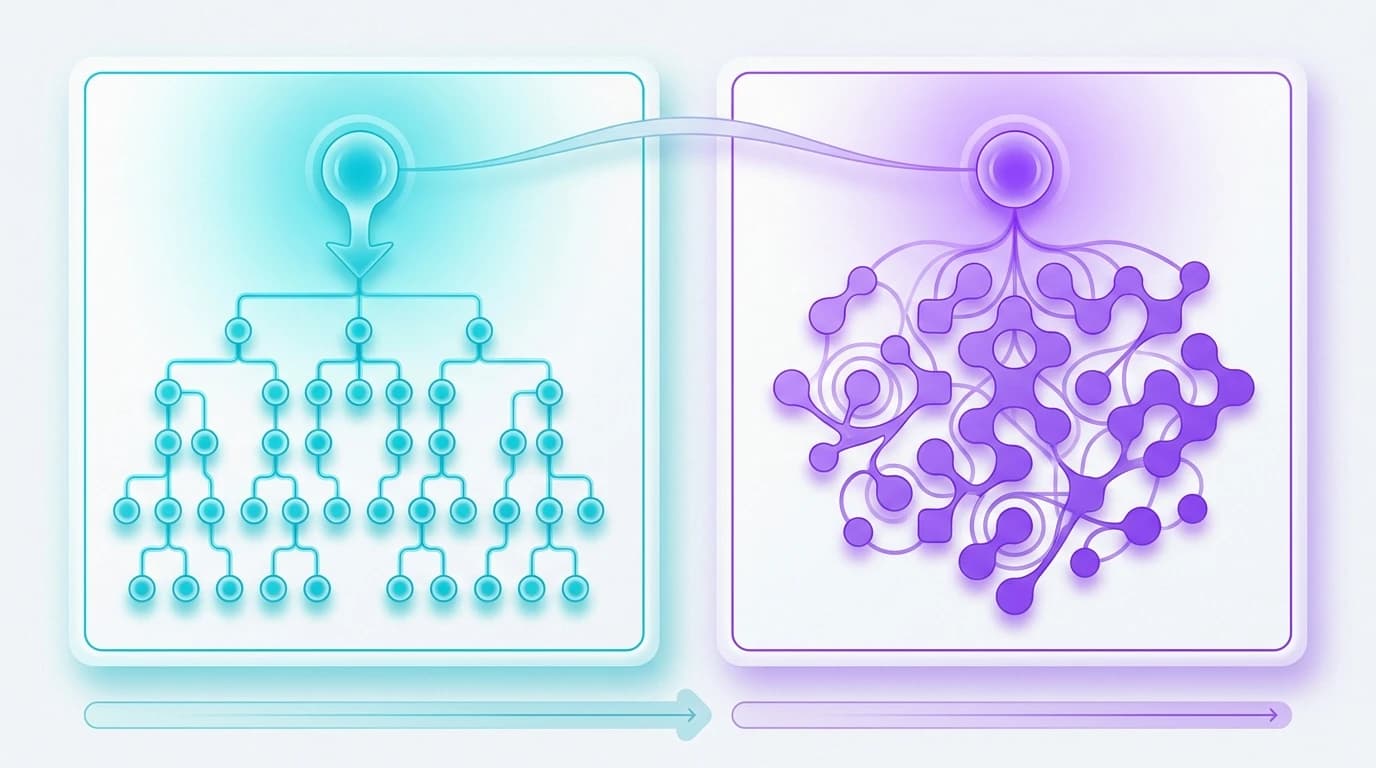
Constructing a representative prompt taxonomy: the 4-tier evaluation model
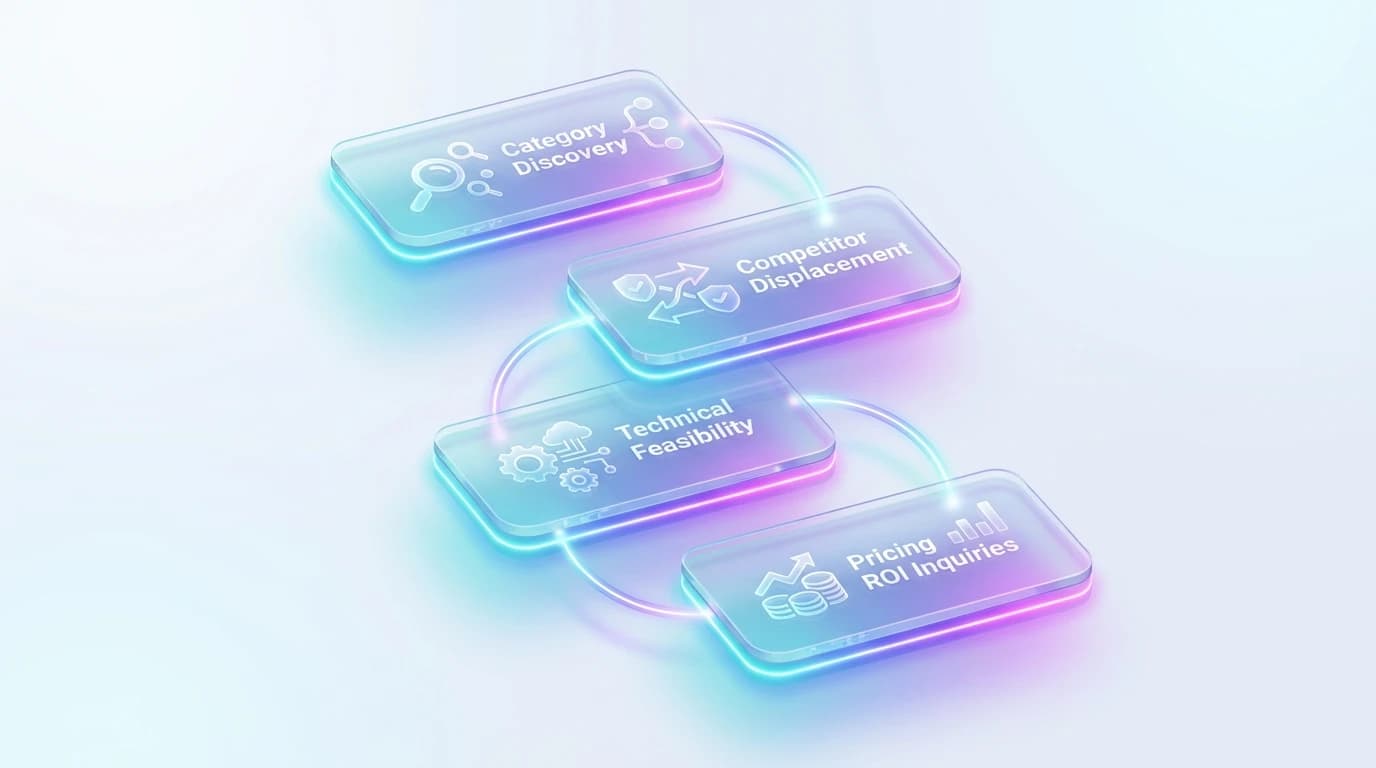
To build an accurate AI Share of Voice measurement benchmark, marketing teams must construct a prompt taxonomy that mirrors the entire software buying cycle across four distinct tiers.
Top-of-funnel buyer exploration mapping an unfamiliar software landscape to construct an initial consideration list.
Objective: Measure baseline category awareness and verify whether your brand appears in standard top-3 LLM shortlists.
Active switching intent where buyers express dissatisfaction with an incumbent vendor and seek alternatives that solve operational pain points.
Objective: Quantify how frequently AI search engines position your product as the preferred replacement when buyers evaluate migration paths.
Technical evaluations assessing operational capabilities, compliance standards, API limits, and architectural constraints.
Objective: Verify whether generative models accurately reflect your product capabilities without hallucinating missing features.
Bottom-of-funnel purchasing validation calculating total cost of ownership, comparing licensing tiers, and evaluating implementation timelines.
Objective: Ensure models output current pricing parameters and commercial terms rather than quoting deprecated tiers or hallucinated contract commitments.
Tier 1: Category discovery prompts (weight: 1.0x to 1.5x)
Category discovery prompts represent top-of-funnel buyer exploration. Buyers use these queries to map an unfamiliar software landscape and build an initial consideration list.
- Example query: "What are the best customer data platforms for B2B SaaS with under 500 employees?"
- Objective: Measure baseline category awareness and verify whether your brand appears in standard top-3 LLM shortlists.
- Primary KPI: Shortlist Inclusion Rate (%).
Tier 2: Competitor displacement prompts (weight: 2.0x)
Competitor displacement prompts reflect active switching intent. In these queries, buyers express dissatisfaction with an incumbent vendor and seek alternatives that solve specific operational pain points.
- Example query: "What are the best alternatives to [Competitor] for enterprise workflow automation with better SOC2 compliance?"
- Objective: Quantify how frequently AI search engines position your product as the preferred replacement when buyers evaluate migration paths.
- Primary KPI: Displacement Win Rate (%).
Tier 3: Feature-specific and technical feasibility prompts (weight: 2.5x)
Technical feasibility prompts evaluate operational capabilities, integrations, compliance standards, and architectural limits. Pulse telemetry indicates that 74.8% of B2B SaaS evaluation discussions on Reddit focus on specific technical trade-offs (such as API rate limits, SCIM SSO provisioning, and webhook reliability) or pricing constraints, compared to only 16.2% generic brand inquiries. SaaS teams can operationalize this by capturing conversational intent data from software evaluation threads.
- Example query: "Can [Brand] handle automated real-time webhooks with SOC2 Type II compliance and Okta SCIM provisioning?"
- Objective: Verify whether generative models accurately reflect your product capabilities without hallucinating missing features.
- Primary KPI: Feature Accuracy Score (%).
Tier 4: Pricing, ROI, and deal-stage inquiries (weight: 3.0x)
Pricing and deal-stage queries represent bottom-of-funnel purchasing validation. Buyers ask AI engines to calculate total cost of ownership, compare licensing tiers, and evaluate implementation timelines.
- Example query: "How much does [Brand] enterprise cost compared to [Competitor] and what is the typical implementation timeline?"
- Objective: Ensure models output current pricing parameters and commercial terms rather than quoting deprecated tiers or hallucinated contract commitments.
- Primary KPI: Pricing and Contract Accuracy Rate (%).
Multi-model benchmarking: analyzing visibility divergence across major AI engines
Different AI search engines use distinct retrieval architectures, citation biases, and ranking heuristics. Measuring AI SOV requires evaluating visibility across the primary platforms software buyers use.
ChatGPT Search (OpenAI GPT-4o and o3 RAG)
ChatGPT Search leverages real-time retrieval-augmented generation (RAG) to query web indexes, publisher partnerships, and structured Reddit discussion threads. OpenAI documentation highlights that ChatGPT Search grounds its answers in live web citations to deliver timely factual responses.
ChatGPT Search averages 4.8 citations per answer, with community discussions representing 71.2% of citations. It prioritizes top-ranked community comments and structured technical documentation when synthesizing vendor comparison shortlists.
Perplexity Pro (Sonar Large and Deep Research)
Perplexity Pro uses a parallel multi-index search architecture that retrieves content simultaneously from live web crawls, Reddit discussions, GitHub repositories, and documentation portals. Perplexity answers feature dense inline footnoting, averaging 6.2 citations per response with a 76.5% community citation share. It specializes in structured comparative tables highlighting functional trade-offs.
Claude 3.7 Sonnet (Hybrid Search and Reasoning)
Claude 3.7 Sonnet focuses on high-context reasoning and qualitative sentiment synthesis. Rather than listing bullet points, Claude emphasizes practitioner caveats, operational nuances, and potential edge-case limitations derived from authentic developer feedback.
Google AI Overviews (Gemini Web RAG)
Google AI Overviews integrate directly with Google organic search index and the Discussions and Forums SERP module. Google AI Overviews display concise consensus cards embedded at the top of search results, with Reddit accounting for 68.4% of cited domain instances. For actionable strategies on ranking forum content for Google engines, see our playbook on ranking Reddit threads in Google search results and AI overviews.
Cross-engine benchmarking matrix
Understanding the architectural nuances of each generative engine allows marketing teams to tailor optimization efforts effectively:
| AI Engine | Retrieval Architecture | Citation Characteristics | Primary Optimization Focus |
|---|---|---|---|
| ChatGPT Search | Real-time web RAG indexing news, forums, and partner content | 4.8 citations per answer; 71.2% community discussion share | Top-3 upvoted Reddit comments, structured feature matrices, clean product documentation |
| Perplexity Pro | Multi-index parallel search (live web, forums, GitHub, docs) | 6.2 citations per answer; 76.5% community citation share | Detailed technical trade-offs, transparent pricing documentation, active Reddit threads |
| Claude 3.7 Sonnet | Extended contextual synthesis and qualitative reasoning | Synthesizes nuanced practitioner sentiment and edge cases | Unprompted peer reviews, authentic forum discussions, transparent limitation docs |
| Google AI Overviews | Direct integration with Google index and Discussions modules | Embedded SERP consensus cards; 68.4% Reddit domain share | DiscussionForumPosting schema, high-ranking Google Reddit threads, forum consensus |
The citation graph: why LLMs weight Reddit consensus over vendor landing pages
When generative models synthesize software evaluations, they actively filter out vendor marketing claims in favor of objective third-party validation.
Citation dominance telemetry: Reddit cited in 68.4% of AI answers
An empirical study across 30 million search citations published in Search Engine Land confirmed that Reddit is the single most cited domain in AI-generated answers across ChatGPT, Google AI Overviews, Gemini, and Perplexity.
Pulse AI visibility telemetry across 12,400 evaluated B2B software queries confirms this pattern: 68.4% of all AI engine answers for software recommendations cite Reddit discussions as authoritative sources. For competitor comparison queries, Reddit citation frequency jumps to 81.2%.
Furthermore, organic community platforms (Reddit, GitHub, specialist developer forums) represent 74.3% of total AI citation share, compared to only 25.7% for traditional software review sites like G2 or Capterra. AI models treat practitioner forum discussions as authentic, unbiased consensus.
The 81.4% alignment factor: community consensus drives vendor recommendations
The correlation between community consensus and AI recommendations is remarkably direct. In 81.4% of evaluated commercial prompt tests across ChatGPT Search and Perplexity Pro, the top software solution recommended by the LLM directly matched the highest-ranked vendor by positive Reddit community sentiment.
Pulse telemetry across 48,500 software alternative threads reveals that while discussions suggest an average of 4.2 distinct vendors, community upvoting concentrates 67.4% of total engagement onto the top 2 solutions.
This concentration produces a decisive competitive advantage: B2B SaaS brands with a dominant positive Reddit community presence (capturing over 35% of upvoted mentions) achieve a 58.4% AI recommendation share. In contrast, brands with low community presence (under 5% mentions) capture only a 6.2% recommendation share. This represents an 841.9% visibility advantage.
The top-3 comment filter and citation skew
LLM retrieval algorithms do not scrape entire forum threads indiscriminately. Pulse telemetry across 8,500 parsed citation source URLs indicates that 87.5% of Reddit citations in generative AI answers reference comments located in the top 3 upvoted positions of a thread.
Across evaluated prompts, AI responses average 4.6 total citations per answer, with 2.3 direct Reddit citations. Securing high-authority, top-3 upvoted positions in relevant community threads is the primary driver of persistent LLM citations.
Retrieval velocity: 3.6-day web RAG citation latency vs. 142.0-day model retraining
A common misconception among marketing teams is that changing AI brand perception requires waiting for foundational models to undergo multi-month training cycles. In reality, web-augmented RAG engines index and cite newly established Reddit discussion consensus in a median of 3.6 days, compared to 142.0 days (4.8 months) for static model retraining checkpoints.
Academic research on Generative Engine Optimization (GEO) by Aggarwal et al. demonstrates that optimizing for authoritative domain citations and statistical consensus increases visibility and recommendation frequency in generative AI search engines by up to 40% over unoptimized baselines. Teams that actively monitor and build community consensus can shift their AI Share of Voice in days rather than quarters by earning brand recommendations in ChatGPT and Perplexity via Reddit.

The hallucination and sentiment defense system: protecting brand integrity in AI search
Generative search engines can introduce errors that directly harm pipeline. Marketing teams must actively audit and protect brand integrity in AI answer outputs.
The 4 critical AI hallucination categories in B2B SaaS
Marketing teams must audit for four specific hallucination types:
Models quote deprecated pricing tiers from multi-year-old articles, misleading enterprise buyers about total cost of ownership.
AI engines claim a key enterprise capability (such as Okta SCIM provisioning or SOC2 compliance) is unsupported because documentation was unindexed or ambiguous.
Models recommend discontinued products or overlook modern market alternatives due to stale training weights.
Historical complaints from past service outages or early product versions dominate AI sentiment summaries, obscuring recent product improvements.
The 4-step hallucination remediation workflow
Remediating AI hallucinations and sentiment drift requires a structured operational process:
Run bi-weekly prompt test suites across ChatGPT, Perplexity, Claude, and Gemini to identify factual inaccuracies and negative sentiment shifts.
Trace hallucinated claims back to the exact source URLs, blog posts, or forum comment IDs cited by the retrieval engine.
Publish clear, LLM-readable technical documentation, structured JSON-LD schema markup, and an optimized llms.txt index that explicitly clarifies pricing models, architectural capabilities, and compliance standards.
Provide objective, verified technical clarification on high-ranking Reddit discussion threads to reset the retrieval ground truth for web-augmented RAG engines.
Teams can establish a permanent listening post for negative sentiment shifts and hallucinations by monitoring brand mentions and protecting sentiment across Reddit discussions.
Frequently asked questions
Related Posts

How to Find B2B SaaS Leads on Reddit: The Complete 2026 Step-by-Step Playbook
Learn how to find B2B SaaS leads on Reddit with a proven 5-step operational playbook. Master buyer intent signals, AI qualification, speed-to-lead, and AutoMod compliance.

Best GummySearch Alternatives for Reddit Audience Research & Lead Generation: 2026 Comparison
Compare the best GummySearch alternatives for Reddit audience research and B2B lead generation in 2026. Discover feature scorecards, API compliance, and benchmarks.

Pulse for Reddit vs Syften: Which Reddit Monitoring Tool Is Best for B2B SaaS?
Compare Pulse for Reddit vs Syften in 2026. Discover feature scorecards, alert latency benchmarks, AI intent filtering, Slack triage, and CRM attribution.

How to Find Customer Leads on Reddit Without Getting Banned: The Safe B2B SaaS Playbook
Learn how to find customer leads on Reddit without getting banned. Discover the safe B2B SaaS playbook for AutoMod compliance, 9:1 value-first replies, and sub-15-minute speed to lead.

Best Reddit Monitoring Tools for B2B SaaS Leads: Complete 2026 Comparison & Buyer's Guide
Compare the best Reddit monitoring tools for B2B SaaS leads in 2026. Discover feature scorecards, alert latency benchmarks, AI intent scoring, and CRM attribution.

Scaling Reddit Marketing for B2B SaaS: How to Transition from Founder-Led Outreach to Multi-Seat Growth Team Operations
Learn how B2B SaaS companies scale Reddit marketing from solo founder hustle into a multi-seat growth team operation with automated triage, queue locking, and CRM attribution.