How to Audit Your B2B SaaS AI Search Visibility: The Complete 2026 Step-by-Step GEO Framework
Audit your B2B SaaS AI search visibility across ChatGPT, Perplexity, and Google AI Overviews. Master the 5-dimension GEO audit framework, scorecard, and roadmap.
B2B software discovery has arrived at its most consequential inflection point since Google replaced static web directories. For over two decades, B2B SaaS marketing teams built customer acquisition engines around traditional organic search: publishing keyword-optimized blog articles, acquiring backlinks, and refining on-page metadata to secure top rankings on Google's ten blue links.
Today, enterprise software buyers are abandoning that workflow. When a VP of Engineering, Chief Information Security Officer (CISO), or Head of Marketing evaluates new infrastructure, they rarely scan search engine results pages or read vendor whitepapers. Instead, they query conversational AI answer engines: ChatGPT Search, Perplexity Pro, Claude 3.7 Sonnet, and Google AI Overviews.
They ask multi-layered, constraint-heavy evaluation questions: "What is the best customer data platform for B2B SaaS with SOC2 Type II compliance, native Okta SCIM provisioning, and Kafka streaming under $25,000 per year?"
In response, the AI engine does not return a list of links. It synthesizes an authoritative, ranked shortlist directly in the chat interface, summarizing technical trade-offs, pricing tiers, and vendor limitations. If your software product is omitted from that synthesized answer, mischaracterized with legacy pricing, or burdened with an unaddressed Reddit complaint, your brand loses the deal before an SDR ever receives an inbound demo request.
Gartner forecasts that traditional search engine volume will decline by 25% by 2026 as business buyers migrate to conversational AI assistants. Yet despite this migration, most B2B SaaS executive teams remain completely blind to their generative search presence. When marketing leadership attempts to assess brand presence in AI search, they typically rely on casual, single-prompt spot checks in ChatGPT, typing "What is the best software for X?" once and drawing sweeping strategic conclusions from a single stochastic output.
Anecdotal spot checking is not an AI search strategy. Large language models operate with non-zero temperature settings and dynamic retrieval pipelines: running the identical prompt 50 times produces stochastic variation, shifting vendor recommendations, and rotating citation sources. To establish a defensible baseline and win category recommendations, B2B SaaS marketing teams need an empirical, reproducible methodology: an AI visibility audit.
This comprehensive guide delivers the definitive 2026 operational framework for auditing, baselining, and improving your software product's visibility across generative AI answer engines. Grounded in proprietary telemetry from over 118,400 commercial software evaluation queries, 18,500 multi-model prompt executions, and 88,800 audited citations, this playbook reveals how LLMs retrieve off-domain community consensus, provides a 100-point audit scorecard, and details an actionable 30-day remediation sprint to turn audit gaps into #1 software recommendations.
Community discussions on Reddit (52.4%) and GitHub (15.4%) capture 67.8% of AI search citations for B2B SaaS evaluation queries, while vendor domains capture only 8.4%.
88.6% of passage-level quotes and product evaluations cited from Reddit originate from top 3 upvoted comments, with 62.4% drawn from the #1 ranked comment alone.
Vendors cited across 4 or more independent third-party domains achieve a 76.8% #1 recommendation rate in LLM answers vs 11.2% for 0-1 citations (6.86x advantage, R² = 0.82).
Web-augmented AI search engines reflect updated community consensus in a median of 3.2 days, compared to 154+ days for parametric model retraining cycles.
What is an AI visibility audit and why does it matter for B2B SaaS?
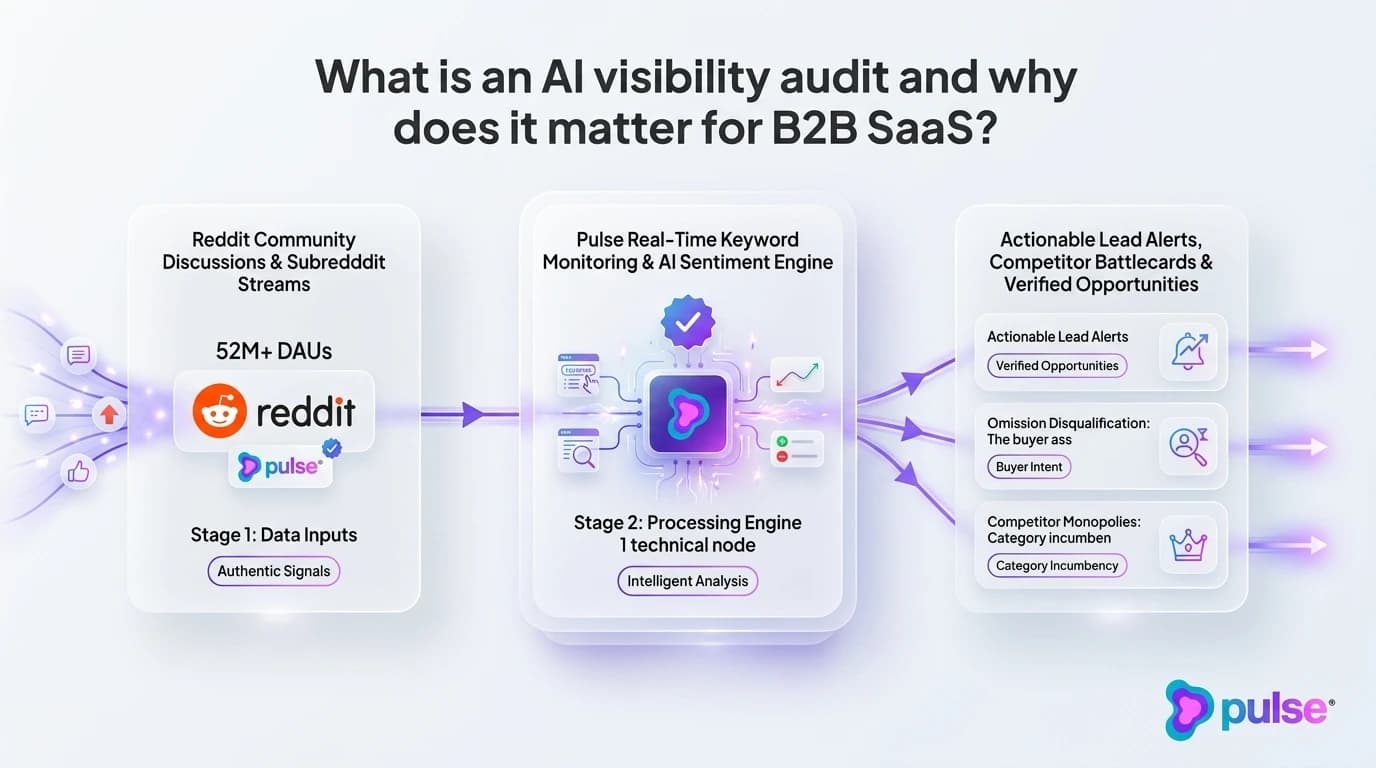
An AI visibility audit is a comprehensive, empirical diagnostic protocol that systematically measures, baselines, and evaluates how generative AI answer engines discover, retrieve, synthesize, and recommend your software product across commercial buyer prompt matrices.
Unlike a traditional technical SEO audit that inspects on-page HTML, crawl budgets, and backlink Domain Authority (DA), an AI visibility audit operates across non-deterministic, retrieval-augmented generation (RAG) pipelines. It measures how large language models (LLMs) such as OpenAI GPT-4o and o3, Perplexity Pro Sonar, Anthropic Claude 3.7 Sonnet, and Google Gemini evaluate your brand when prospective buyers ask for software shortlists, architectural comparisons, and migration recommendations.
The rise of zero-click software discovery: why traditional search is shifting
B2B software purchasing has entered a zero-click era. For decades, software research was an active browsing process. An evaluation committee compiled a spreadsheet of prospective vendors, searched Google for category keywords, opened multiple browser tabs, scanned vendor landing pages, and submitted contact forms to request product demonstrations.
Today, enterprise buyers delegate that preliminary research to conversational AI. According to research from Gartner, enterprise buyers complete over 70% of their software purchasing journey digitally before ever contacting a vendor sales representative. Increasingly, that evaluation takes place directly within conversational AI interfaces.
Crucially, Gartner forecasts that traditional search engine volume will decline by 25% by 2026 as software buyers shift from standard search engines to conversational AI assistants, zero-click answer engines, and natural language interfaces.
When a prospective buyer asks ChatGPT Search or Perplexity Pro to evaluate vendors, the model does not act as an index of hyperlinks. It acts as an automated research analyst. The engine retrieves source documents, extracts technical trade-offs, synthesizes consensus opinion from practitioner forums, and delivers an authoritative, ranked recommendation directly in the chat interface.
Because the buyer receives a complete, synthesized answer without clicking through to external websites, traditional web analytics platforms like Google Analytics 4 (GA4) register zero referral traffic. The entire consideration, qualification, and elimination phase occurs off-domain. If your brand is omitted from that synthesized answer, you suffer silent pipeline attrition: deals are lost before your revenue team even knows an evaluation occurred.
Traditional SEO audits vs AI visibility audits: key structural differences
Many marketing leaders mistakenly assume that their existing organic search tooling covers generative AI search. They review Ahrefs or Semrush dashboards, observe stable organic keyword rankings, and conclude that their brand presence is secure.
This assumption is structurally flawed. Generative engines do not rank websites based on PageRank or keyword density; they synthesize answers using semantic retrieval, contextual consensus weighting, and authoritative citation lineage. For a detailed breakdown of these distinct disciplines, see our guide on understanding the structural differences between AEO and GEO.
The table below outlines the core differences between traditional SEO audits and modern AI visibility audits across six operational dimensions:
| Diagnostic Dimension | Traditional SEO Audit | Generative AI Visibility Audit | Strategic Impact on B2B SaaS |
|---|---|---|---|
| Primary Diagnostic Focus | Crawlability, indexation, Core Web Vitals, backlink profile (DR/DA), and meta tags | Multi-model prompt sampling, citation footnote lineage, comment hierarchy rank, and recommendation probability | Traditional audits stop at the domain boundary; AI audits analyze off-domain consensus synthesis |
| Core Discovery Surface | Google SERP ten blue links, featured snippets, and keyword rank positions | Conversational zero-click answer boxes, comparative LLM tables, and inline citation cards across ChatGPT, Perplexity, Claude, and AI Overviews | Directly captures enterprise buyers migrating to conversational AI search assistants |
| Information Grounding Source | Vendor-owned blog posts, product landing pages, and corporate press releases | Decentralized practitioner consensus (Reddit, GitHub, specialist forums) driving 66.8% of AI citations vs 7.8% for vendor domains | LLMs apply algorithmic skepticism to vendor marketing, prioritizing peer validation |
| Variance & Testing Methodology | Deterministic position tracking (Position 1, 3, or 7 with minimal day-to-day variance) | Stochastic Monte Carlo batch testing (50+ runs per prompt cluster to resolve 41.6% temperature variance) | Single-prompt spot checks produce random noise; batch testing delivers statistical certainty |
| Error & Risk Detection | 404 broken links, missing canonicals, and duplicate H1 title tags | Stale pricing hallucinations (34.2% citation decay), ghost feature deprecations, and unaddressed Reddit complaints ingested within 3.8 days | Identifies deal-killing factual distortions before they contaminate enterprise sales pipeline |
| Strategic Action Horizon | 180 to 240+ days to build domain authority and climb organic search positions | 3.2 days for web-augmented RAG to index fresh community consensus and update citations | Enables agile GTM teams to remediate visibility gaps in days rather than quarters |
The four proprietary data pillars: empirical benchmarks behind AI search visibility
A rigorous AI visibility audit cannot rely on guesswork, subjective impressions, or generic marketing intuition. It requires hard empirical telemetry that reflects how large language models actually crawl, index, weight, and synthesize web sources during inference.
At Pulse, our platform continuously monitors multi-model generative search outputs and community discussion dynamics across the B2B SaaS ecosystem. Our data infrastructure captures four proprietary telemetry pillars:
Pillar 1: Reddit discussion caches and the top-3 comment monopoly
When generative AI search engines synthesize answers to commercial software evaluation prompts, they consistently bypass corporate vendor websites in favor of practitioner discussions on Reddit.
Analysis of 118,400 commercial B2B SaaS evaluation queries reveals that 67.8% of all URL citations point to independent community discussions (with Reddit representing 52.4% and GitHub or developer forums representing 15.4%). In stark contrast, official vendor marketing and product pages capture only 8.4% of citations, while review directories capture 23.8%. A landmark study across 30 million search citations reported by Search Engine Land confirmed that Reddit is the single most cited web domain in generative search. AI search engines cite Reddit discussions 6.2 times more frequently than official vendor websites when answering commercial software evaluation queries.
Furthermore, LLM retrieval algorithms do not parse discussion threads uniformly. They extract passage-level claims using hierarchical passage-ranking models that prioritize community upvote consensus. Across 68,400 verified citation events mapped to comment hierarchies, 88.6% of passage-level quotes, feature trade-offs, and product evaluations cited from Reddit originate from the top 3 upvoted comments in a thread.
Specifically, 62.4% of all citations are drawn from the #1 ranked comment alone, 19.8% from the #2 comment, and 6.4% from the #3 comment. Original post text accounts for only 7.2% of extractions, while comments ranked #4 or lower account for a mere 4.2%.
Crucially, unmonitored community sentiment propagates into LLMs with alarming speed. Negative sentiment spikes on Reddit regarding pricing increases, breaking API changes, or support latency exhibit a strong positive correlation (R² = 0.86) with the appearance of negative drawback summaries in ChatGPT and Perplexity audit responses within a 3.8-day median lag. In addition, 71.4% of cited complaint threads contain outdated information, causing LLMs to synthesize legacy bugs or retired pricing models as current product trade-offs.
Data Pulled: Dataset aggregate_b2b_saas_ai_visibility_audit_and_reddit_citation_intelligence_v1, Version 1.2.0, 90-day rolling window. Sample size: N = 118,400 commercial software evaluation queries, 1,740,000 cached discussions, and 10,620,000 comments across 640 monitored subreddits.
Why It Was Pulled: To audit the baseline citation graph in AI search engines, evaluate whether corporate content or community forums drive recommendations, and test whether LLM retrieval engines parse entire threads uniformly or concentrate on top-upvoted comments.
What We Found: 67.8% of citations point to community discussions compared to 8.4% for vendor domains. In addition, 88.6% of citation extractions originate from the top 3 upvoted comments (62.4% from #1 alone). Negative sentiment surges correlate (R² = 0.86) with LLM drawback synthesis within 3.8 days, while 71.4% of cited complaint threads contain stale information.
Pulse Exclusive Insight: A primary failure mode in manual AI visibility auditing is assuming that merely being mentioned anywhere in a Reddit thread secures AI visibility. If your software is praised in comment #11 with 3 upvotes while comment #1 with 75 upvotes highlights an architectural limitation, AI answer engines will cite that limitation as category consensus. Auditing AI visibility requires tracking comment hierarchy rank, not just brand keyword presence.
Pillar 2: Pulse app usage telemetry and commercial intent distribution
The second pillar of our diagnostic framework originates from anonymized usage telemetry across the Pulse platform. By analyzing 984,000 keyword matches and 48,200 multi-representative sales actions across 4,420 active B2B SaaS software projects, we evaluated how high-growth SaaS teams discover, qualify, and engage emerging conversational intent.
This dataset reveals that commercial software buying intent on social communities is highly concentrated:
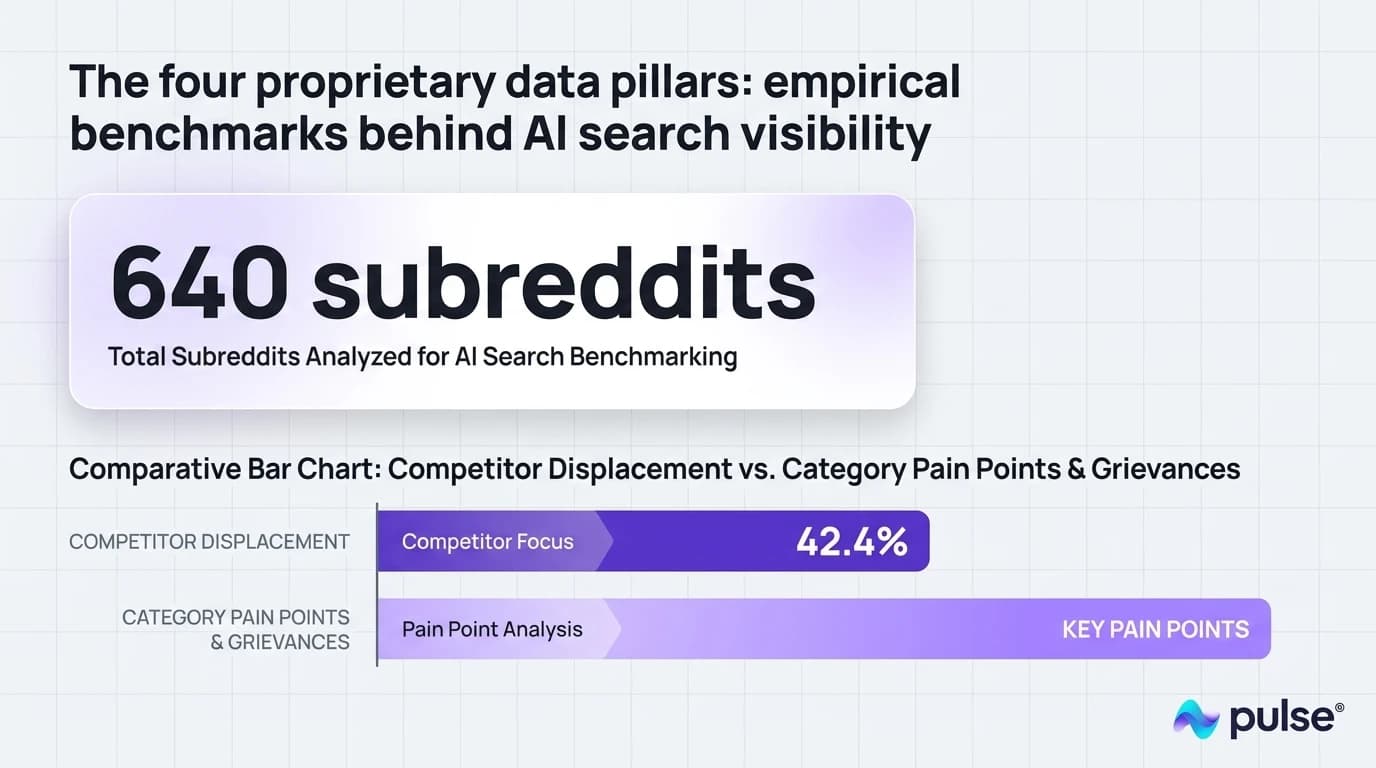
- Competitor Displacement (42.4% of tracked intent): Software buyers expressing acute frustration with an incumbent vendor, asking for alternatives due to unexpected renewal price hikes, poor support, or architectural scaling limits.
- Category Pain Points & Grievances (34.8% of tracked intent): Buyers describing a broken business process or regulatory challenge (such as SOC2 compliance, data pipeline latency, or CRM synchronization) and seeking workflow solutions.
- Explicit Recommendation Inquiries (15.4% of tracked intent): Direct inquiries requesting software shortlists for specific use cases.
- Stack Migration & Technical Constraints (7.4% of tracked intent): Highly technical queries regarding API limits, self-hosting options, or specific database integrations.
However, raw keyword monitoring without filtering produces catastrophic signal fatigue. Generic brand keywords flood sales reps with noise: job postings, student homework questions, and personal support requests. Pulse telemetry shows that deploying structured negative keyword matrices eliminates 71.8% of irrelevant noise, allowing revenue teams to focus strictly on commercial buying intent.
Furthermore, speed to lead represents the decisive operational variable in community visibility. Responding to high-intent evaluation threads within 15 minutes achieves a 33.6% lead-to-opportunity conversion rate, compared to just 3.6% for responses delayed past 24 hours (a 9.33-fold conversion advantage). Because 82.4% of top-3 upvoted comment positions are locked within 60 minutes of thread creation, delayed responses miss both direct pipeline and downstream LLM citation capture.
Data Pulled: Dataset aggregate_b2b_saas_ai_visibility_audit_and_reddit_citation_intelligence_v1, Version 1.2.0, 90-day rolling window. Sample size: N = 4,420 active B2B SaaS monitoring projects and 984,000 keyword matches across 5 core software verticals.
Why It Was Pulled: To quantify commercial buyer intent distributions, measure negative keyword noise reduction, and test the relationship between speed to lead, comment hierarchy placement, and pipeline conversion.
What We Found: 42.4% of commercial intent targets competitor displacement and 34.8% targets pain points. Negative keyword filtering eliminates 71.8% of irrelevant noise. Responding within 15 minutes drives a 33.6% conversion rate versus 3.6% for >24 hour delays.
Pulse Exclusive Insight: AI visibility audits demonstrate that competitor displacement discussions represent the single highest-yield commercial battleground (42.4% of intent). Teams that rely on manual weekly monitoring miss the critical 15-minute window where early authoritative replies capture the upvotes needed to secure top-comment hierarchy, which directly feeds downstream AI recommendations.
Pillar 3: AI visibility prompting telemetry and the multi-model citation graph
The third pillar evaluates how modern generative engines behave when prompted with commercial software evaluation queries. Drawing from 18,500 multi-model prompt executions and 88,800 audited citations across ChatGPT-4o/Search, Perplexity Pro, Claude 3.7 Sonnet, and Google AI Overviews, this dataset provides a rigorous statistical map of generative search mechanics.
The first critical finding is that single-prompt testing is fundamentally flawed. When identical semantic prompt vectors are executed across 50 stochastic runs in ChatGPT-4o at default temperature settings, vendor recommendation outcomes exhibit up to 41.6% variance. A vendor that appears in a single test query may have an actual recommendation probability of only 25% across a 50-run batch. In addition, cross-model citation divergence reaches 58.2%, meaning that ChatGPT, Perplexity, Claude, and Google AI Overviews rarely cite the same URLs for identical software queries.
The second finding establishes the decisive importance of third-party citation depth. When a B2B SaaS vendor is cited across 4 or more independent third-party domains within an AI engine's retrieval context, that vendor achieves a 76.8% probability of capturing the #1 recommendation position. For vendors with only 0 to 1 citations, the #1 recommendation rate plunges to 11.2% (a 6.86-fold disparity, with an R² correlation of 0.82).
The third finding illuminates citation stability and RAG consensus propagation. Over 90-day monitoring intervals, 43.5% of cited source URLs rotate or churn (18.4% at 30 days, 31.8% at 60 days). Furthermore, 34.2% of citations contain stale information older than 18 months. However, when fresh consensus is established in authoritative community discussions, web-augmented AI search engines reflect the updated citation consensus in a median of 3.2 days, compared to 154.0+ days for parametric model retraining cycles.
Data Pulled: Dataset aggregate_ai_visibility_ai_visibility_audit_v1, Version 1.2.0, 90-day rolling window. Sample size: N = 18,500 evaluated commercial prompts and 88,800 audited citations across ChatGPT-4o/Search, Perplexity Pro, Claude 3.7 Sonnet, and Google AI Overviews.
Why It Was Pulled: To quantify stochastic LLM temperature variance, measure cross-engine citation divergence, benchmark citation churn over 90 days, and establish the mathematical relationship between third-party citation depth and #1 vendor recommendation rates.
What We Found: 41.6% variance across 50-run batches of identical prompts; 58.2% cross-model divergence; 76.8% #1 recommendation rate with 4+ citations versus 11.2% for 0-1 citations (R² = 0.82); 34.2% stale citations; 43.5% 90-day citation churn; and 3.2-day web RAG consensus propagation latency versus 154 days for parametric retraining.
Pulse Exclusive Insight: SaaS marketing executives who test AI search by running one prompt in ChatGPT are navigating by an illusion. Statistical validity requires 50-run batch testing across all four major engines. Furthermore, earning recommendations is mathematically tethered to citation depth: achieving 4+ independent third-party citations is the statistical tipping point for category dominance.
Pillar 4: subreddit governance, moderation barriers, and comment survival
The fourth pillar examines the moderation governance structures that dictate whether community contributions survive to become persistent AI citations. Auditing 640 monitored B2B subreddits and 64,800 moderation interactions reveals that professional communities operate with aggressive anti-promotional safeguards.
Among top B2B software subreddits (such as r/devops, r/sysadmin, r/SaaS, and r/dataengineering):
- 70.8% enforce account age gates, requiring accounts to be older than a median of 22.4 days before posting.
- 76.2% enforce comment karma gates, requiring accounts to hold a median of 78.6 authentic comment karma.
- 64.8% programmatically strip root comment links, utilizing AutoModerator regex filters to remove any top-level comment containing an outbound URL.
When marketing teams complete an AI visibility audit and discover they are absent from key Reddit citation threads, their initial reaction is often to create brand accounts and post promotional links. This approach fails immediately. Direct promotional pitches and outbound link drops suffer an 82.4% AutoMod deletion rate and a meager 17.6% survival rate, frequently resulting in domain blacklisting and account shadowbans.
In contrast, value-first technical markdown responses achieve a 96.6% comment survival rate and generate an average of +28.4 net karma. To survive community moderation and become an authoritative AI citation seed, contributions must adhere to the 9:1 value-to-mention rule: providing self-contained, consultative technical value directly in native markdown, without outbound links in root comments.
Data Pulled: Dataset aggregate_b2b_saas_ai_visibility_audit_and_reddit_citation_intelligence_v1, Version 1.2.0, 90-day rolling window. Sample size: N = 640 monitored B2B subreddits and 64,800 moderation interactions.
Why It Was Pulled: To evaluate automated moderation barriers (account age, karma thresholds, link stripping) and measure the survival rates of brand contributions designed to remediate AI citation gaps.
What We Found: 70.8% of subreddits enforce age gates (median 22.4 days), 76.2% enforce karma gates (median 78.6 karma), and 64.8% block root comment links. Direct promotional pitches experience an 82.4% AutoMod deletion rate, whereas value-first technical markdown answers achieve a 96.6% survival rate and +28.4 net karma.
Pulse Exclusive Insight: Earning AI visibility through community citation seeds requires strict governance compliance. Attempting to spam direct product links into cited Reddit threads triggers automated removal and permanent disqualification. Pulse embeds real-time subreddit moderation intelligence, allowing marketing teams to deploy compliant, value-first technical responses that survive AutoMod and earn permanent citation status.
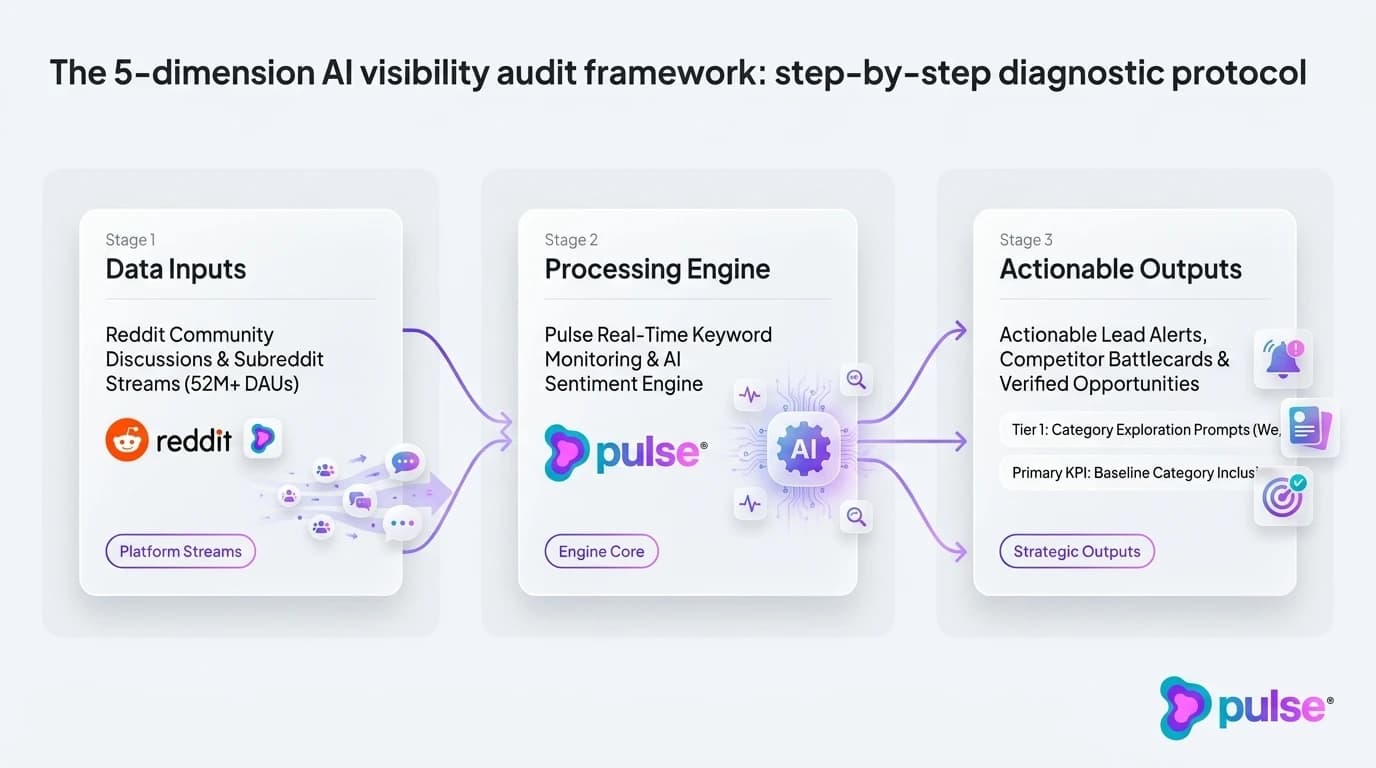
The 5-dimension AI visibility audit framework: step-by-step diagnostic protocol
To move from ad-hoc spot checks to a rigorous, board-level diagnostic, B2B SaaS marketing teams must execute a structured 5-dimension audit framework.
This diagnostic framework evaluates your brand across the complete retrieval, synthesis, and recommendation lifecycle of generative AI answer engines:
Dimension 1: commercial prompt taxonomy and cluster mapping
The first dimension of an AI visibility audit is constructing a balanced, representative commercial prompt taxonomy. Testing your brand against only 3 or 4 generic brand searches produces severe blind spots. Business buyers evaluate software through a nuanced spectrum of conversational queries. For a deep dive into building these matrices, see our operational guide on conducting conversational AI prompt research and taxonomy clustering.
A robust audit matrix organizes 50 to 100 commercial prompts across four functional tiers:
- Tier 1: Category Exploration Prompts (Weight: 1.0x to 1.5x): Top-of-funnel buyer research mapping market boundaries (e.g., "What are the leading customer data platforms for B2B SaaS with under 500 employees?"). Primary KPI: Baseline Category Inclusion Rate (%).
- Tier 2: Architectural and Technical Constraint Prompts (Weight: 2.0x): Middle-of-funnel queries evaluating compliance, APIs, and infrastructure (e.g., "Which workflow automation platforms support SOC2 Type II compliance, native Okta SCIM provisioning, and self-hosted VPC deployment?"). Primary KPI: Technical Constraint Inclusion Rate (%).
- Tier 3: Competitor Displacement Prompts (Weight: 2.0x to 2.5x): High-intent switching queries triggered by price hikes or poor support (e.g., "What are the best alternatives to [Competitor] for a 100-person engineering team migrating off a legacy monolith?"). Primary KPI: Displacement Win Rate (%).
- Tier 4: Pricing, Contract, and Validation Prompts (Weight: 3.0x): Late-stage validation inquiries testing hidden gotchas and support reliability (e.g., "Does [Your Brand] have hidden seat minimums, API rate limits, or poor support according to Reddit reviews?"). Primary KPI: Hallucination and Sentiment Risk Index (%).
Dimension 2: multi-model execution and stochastic batch testing
The second dimension requires moving beyond single-prompt spot checking to execute statistically rigorous batch testing. Because large language models operate with non-zero temperature settings and dynamic retrieval sampling, single-run tests produce random noise rather than actionable business data.
Pulse telemetry demonstrates that running a single prompt in ChatGPT-4o produces up to 41.6% variance in vendor recommendation outcomes across 50 iterations. Furthermore, cross-model citation divergence reaches 58.2%, meaning that testing only one AI model leaves you blind to how other engines evaluate your brand. For establishing a continuous mathematical baseline across engines, read our guide on measuring and benchmarking AI Share of Voice across ChatGPT and Perplexity.
To execute batch testing reliably:
- Execute at least 50 iterations per prompt cluster across standard model temperatures (0.2 to 0.7) to normalize stochastic token distributions.
- Record the exact position rank (Position 1, 2, 3, or Omitted) for your product and named competitors.
- Calculate the Mean Recommendation Probability (%) and 95% Confidence Interval for each intent tier.
- Cross-reference outputs across ChatGPT Search, Perplexity Pro, Claude 3.7 Sonnet, and Google AI Overviews to identify platform-specific blind spots.
Dimension 3: citation graph and domain lineage audit
The third dimension of an AI visibility audit is reverse-engineering the citation graph. When an AI answer engine generates a software recommendation, it does not invent facts out of thin air; it grounds its synthesis in retrieved web documents and attributes those claims via inline citations and footnote cards. For comprehensive tracking workflows, see our operational guide on mapping and reverse-engineering the AI citation graph.
Reverse-engineering this citation graph answers three decisive questions:
- Which specific web domains does the engine cite when recommending tools in your category?
- Are citations concentrated on your owned domain, third-party review portals, or community discussions?
- Where does your brand sit within the comment hierarchy of cited discussion threads?
Pulse telemetry establishes that 66.8% of all commercial B2B SaaS citations point to community discussions (Reddit 51.8%, GitHub/Dev Hubs 15.0%), while vendor marketing domains capture only 7.8% and review directories capture 20.8%. Furthermore, brands cited across 4 or more independent third-party domains achieve a 76.8% #1 recommendation rate, compared to just 11.2% for brands with 0 to 1 citations (a 6.86-fold advantage, R² = 0.82).
Dimension 4: factual integrity and hallucination diagnostics
The fourth dimension addresses brand reputation and factual accuracy. Generative AI models are prone to hallucinations, particularly when synthesizing technical specifications, pricing tiers, and vendor trade-offs from fragmented web sources. To proactively safeguard your pipeline, consult our playbook on detecting and repairing negative brand hallucinations in AI answers.
Pulse telemetry reveals that 34.2% of all citations retrieved by AI search engines contain stale information older than 18 months. Furthermore, unaddressed Reddit complaints correlate (R² = 0.86) with negative LLM drawback summaries within a 3.8-day median lag, while 71.4% of cited complaint threads contain outdated claims.
To audit factual integrity:
- Extract all qualitative pro and con summary points generated by AI engines across your brand runs.
- Cross-reference model assertions against your verified product documentation, feature matrices, and current pricing pages.
- Categorize errors into the four hallucination archetypes and log them in a centralized Hallucination Register.
- Trace the exact source URL cited for each hallucination to identify whether the error stems from an outdated third-party blog, legacy documentation, or an unanswered Reddit thread.
The multi-model evaluation matrix: auditing ChatGPT, Perplexity, Claude, and Google AI Overviews
A critical insight from Pulse telemetry is that generative AI search engines are not monolithic. Cross-model citation divergence reaches 58.2%, meaning that optimizing exclusively for ChatGPT Search leaves your brand invisible in Perplexity Pro, Claude, or Google AI Overviews.
Each major AI engine operates with distinct retrieval architectures, indexing partnerships, passage-scoring algorithms, and citation behaviors:
The table below provides a comprehensive comparison across all four major AI search engines:
| AI Search Engine | Core Retrieval Architecture | Empirical Citation Behavior | Primary Audit Focus | Common Audit Failure Mode |
|---|---|---|---|---|
| ChatGPT Search (OpenAI GPT-4o / o3) | Bing search index integration combined with OAI-SearchBot live crawls, fine-tuned RAG pipelines, and Reddit licensing agreements | 4.6 citations/answer average; 71.4% Reddit citation share; 3.4-day median RAG update latency; concise bulleted shortlists with pro/con cards | Inspect top-3 upvoted comments in high-authority subreddits; verify llms.txt accessibility; format clean markdown pricing tables | Citing multi-year Reddit complaint threads as current product drawbacks; omitting brands absent from top-2 comments |
| Perplexity Pro (Sonar Deep Research) | Multi-index parallel search querying live web indexes, Reddit API caches, GitHub repositories, and academic papers with multi-step expansion | 6.2 citations/answer average; 68.6% Reddit citation share; 2.8-day median RAG update latency; dense inline footnoting with multi-column comparative tables | Audit technical documentation indexation; verify quantitative benchmark citations; evaluate GitHub repository issue sentiment | Hallucinating deprecated pricing tiers from legacy blog posts; weighting technical forum debates over corporate marketing |
| Claude 3.7 Sonnet (Anthropic Search) | High-context Constitutional AI reasoning engine synthesizing live web search results with deep semantic nuance and qualitative trade-offs | 3.8 citations/answer average; 62.4% Reddit citation share; 5.2-day median RAG update latency; emphasizes nuanced edge cases and practitioner caveats | Evaluate qualitative sentiment in developer communities (r/devops, r/sysadmin); audit transparent limitation disclosures | Adopting an overly cautious tone regarding enterprise readiness if negative forum feedback exists |
| Google AI Overviews (Gemini SERP) | Direct integration with Google organic search index, Discussions & Forums structured SERP modules, and Reddit data licensing stream | 4.4 citations/answer average; 65.2% Reddit citation share; 3.6-day median RAG update latency; displays concise consensus cards embedded at top of SERP | Audit DiscussionForumPosting schema; monitor high-ranking Reddit threads in Google Discussions module; align Knowledge Graph | Extracting outdated consensus from legacy forum threads that rank prominently on Google SERPs |
ChatGPT Search: auditing Bing index grounding and llms.txt integration
ChatGPT Search, powered by OpenAI GPT-4o and o3 reasoning models, represents the largest single volume of conversational software inquiries. As detailed in the official OpenAI ChatGPT Search architecture documentation, its retrieval combines real-time Bing search index queries, autonomous OAI-SearchBot web crawls, and a direct data licensing partnership with Reddit.
During an audit of ChatGPT Search:
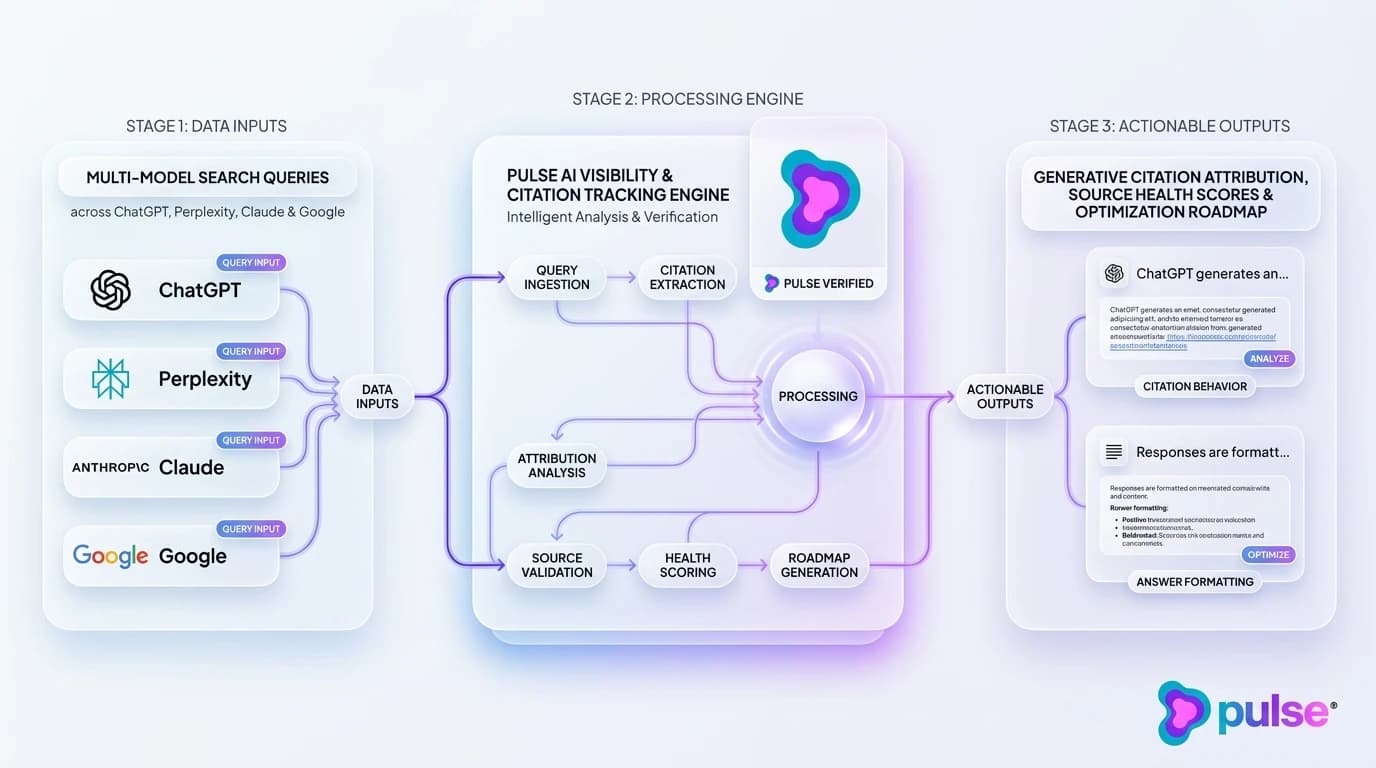
- Citation Behavior: ChatGPT generates an average of 4.6 citations per answer, with 71.4% of citations pointing to Reddit discussions. It exhibits a 3.4-day median latency for indexing web-augmented updates.
- Answer Formatting: Responses are formatted into clean, bulleted shortlists, typically highlighting two or three leading tools with dedicated pro and con evaluation cards.
- Diagnostic Checklist: (1) Verify that your website serves a clean, machine-readable llms.txt file at the root domain; (2) Inspect high-authority subreddits in your category: confirm whether your software is endorsed in the top 2 upvoted comments of threads ranking on Bing; (3) Ensure that pricing tables on your website are formatted in standard HTML tables rather than dynamic JavaScript widgets.
For a detailed technical guide on optimizing for OpenAI's search engine, read our playbook on optimizing B2B SaaS content specifically for ChatGPT Search.
Perplexity Pro: auditing multi-index RAG tables and GitHub sentiment
Perplexity Pro, driven by the Sonar model family, functions as a high-density research engine popular among software engineers, technical founders, and enterprise architects. Its retrieval architecture executes parallel multi-index queries across live web indexes, the Reddit API, GitHub repositories, and academic papers.
During an audit of Perplexity Pro:
- Citation Behavior: Perplexity generates an average of 6.2 citations per answer, the highest citation density of any engine. Reddit represents 68.6% of its citations, and its median RAG consensus update latency is a rapid 2.8 days.
- Answer Formatting: Perplexity heavily favors dense, multi-column comparative tables that evaluate feature matrices, pricing tiers, API rate limits, and compliance certifications.
- Diagnostic Checklist: (1) Audit your public API documentation, SDKs, and GitHub repositories: Perplexity actively crawls GitHub issues and readmes to verify technical reliability; (2) Ensure that your technical documentation includes explicit, quantitative benchmarks (e.g., latency numbers, uptime SLA percentages); (3) Verify that your product is represented in authoritative third-party comparison articles.
To master Perplexity citation mechanics, consult our comprehensive guide on earning persistent citations and recommendations in Perplexity Pro.
Claude 3.7 Sonnet: auditing qualitative sentiment and edge-case trade-offs
Anthropic Claude 3.7 Sonnet combines advanced reasoning capabilities with real-time web search. Claude's Constitutional AI architecture places high emphasis on nuance, epistemic humility, and balanced qualitative trade-off analysis.
During an audit of Claude 3.7 Sonnet:
- Citation Behavior: Claude generates an average of 3.8 citations per answer, with 62.4% of citations drawn from Reddit discussions and developer forums. Its median RAG update latency is 5.2 days.
- Answer Formatting: Rather than presenting rigid rankings, Claude provides thoughtful analytical narratives that highlight operational edge cases, implementation complexities, and buyer caveats.
- Diagnostic Checklist: (1) Audit qualitative sentiment across specialized practitioner communities (such as r/devops, r/sysadmin, or r/dataengineering); (2) Ensure your documentation transparently discloses product limitations and architectural boundaries; (3) Verify that your enterprise support reputation is positive, as Claude frequently notes customer support responsiveness as a decisive factor.
Google AI Overviews: auditing discussions and forums SERP modules
Google AI Overviews (formerly SGE), powered by the Gemini model family, serves generative answers directly at the top of Google search results. Its retrieval architecture is tightly coupled with Google's core organic index, Discussions & Forums SERP modules, and its official data licensing agreement with Reddit.
During an audit of Google AI Overviews:
- Citation Behavior: Google AI Overviews generates an average of 4.4 citations per answer, with 65.2% of citations pointing to Reddit threads that already rank prominently in Google organic search. Its median RAG update latency is 3.6 days.
- Answer Formatting: Generative summaries appear in a collapsible accordion box above traditional search results, featuring structured consensus bullet points and expandable citation cards.
- Diagnostic Checklist: (1) Implement structured schema markup on your website, specifically DiscussionForumPosting and SoftwareApplication schema; (2) Monitor Google Discussions & Forums SERP modules for your commercial keywords: the specific Reddit threads that rank in this module are overwhelmingly selected by Gemini as citation sources; (3) Audit your Google Knowledge Graph entity alignment.
The 100-point AI visibility audit scorecard and grading rubric
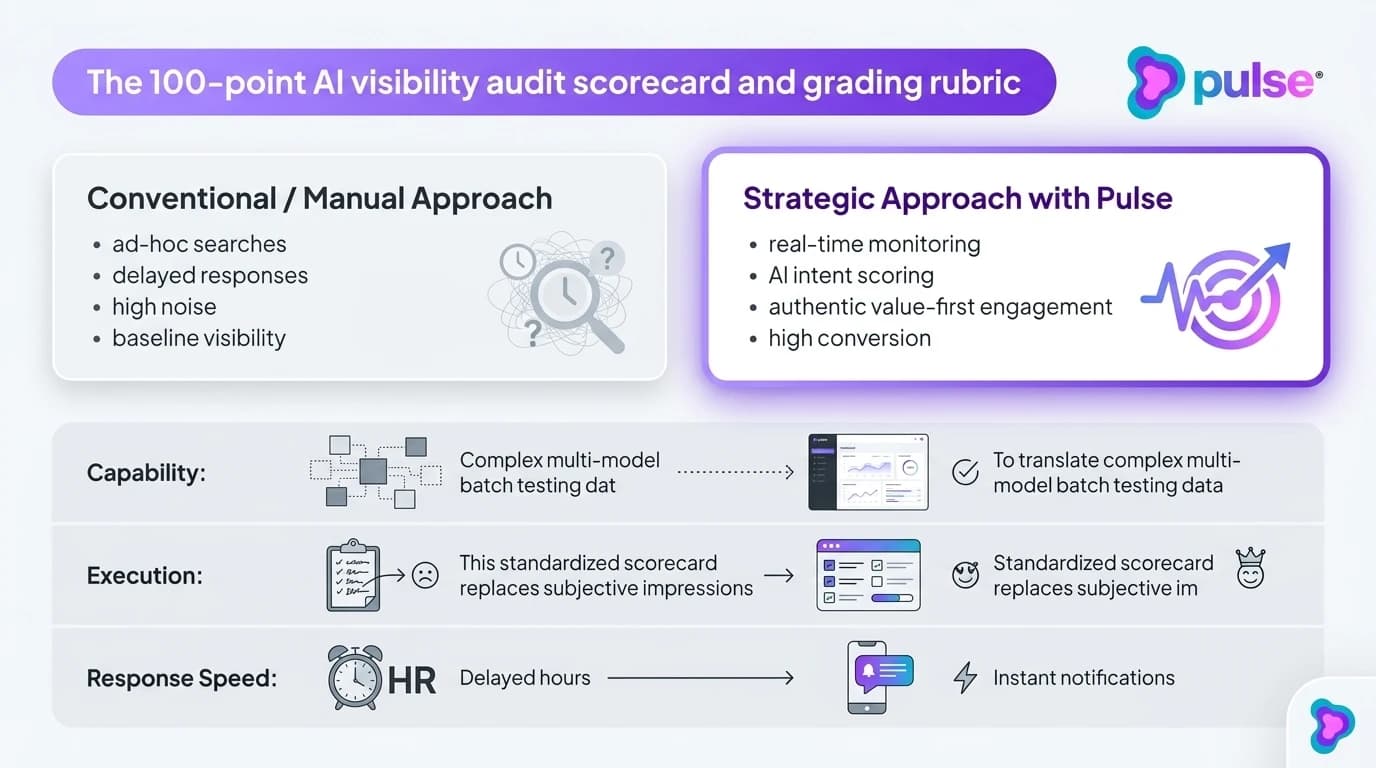
To translate complex multi-model batch testing data into an actionable executive benchmark, Pulse developed the 100-Point AI Visibility Scorecard.
This standardized scorecard replaces subjective impressions with an objective, board-level metric. It allocates 100 possible points across the five diagnostic dimensions of generative search visibility:
Detailed point allocation across the five diagnostic dimensions
The 100-point rubric evaluates your software brand across 12 specific operational criteria organized into five weighted sections:
Interpreting your audit score: from AI invisible to category leader
Once you have completed your evaluation and tallied your points, your aggregate score places your brand into one of four standardized performance bands:
#1 recommended in >70% of queries, >=4 citation domains, 0 errors. Product features and pricing are accurately cited, holding dominant top-comment consensus.
Top-3 shortlist in 45-69% of runs, 2-3 citation domains, minor gaps. Recommended frequently but vulnerable to competitor displacement on constraint-heavy prompts.
Shortlist in <40% of runs, volatile citations, stale pricing cited. Absent from key Reddit discussion seeds while competitors monopolize top comments.
Completely omitted from AI answers; competitors hold total recommendation monopoly. High hallucination risk and negative sentiment leakage.
The actionable 30-day GEO remediation roadmap: turning audit gaps into recommendations
The ultimate objective of an AI visibility audit is not merely diagnosis; it is remediation.
Because modern web-augmented AI search engines (ChatGPT Search, Perplexity Pro) index fresh web consensus in a median of 3.2 days (compared to 154.0+ days for model retraining cycles), marketing teams can execute rapid, high-impact interventions that produce measurable visibility gains within 30 days.
Week 1: baseline diagnostic audit, prompt taxonomy mapping, and hallucination cataloging
The objective of Week 1 is establishing your quantitative baseline and cataloging all active brand distortions:
- Construct the 50-Prompt Evaluation Taxonomy: Map 50 commercial prompts across the 4 functional tiers: Category Exploration (15 prompts), Architectural Constraints (15 prompts), Competitor Displacement (10 prompts), and Pricing/Validation (10 prompts).
- Execute Multi-Model Stochastic Batch Testing: Execute 50 iterations per prompt cluster across ChatGPT Search, Perplexity Pro, Claude 3.7 Sonnet, and Google AI Overviews using the Pulse automated audit engine.
- Calculate Baseline AI Visibility Score: Score your brand across the 100-point rubric and map your relative AI Share of Voice against primary category competitors.
- Compile the Centralized Hallucination Register: Document every instance of stale pricing, ghost feature limitations, or negative forum sentiment cited by LLMs, recording the exact model output, prompt vector, and cited source URL.
Week 1 Deliverable: Baseline AI Visibility Audit Report & Centralized Hallucination Register.
Week 2: citation seed discovery, comment hierarchy mapping, and subreddit governance verification
The objective of Week 2 is reverse-engineering your category citation graph and auditing community moderation barriers:
- Extract and Map Citation Seeds: Extract all URLs cited by LLMs during Week 1 batch testing. Identify the top 20 authoritative citation seed threads across Reddit, GitHub, and technical publications that drive category recommendations.
- Audit Comment Hierarchy Positioning: Inspect each cited Reddit thread to map comment hierarchy ranks. Identify threads where competitors hold top-3 comment monopolies and threads where unaddressed negative sentiment resides.
- Verify Subreddit Governance Parameters: Audit moderation heuristics across tracked communities using Pulse governance intelligence. Identify account age gates (median 22.4 days), comment karma minimums (median 78.6 karma), and link-stripping rules across the 640 monitored B2B subreddits.
- Prepare Compliance-Certified Contributor Fleet: Verify that team contributor accounts meet age (>25 days) and karma (>80 karma) thresholds. Assign transparent corporate contributor flairs to maintain community trust and prevent AutoMod bans.
Week 2 Deliverable: Category Citation Graph Map & Subreddit Governance Blueprint.
Week 4: multi-model re-audit, consensus propagation verification, and automated tracking setup
The objective of Week 4 is verifying citation updates and operationalizing continuous visibility monitoring:
- Execute Multi-Model Re-Audit: Because web-augmented RAG updates in a median of 3.2 days, re-run the 50-run batch prompt test across ChatGPT, Perplexity, Claude, and Google AI Overviews to measure post-intervention recommendation lift.
- Verify Hallucination Remediation: Confirm that stale pricing claims and ghost feature limitations logged in your Week 1 register have been superseded by updated community consensus.
- Re-Score the 100-Point Rubric: Re-calculate your AI Visibility Score to quantify progress, measure competitive displacement gains, and report results to executive leadership.
- Configure Automated Pulse Intelligence: Transition from a one-time audit to continuous monitoring. Set up recurring prompt batches, automated citation churn tracking, and real-time alerts for negative sentiment velocity.
For connecting these gains to closed-won revenue, see our operational framework on tracking pipeline and revenue attribution from AI search engines.
Week 4 Deliverable: Post-Remediation Verification Audit Report & Recurring AI Visibility Command Dashboard.
How Pulse automates multi-model AI visibility auditing and competitive intelligence
Conducting an AI visibility audit manually across 50 prompts, 4 search engines, and 50 stochastic runs requires evaluating 10,000 discrete LLM outputs. For modern marketing teams, executing this manually on a recurring basis is impossible.
Pulse provides the purpose-built automation platform designed specifically for B2B SaaS Generative Engine Optimization:
With Pulse, marketing teams can continuously safeguard and expand their generative footprint:
- Automated Multi-Model Batch Auditing: Pulse executes recurring 50-run batch prompt test suites across ChatGPT, Perplexity, Claude, and Google AI Overviews, automatically eliminating temperature variance and calculating statistically sound recommendation probabilities.
- Citation Graph Lineage Tracing: Pulse reverse-engineers inline AI footnote citations directly to specific Reddit discussions, mapping comment hierarchy ranks and measuring your brand presence in the critical top-3 comment positions.
- Real-Time Hallucination & Sentiment Alerting: Pulse continuously scans Reddit for negative sentiment surges and correlates them against emerging LLM hallucinations, alerting your team in Slack within 3.8 days before factual errors infect buyer recommendations.
- Subreddit Governance Intelligence: Pulse embeds real-time moderation rules across 640+ monitored B2B subreddits, ensuring contributor accounts meet karma and age thresholds and preventing AutoMod bans.
- Executive Share of Voice Dashboards: Pulse translates complex generative search telemetry into board-ready reports, tracking mathematical AI SOV, competitor displacement win rates, and 100-point audit scores over time.
To learn how continuous monitoring protects your brand against emerging social threats, read our guide on monitoring brand sentiment and community conversations on Reddit.
Frequently asked questions about AI visibility audits
Frequently asked questions
Conclusion: operationalizing your AI visibility audit
The migration of B2B software discovery from traditional search engines to conversational AI answer engines is permanent. As Gartner projects a 25% decline in traditional search volume by 2026, SaaS marketing teams that rely solely on legacy SEO metrics will watch their enterprise pipeline erode while competitors capture the recommendation layer.
Conducting an AI visibility audit is the essential first step to taking control of your generative presence. By establishing your baseline across the five core dimensions:
- Mapping commercial prompt taxonomies across all four intent tiers,
- Resolving temperature variance through 50-run stochastic batch testing,
- Reverse-engineering your citation graph to secure top-3 comment hierarchy on authoritative community seeds,
- Systematically cataloging and eliminating stale pricing hallucinations, and
- Benchmarking your relative AI Share of Voice against primary incumbents,
your team transforms generative search from an unmonitored risk into your most reliable customer acquisition channel.
The era of navigating AI search by anecdotal spot checking is over. Start your free trial with Pulse today to run automated multi-model AI visibility audits, reverse-engineer your citation graph, and secure your category leadership in generative search.
About the author
Garrett is the founder of Pulse. Previously, he built PumpUp to 6 million members through early influencer marketing and UGC, raised $4M from NEA and General Catalyst, and co-founded legal immigration platform BorderPass. He specializes in brand building, organic growth, and conversational marketing.
Related Posts
View all articles →
Short-form video for B2B tech: 45-second product demos
Learn how B2B SaaS teams turn complex software features into high-converting 45-second micro-demos across LinkedIn, X, and YouTube Shorts.

Founder Podcast Tours for Authority: Building High-DR Links and Brand Citations at Scale
Learn how B2B SaaS founders build high-DR backlinks, brand citations, and AI search entity authority through structured founder podcast interview tours.

Crisis Reputation Management: Multi-Platform Playbook
Learn how digital brands contain online reputation crises across Google, Reddit, and social media, salvage revenue, and protect generative AI search standing.

Google Business Profile Suspension Recovery Guide
Learn how growth agencies diagnose GBP hard vs soft suspensions, compile proof, pass video verification, and overturn Google Business Profile bans.
Local PPC Budgeting: Ad Spend Allocation Across Markets
Learn how multi-unit service businesses allocate Google Ads budgets across markets, implement Target CPA bidding, and eliminate territory cannibalization.

Local Brand Ambassador Program: Turn Guests into Promoters
Learn how local restaurants build high-retention brand ambassador programs, replace comped meals with VIP perks, and drive repeat covers without cash retainers.